Size GuideEco ImpactContact Us

Specification · 9 min read

A field guide to tote valve threads

S60x6, S70x6, NPT, BSP and the adapters between them. Identify yours in ten seconds.

October 10, 2024 · Walt Krzeminski · ToteOrbit, Indianapolis

Question about this post?

Reply within 1 business day

It goes straight to the bench that wrote it. We answer operator questions whether or not there is an order attached.

US or Canada only — 10 digits, e.g. (317) 204-0100
US ZIP like 46226, or Canadian postal code like M5V 2T6
Whole units, 1 to 100,000

Fields marked * are required. Phone and postal code are checked against real US and Canadian number ranges, so please enter details we can actually reach you on.

Roughly a third of our support email is a thread question wearing a different hat. Here is every thread you will meet on an IBC tote, how to identify it without a gauge, and what to do when yours does not match your hose.

The five you will actually encounter

S60x6 — the standard IBC outlet

Sixty millimetres nominal, six millimetre pitch, buttress profile. This is what the vast majority of caged composite IBCs have at the outlet. It seals against a flat gasket face at the base of the port, not on the thread flanks, and it seats in about two and a half turns.

S70x6 — the larger European cousin

Seventy millimetres, same six millimetre pitch and same buttress profile. Common on imported units and on some 330 gallon bottles. Everything about handling it is identical to S60x6 except that S60 fittings will not fit.

2 inch NPT

National Pipe Taper, 11.5 threads per inch, tapered. Seals on the thread flanks with tape or dope. You will find it on drums, on retrofitted valves, and on a good proportion of older North American units where somebody replaced the original assembly.

2 inch BSP

British Standard Pipe, parallel or tapered depending on variant. Turns up on imported containers and on equipment sourced outside North America. Close enough to NPT in diameter to be forced together, far enough off in pitch angle to leak afterwards.

6 inch buttress — the fill cap

Every composite IBC has one at the top. Coarse buttress, gasketed lid, and the choice between vented and solid matters more than the thread does. See the bulging bottle post for why.

Stainless IBCs are a separate world — tri-clamp, DIN and sanitary fittings, which are flanged rather than threaded and clamp together with a gasket between ferrules.

Identifying yours in ten seconds, without tools

  1. Look at the thread profile. Buttress threads are visibly asymmetric — one steep flank and one shallow ramp. Pipe threads are symmetric vees.
  2. Look for a flat face at the base of the port. A machined or moulded flat seating surface means a gasket seal, which means buttress.
  3. Count turns to hand tight. S60x6 seats in roughly two and a half turns and then stops. NPT keeps getting tighter the further you go, because it is tapered.
  4. Measure across the threads. Sixty millimetres is about 2.36 inches, noticeably larger than a 2 inch NPT male at roughly 2.37 inches outside — close, which is exactly the problem, so use the profile rather than the diameter to decide.

Why forcing NPT into S60x6 fails slowly

Both are roughly two inches. An NPT male will bite into an S60x6 port and feel properly tight. It is not sealing against anything — it is deforming the buttress threads. The joint holds for a day or two, the polypropylene relaxes, and then it weeps, usually in transit and usually onto somebody else's trailer deck.

Worse, the damage is to the moulded port on the bottle, which is not a replaceable part. Cross-threading is one of the few faults that condemns an otherwise sound bottle, and it is inspection point ten at our grading bench for that reason.

Adapters, which cost a few dollars

  • S60x6 male to 2 in NPT female — the single most useful adapter in this industry.
  • S60x6 male to 2 in camlock type C — for quick hose connection.
  • S60x6 male to 3/4 in garden hose thread — rain kits, wash stations, site water.
  • 2 in NPT male to 1.5 in camlock — transfer pump hookup.
  • Poly reducing bushings, 2 in to 1 in and 2 in to 3/4 in.
  • 6 in lid inserts with a 2 in NPT port — for dip tubes, vents and level gauges.

Always adapt rather than re-tap. The port on the bottle is the one component you cannot replace without replacing the bottle.

Torque, briefly

Hand tight plus a quarter turn with a strap wrench, against a new gasket. Never reuse a flange gasket. Never put a pipe wrench on an S60x6 joint — you will win the argument with the valve and lose it with the tote, because over-torquing permanently distorts the gasket face.

NPT into a polypropylene port is the opposite failure mode: poly threads strip easily, so hand tight plus two turns with three wraps of PTFE tape, and stop there.

When you genuinely cannot tell

Photograph the port straight on and from the side, with something for scale, and email it to us. We identify these every week and the answer takes one reply. The full thread and seat tables are in chapter two of the size guide.

Why S60x6 exists at all

It is a reasonable question. Pipe threads were already standard everywhere, so why did the IBC industry adopt something different?

Because a pipe thread seals on its own flanks, which requires both parts to be rigid and dimensionally stable. A blow-moulded HDPE port is neither — the wall thickness varies, the material creeps, and the moulded thread relaxes over time. A tapered thread in that material either leaks or splits.

A buttress thread with a flat gasket face moves the sealing function off the thread entirely. The thread provides clamping force; the gasket provides the seal. That works in a moulded plastic port in a way NPT never could, and it is why the standard looks odd and is actually correct.

Why the asymmetric profile

One steep flank, one shallow ramp. The steep flank takes the axial load from the clamping force; the shallow ramp makes the thread easy to start and hard to cross-thread under normal handling.

Which is exactly why forcing an NPT male into it does so much damage: the symmetric vee of a pipe thread bites into the shallow ramp and shears the load-bearing flank off. Once that has happened the port cannot take clamping force, and no gasket will seal a joint with no clamping force.

Camlock, and when to fit one permanently

If a tote is going to be connected and disconnected repeatedly — a glycol top-up reservoir, a dilution water supply, a jobsite tank — fit a camlock adapter and leave it on. The repeated threading and unthreading of a buttress joint is what wears ports out, and a camlock moves all that wear onto a cheap replaceable part.

Type C is the usual choice for a hose end and type F for a male adapter. Keep the dust cap on the camlock between uses; an open camlock on a site tote collects grit, which is then dragged across the sealing face.

The six-inch lid, in more detail

Coarse buttress, gasketed, and the one place where thread wear almost never matters because it carries no pressure load in normal service. What does matter is the gasket and the vent choice.

Lid gaskets perish faster than flange gaskets because they see more sun, more temperature cycling and more handling. Replace them on the same schedule as valve gaskets, which is to say every time the lid comes off for any reason.

On vent choice: vented if the cargo tolerates air contact and the tote sees temperature swing, solid if the cargo must stay sealed. Getting this wrong deforms more bottles than any other single error — see heat, sun and the bulging bottle.

Tri-clamp, for the stainless case

If you move to stainless you leave threaded fittings behind. Tri-clamp is a flanged connection: two ferrules, a gasket between them, and a clamp that pulls them together. Sizes are nominal tube — 1.5, 2 and 3 inch are the common ones.

Two rules. Finger tight on the clamp nut, never a wrench — over-tightening extrudes the gasket into the flow path. And match the gasket material to the cargo and the temperature, because the gasket is the entire seal and there is nothing else holding the joint.

A spares box worth keeping

For a fleet of a dozen or more totes:

  • A dozen EPDM flange gaskets, and half a dozen Viton if you run oils or solvents.
  • Three or four valve rebuild kits for your valve type.
  • Two spare 2 inch butterfly valves.
  • Four S60x6 to 2 inch NPT adapters — one per transfer line, permanently fitted.
  • Two S60x6 to garden hose adapters for washdown and site water.
  • Half a dozen S60x6 dust caps.
  • Four six-inch lid gaskets and two spare lids, one vented and one solid.
  • A strap wrench. And the pipe wrench stored somewhere else entirely.

That box costs very little and it has kept a great many containers in service that would otherwise have been retired for a consumable. Everything in it is on the accessories page and ships the same afternoon on orders before 1 PM Eastern.
REFERENCE

Reference

The tables behind this post

Dimensions, threads and seat materials in full, so you do not have to go looking. The complete reference is in the size guide.
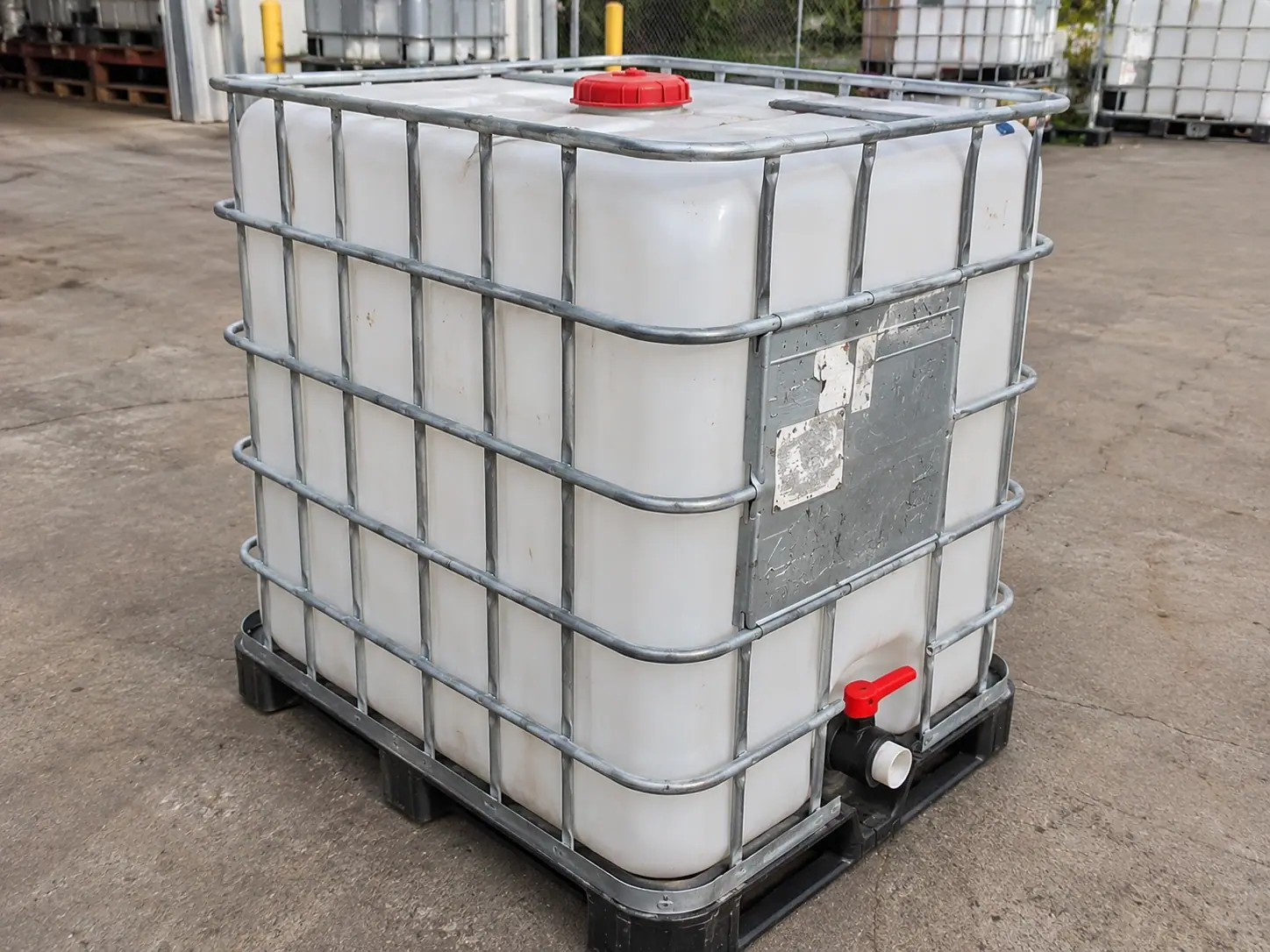
A reconditioned 275 gallon caged composite IBC tote on a black plastic pallet, showing the galvanised cage, the moulded HDPE bottle, the red discharge valve and the six-inch fill capFig. 1
A single 275 gallon unit off the outbound pad. Galvanised tubular cage, blow-moulded HDPE bottle, 2 in S60x6 outlet, six-inch vented fill cap.
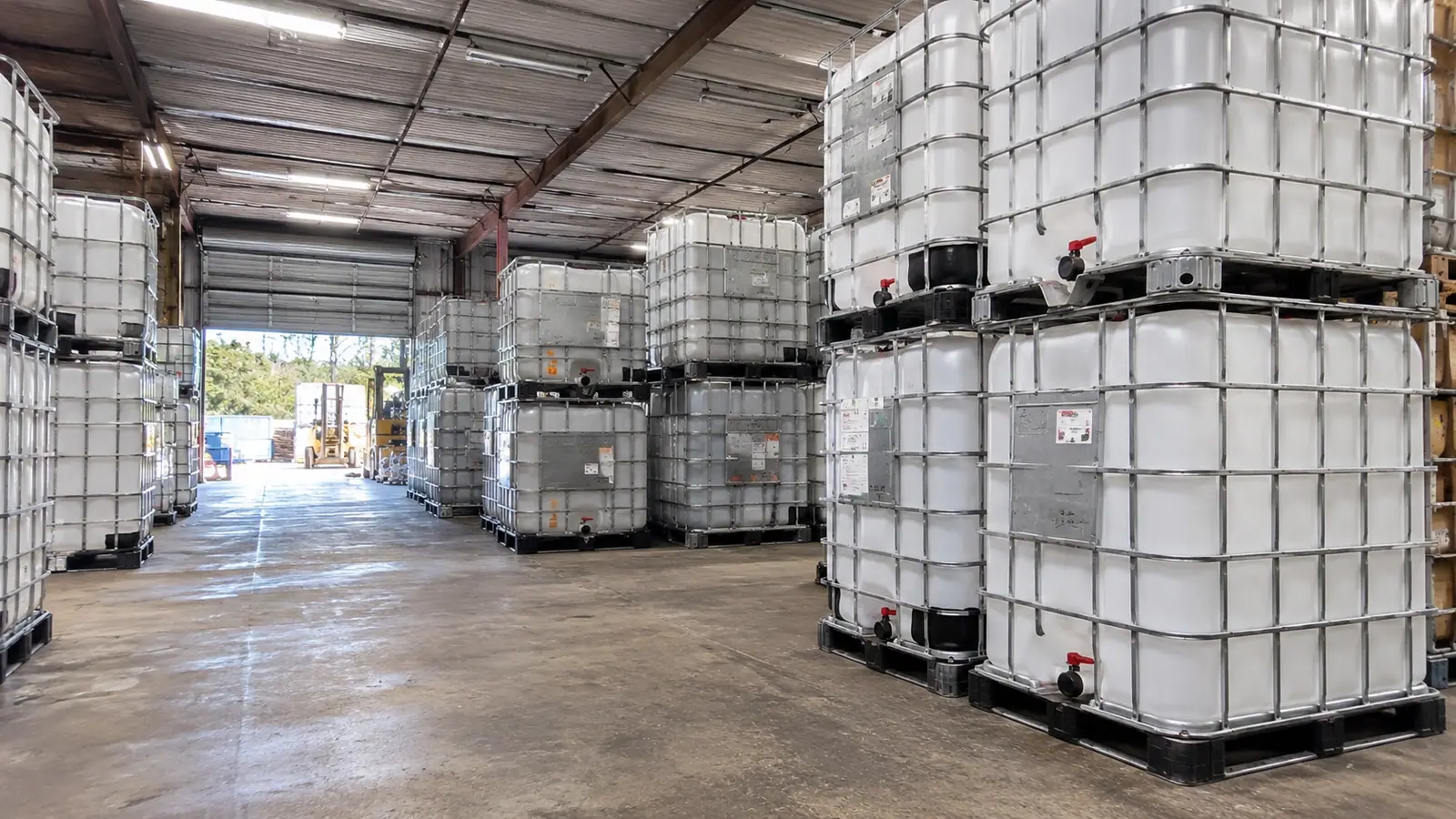
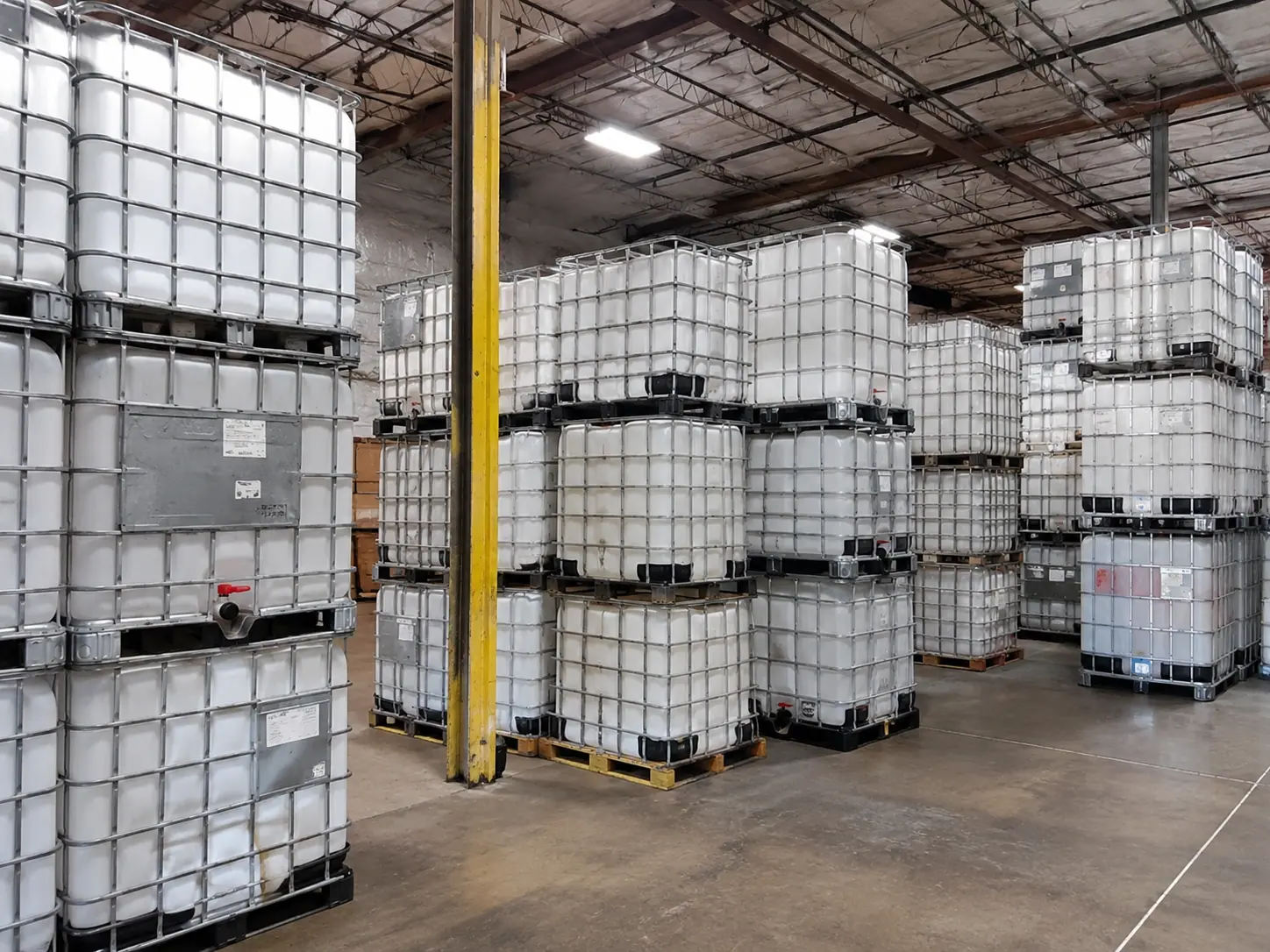
Rows of IBC totes stacked two and three high on pallets inside the Indianapolis warehouseFig. 2
Graded stock under roof, staged two and three high. Loaded units never stack more than two, and never while warm.
Nominal figures. Gross weight assumes water at 8.34 lb/gal — multiply by your cargo's specific gravity, then check it against the maximum permitted gross mass on the unit's own marking.
CapacityLitresFootprintHeightTareGross (water)Stack loaded
275 gal1,04148 × 40 in46 in≈140 lb≈2,435 lb2 high
330 gal1,24948 × 40 in53 in≈155 lb≈2,905 lb2 high
350 gal1,32548 × 40 in56 in≈165 lb≈3,075 lb2 high
120 gal45440 × 32 in38 in≈95 lb≈1,095 lb2 high
180 gal68142 × 36 in42 in≈115 lb≈1,616 lb2 high
550 gal2,08260 × 48 in60 in≈240 lb≈4,830 lb1 high

B / FITTINGS

What threads onto it

Fittings, threads and seat materials

S60x6 is a buttress thread that seals against a flat gasket face, not on the thread flanks. It is not interchangeable with NPT — forcing one into the other is the commonest hidden fault in used containers.
FittingSizeSeals bySeat optionsTypical service
S60x6 butterfly valve2 inFlat gasket faceEPDM, Viton, PTFEThe standard IBC outlet
S70x6 butterfly valve2 inFlat gasket faceEPDM, VitonEuropean and some 330 gal units
2 in NPT ball valve, poly2 inThread flanks + tapeEPDM, VitonRetrofits, metered dispensing
2 in NPT ball valve, stainless2 inThread flanks + tapePTFESolvents, pressure, hot cargo
3 in butterfly valve3 inFlat gasket faceEPDM, VitonViscous cargo, high flow
6 in fill cap6 inGasketed lidEPDM, siliconeVented or solid — choose deliberately
Camlock adapter, type C1.5 / 2 inCam arms + gasketBuna, VitonRepeated connect / disconnect
Bulkhead tap3/4 inBoth-side gasketsBrass, polyRain kits, site water
The valve body rarely fails. The seat does, and it is chosen by cargo rather than by price. Always verify against your specific concentration and temperature.
MaterialGood withAvoid withTemperatureCost
EPDMWater, acids, caustics, brine, ag-chemOils, fuels, aromatics-40 to 250 °FLow
Viton (FKM)Solvents, oils, fuels, aromaticsKetones, amines, hot steam-15 to 400 °FHigh
Nitrile (NBR)Oils, diesel, greases, hydraulicsOzone, strong oxidisers-30 to 250 °FLow
PTFE envelopeAlmost all chemistry, high purityNeeds very flat flange faces-100 to 450 °FHigh
SiliconeFood contact, wide temperatureSolvents, abrasion-60 to 450 °FMedium

C / COMPATIBILITY

Will HDPE hold it?

Sixteen cargo families, rated

HDPE is brilliant at most things and hopeless at a few. Where the answer is C, we will point you at stainless rather than sell you a container that will craze.
A = suitable, B = suitable with limits, C = not recommended in a composite IBC. Guidance only — verify against your own concentration and temperature.
Cargo familyHDPESeatNotes
Water, potable and non-potableAEPDM / siliconeFood-history units for potable
Acids and caustics, aqueousAEPDM / PTFEVent fuming cargo
Liquid fertiliser, UAN, NPKAEPDMSG up to 1.32 — check your lift-gate
Brine and chloride de-icerAEPDMHard on galvanising, kind to HDPE
Food syrups, oils, concentratesASilicone / VitonDocumented food history only
GlycolsAEPDMVery common; SG 1.04–1.11
AlcoholsAViton / PTFEFlammable — bond and vent
Diesel and gas oilBViton / NBRPermeates slowly over long storage
Mineral spiritsBVitonSwells HDPE slowly
Surfactants and detergentsBEPDMOdour fixation risk — dedicate units
Latex, adhesives, water-based paintAEPDMCures if left. Wash promptly.
Ketones, aromatics, chlorinated solventsC—Crazes HDPE. Stainless only.
Gasoline and low-conductivity fuelsC—Static risk. Steel or stainless.
Essential oils, flavour concentratesC—Fixes into the wall permanently. Never.
Hydrogen peroxide above 10%C—Decomposition and pressure risk
Dairy and hot-fill above 140 °FC—Needs CIP and steam. Stainless.

Permeation

Small non-polar molecules pass slowly through HDPE rather than attacking it. The bottle looks perfect and your cargo quietly leaves. It is a storage-duration problem: diesel for a week is fine, diesel for a year is not.

Crazing

Ketones, aromatics and chlorinated solvents cause fine surface cracking that propagates under stress. It is invisible until you hold the wall against a raking light, and it is a critical grading failure.

Odour fixation

Terpenes and some surfactants dissolve into the polymer itself rather than sitting on the surface. No wash removes them. This is why a food-grade tote has to have been a food tote from new.

A wide aisle inside the warehouse with IBC totes stacked on both sides and a roller door open at the far end
Compatibility decides where a container can go next. Everything in this aisle carries a written cargo history.

E / GRADING

A grade is a promise, not a mood

How every unit is scored

We publish the whole system because a grade without written criteria is just an opinion with a price tag. Nineteen points, fixed thresholds, one card per unit, seven years on file.
Every unit is scored against all nineteen. A single critical failure condemns the unit regardless of how the other eighteen score.
#PointCritical?
01Prior cargo declaration — present, written, specificYes
02Residual liquid — any volume at allYes
03Odour after wash — fixed odour by trained noseYes
04Bottle corner stress whiteningNo
05Interior scoring you can feelNo
06Interior crazing — fine surface crackingYes
07Bottle bulge or deformationYes
08Wall thickness at the thinnest pointYes
09Dome port condition and flange flatnessNo
10Outlet threads — cross-threading, chippingYes if crossed
11Valve function, full open and closeNo, replaceable
12Gasket condition — compression set, bloomNo, replaceable
13Cage squareness along the top railNo, pressable
14Cage weld integrity at tube intersectionsYes
15Cage coating and galvanising lossNo
16Pallet condition — cracked feet, rot, corrosionNo, replaceable
17Forklift pocket integrityNo
18UN marking legibility and dateNo, re-markable
19Leak test under our procedureYes

D / ORDERING

Commercial terms, up front

Lead times, minimums and what happens when it goes wrong

Discovering these at invoice stage is nobody's idea of a good relationship, so they are published.
Published so nothing arrives as a surprise at invoice stage. Prices themselves move weekly with resin, scrap steel and freight, which is why we do not publish a list.
ItemDetail
Minimum orderOne unit. No account minimum, no membership.
Stock lead timeGrade A and B 275 gal usually ship the same week
Rebottled lead time2–3 weeks, built to order in bay D
Food-grade lead time1–3 weeks when stock exists; supply-dependent
Full truckload45 on a 48 ft flat, 48 in a 53 ft van, 90 empties double-stacked
Payment, first orderPrepay by ACH or card
Payment, establishedNet 30 on credit approval
Grade guaranteeRegrade or replace, our freight both ways, 14 days
Leak warranty30 days from delivery, normal atmospheric service
CancellationFree until the truck is loaded
Returns14 days on unused stock units, freight at your cost
Sales taxIndiana resale certificates and out-of-state equivalents accepted

F / END OF LIFE

Reuse first, recycle last

What happens when the container is finally finished

Every unit that arrives is assessed down this list, in this order. 99.4% of incoming mass avoided landfill in 2024, and reuse plus repair accounted for over three quarters of it.
Assessed in this order, per unit, every time. The granulator is the fourth choice, not the first. 2024 figures against 2,994,000 lb of inbound mass.
StepOutcomeShare of massCost to us
01Reuse as is — wash and redeploy63.9%11 gal of mostly reclaimed water
02Repair and reuse — valve, gasket, pallet, cage11.4%Parts and bench time
03Rebottle — new bottle, reclaimed steel9.6%A new bottle, two thirds of mass retained
04Upcycle — rain kits, grow beds, wash stations3.2%Fabrication time
05Material recovery — HDPE regrind, steel, wood11.3%Grinding, washing, drying energy
06Residual to licensed disposal0.6%Sludge, gasket rubber, fasteners, laminates
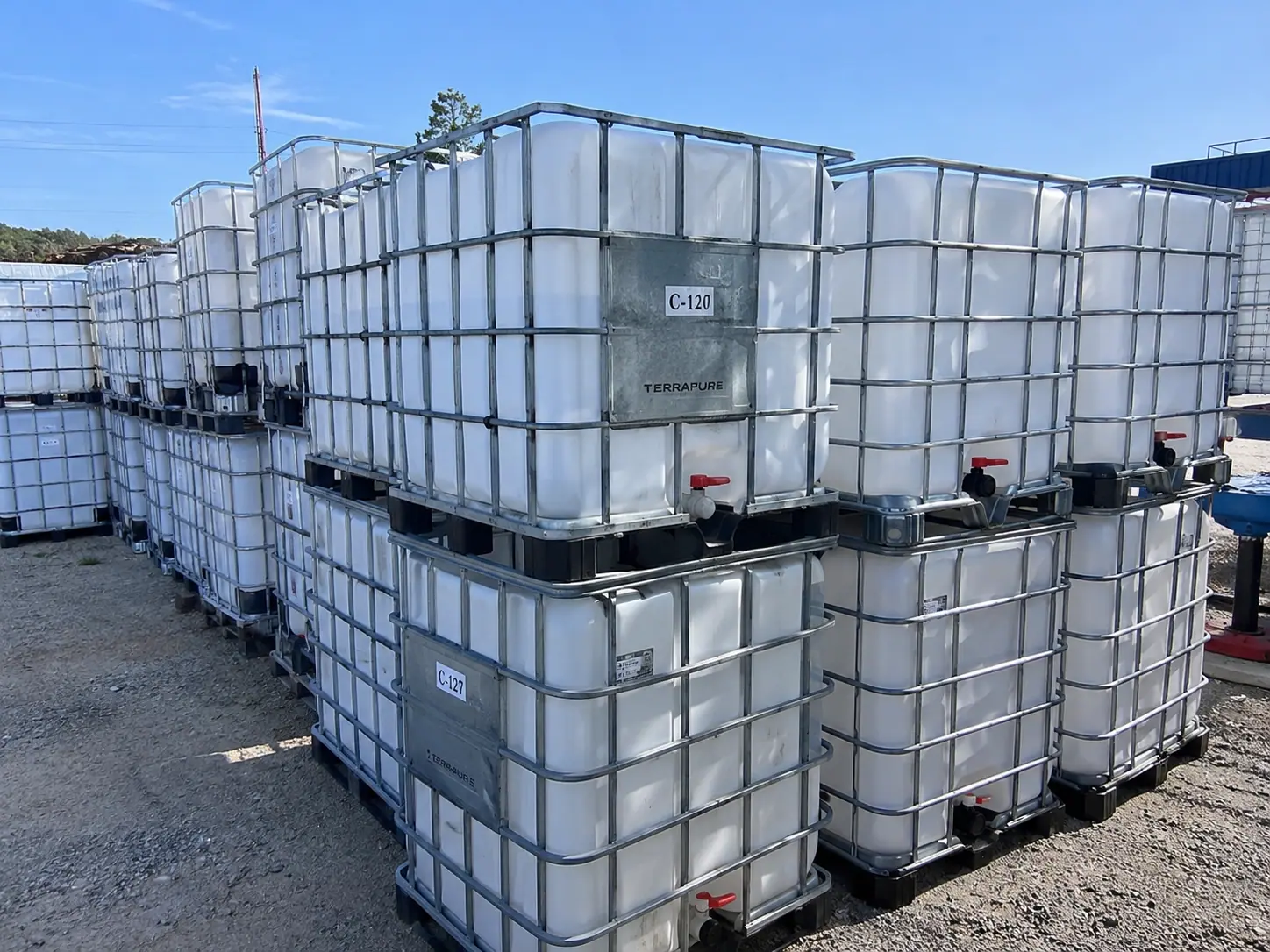
Stacks of used IBC totes under a clear blue sky on the gravel pad, awaiting grading
Inbound. Nothing comes off the trailer before its cargo declaration is read.
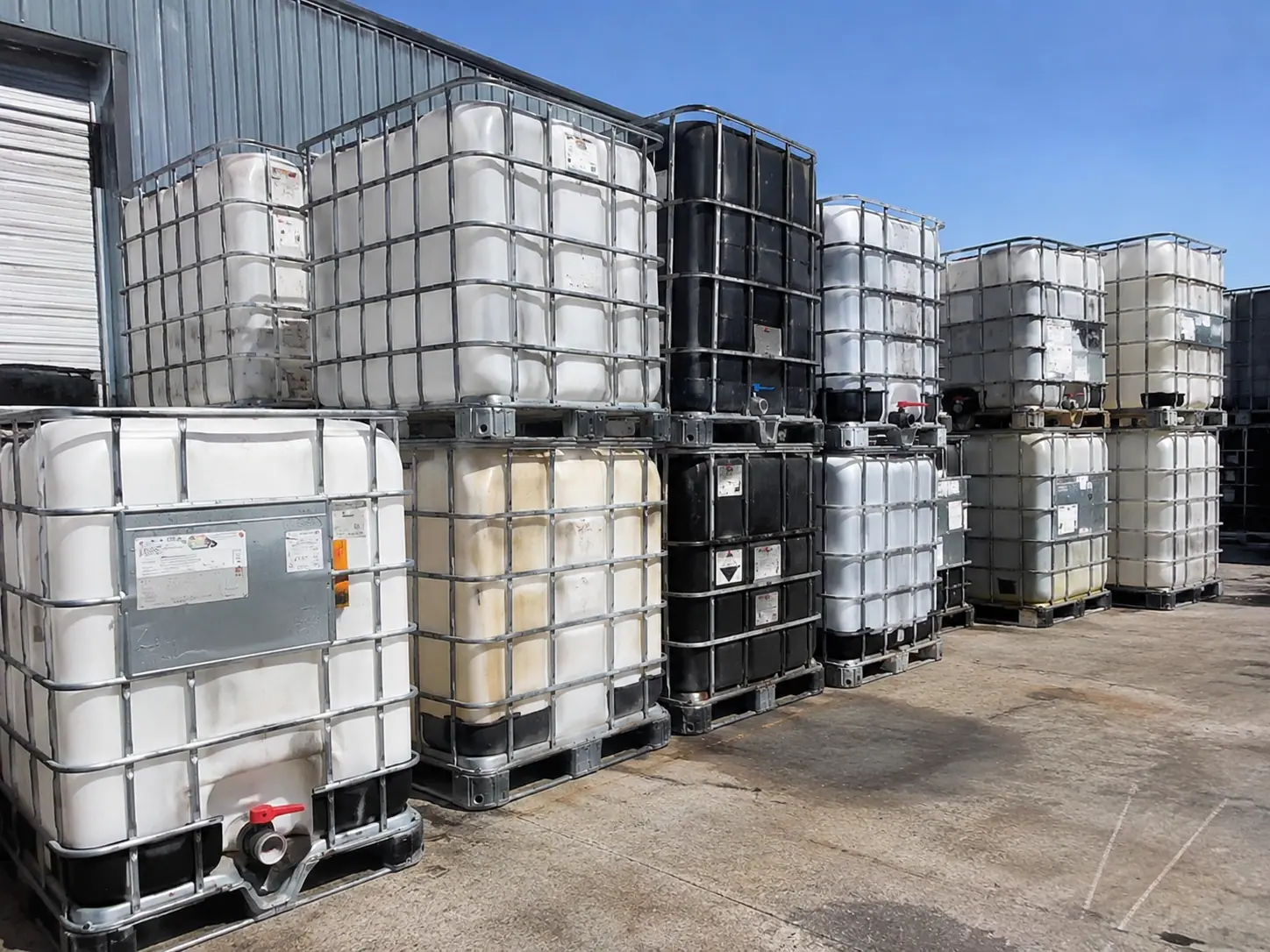
Mixed white and black IBC totes staged beside the loading dock doors
Graded and sorted. Black bottles are UV-stable units destined for outdoor service.
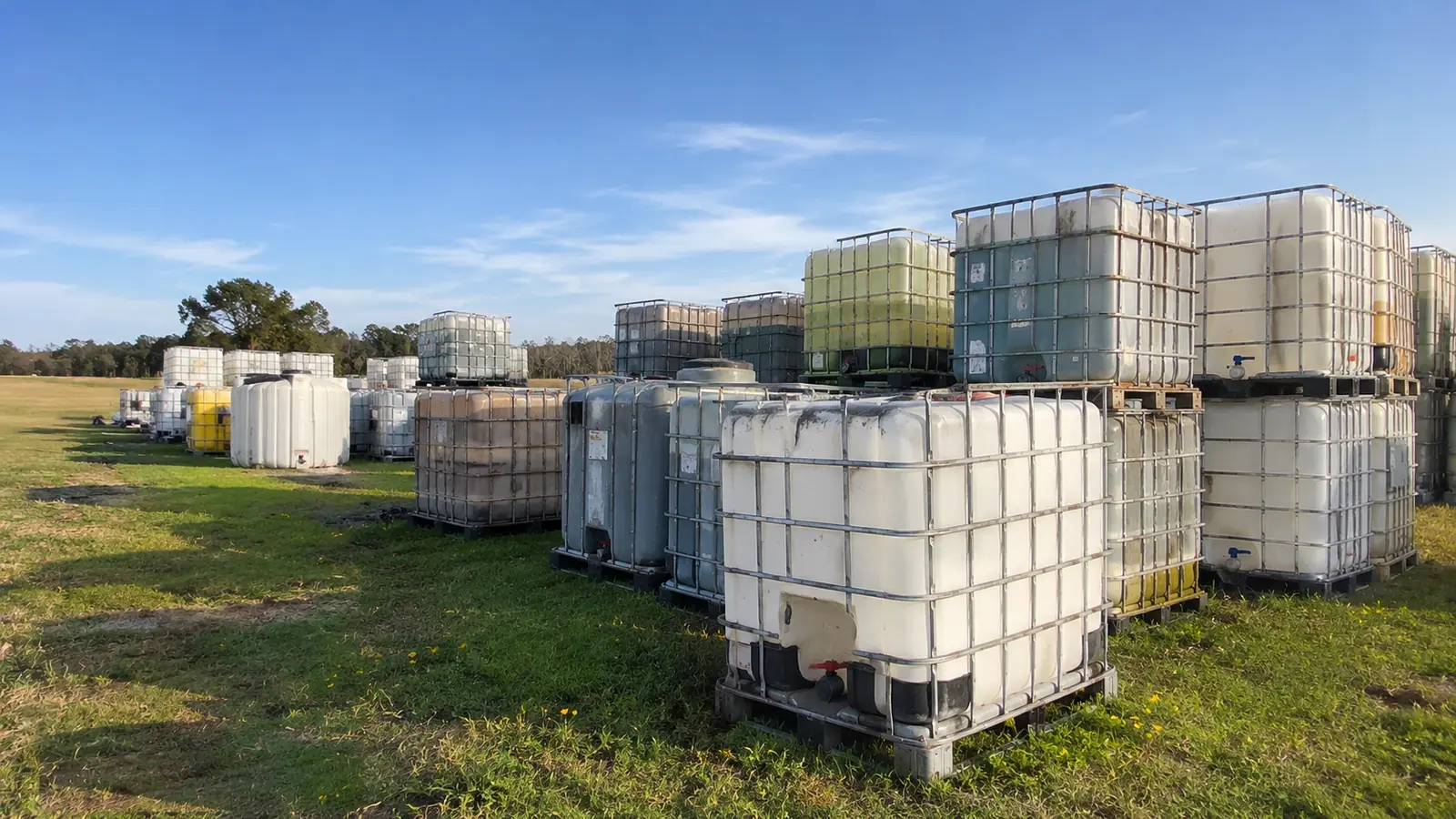
A wide field of IBC totes standing on grass under a blue sky, waiting to be collected
Recovered from a customer yard. Every one of these avoided a crusher.

From reading to ordering

Put it to work.

Quantity, grade and delivery ZIP in the form above gets you a delivered price tomorrow.
Use the form aboveAll posts
Get a quote