Size GuideEco ImpactContact Us

Maintenance · 7 min read

Heat, sun and the bulging bottle problem

Why a sealed tote deforms on a hot trailer, and why the fix is a $9 lid rather than a stronger bottle.

June 28, 2024 · Priya Raghunathan · ToteOrbit, Indianapolis

Question about this post?

Reply within 1 business day

It goes straight to the bench that wrote it. We answer operator questions whether or not there is an order attached.

US or Canada only — 10 digits, e.g. (317) 204-0100
US ZIP like 46226, or Canadian postal code like M5V 2T6
Whole units, 1 to 100,000

Fields marked * are required. Phone and postal code are checked against real US and Canadian number ranges, so please enter details we can actually reach you on.

A tote leaves your dock square and arrives looking slightly pregnant. Nothing leaked, nothing was dropped, and the driver is adamant nothing happened. He is probably right. What happened was a solid lid and an afternoon.

The mechanism, in one paragraph

Liquids expand when they warm. So does the air in the head space. A sealed container with no vent has nowhere to put that expansion, so internal pressure rises. HDPE is a thermoplastic that softens as it warms, so at exactly the moment the pressure goes up the wall gets more compliant. The bottle takes the path of least resistance and bulges outward between the cage bars.

Cool it down and it mostly comes back — but not entirely. Each cycle leaves a little permanent deformation, and the corners where the material worked hardest start to show stress whitening.

Where it happens

  • Closed trailers in summer. The interior of a dark dry van can reach well over 120 °F on a hot afternoon.
  • Outdoor storage in direct sun. Particularly on a natural translucent bottle, which both transmits and absorbs.
  • After a hot fill. Filling at 120 °F and sealing immediately traps the whole cooling cycle, which creates vacuum rather than pressure and can collapse a bottle inward.
  • Fermenting cargo. Spent grain, yeast slurry and some agricultural by-products keep producing gas. This is a pressure problem independent of temperature and it builds much faster than people expect.

The fix is a lid, not a stronger bottle

A vented lid lets the bottle breathe. It is a six-inch cap with a one-way or two-way vent that equalises pressure while keeping liquid and most contamination out. It costs very little and it solves nearly all of this.

A solid lid is required when the cargo must stay genuinely sealed — food-grade units, anything hygroscopic, anything with an odour you do not want escaping. If you need a solid lid, you have to manage the temperature exposure instead, because you have removed the pressure relief.

Getting this single choice wrong deforms more bottles than any other error we see. It is the first question we ask when somebody sends us a photograph of a bulged unit.

The ullage rule

Leave five to ten per cent head space. Nobody fills a tote to 275 gallons, and the reason is exactly this. On a solid-lid unit going into summer transport, err toward ten.

What to do with a bulged tote

First, let it cool fully and look again — a great deal of apparent deformation is elastic and disappears. Then check three things:

  1. Does it sit square? If the base has deformed enough that it rocks on a flat floor, the unit is done for cargo service.
  2. Stress whitening at the corners? Chalky pale patches mean permanent structural damage to the polymer. It drops the unit a grade and it means fewer trips left.
  3. Does it still pass a leak test? Bulging frequently does not cause an immediate leak, which is what makes it insidious — the unit looks serviceable and has lost margin you cannot see.

A bulged bottle is point seven on our grading bench and it is a critical failure. Those units go to rebottling rather than quietly becoming Grade C. The cage and pallet are almost always fine.

Practical rules for summer

  • Vented lids unless you have a specific reason not to.
  • Ten per cent ullage on anything going into a closed trailer.
  • Never stack units that are warm to the touch.
  • Shade or black UV-stable bottles for outdoor storage.
  • Fermenting cargo vents, always, and never sits over a hot weekend.
  • Let hot-filled product cool with the lid loose before sealing.

None of that costs anything. All of it prevents a problem that turns a serviceable container into a rebottle candidate.

The vacuum version, which is worse

Everything above describes positive pressure. The opposite failure is more damaging and less understood: fill hot, seal with a solid lid, and let it cool.

As the contents cool they contract, and a sealed container with no vent generates partial vacuum. HDPE in compression does not bulge outward — it panels inward, and a collapsed bottle is almost always permanently deformed because the wall buckles rather than stretching.

If you hot-fill, leave the lid loose until the contents have cooled, then seal. Or use a two-way vented lid, which equalises in both directions. This is a routine problem in syrup and sauce operations and it is entirely avoidable.

Trailer temperatures, measured

We have put data loggers in loads out of curiosity. A dark dry van sitting on a yard in full July sun reached 128 °F internal in the afternoon, against an ambient of 91 °F. Under way with airflow it dropped to the high nineties, then climbed again at every stop.

That matters for two reasons. First, 128 °F is comfortably into the range where HDPE creeps under load, which is the argument against stacking loaded units in summer transit. Second, the cycling — up at every stop, down under way — fatigues the wall more than a single sustained temperature would.

Which cargoes expand most

Thermal expansion coefficients vary enough to matter:

  • Water-based chemistry expands least. Water is unusually well behaved.
  • Glycols expand noticeably more than water across the same range.
  • Hydrocarbons and solvents expand considerably more — frequently two to three times water's rate.
  • Anything fermenting is not thermal expansion at all. It is gas generation and it has no upper bound you can plan for.

So the ullage you need is cargo-specific. Five per cent is fine for aqueous chemistry in a vented container; ten is sensible for solvents, and fermenting cargo wants a vent plus headspace plus not sitting over a warm weekend.

Black bottles, and when they are worth it

A black UV-stable bottle absorbs more heat than a natural translucent one, which sounds like exactly the wrong answer for a heat problem. In practice it is usually the right one for outdoor storage, because UV embrittlement over eighteen months is a bigger threat than daily thermal cycling.

The exception is cargo that is itself heat-sensitive, where shading a natural bottle beats heating a black one. If you are storing outdoors long-term with a temperature-sensitive product, shade is the answer rather than pigment. More in tote storage and the UV clock.

Assessing a bulged unit properly

Let it cool fully first — much of what looks like damage is elastic. Then:

  1. Does it sit square on a flat floor? If it rocks, the base has deformed and it is done for cargo.
  2. Any chalky white patches at the corners? That is stress whitening — permanent structural damage and an automatic grade drop.
  3. Does the cage still carry the bottle, or is the bottle carrying the cage? A bottle pressing outward against the bars is taking load it was not designed to take.
  4. Does it still hold a leak test? Bulging frequently does not cause an immediate leak, which is the insidious part.

The nine-dollar summary

A vented lid is the cheapest risk control in this entire industry. If your cargo tolerates air contact and your tote will see sun or temperature swing, fit one. If your cargo must stay sealed, you have bought a temperature management problem along with the solid lid, and the ten per cent ullage is not optional.

We stock both lid types and the gaskets for them on the accessories page, and we will tell you which one your cargo wants if you describe it in the form.
REFERENCE

Reference

The tables behind this post

Dimensions, threads and seat materials in full, so you do not have to go looking. The complete reference is in the size guide.
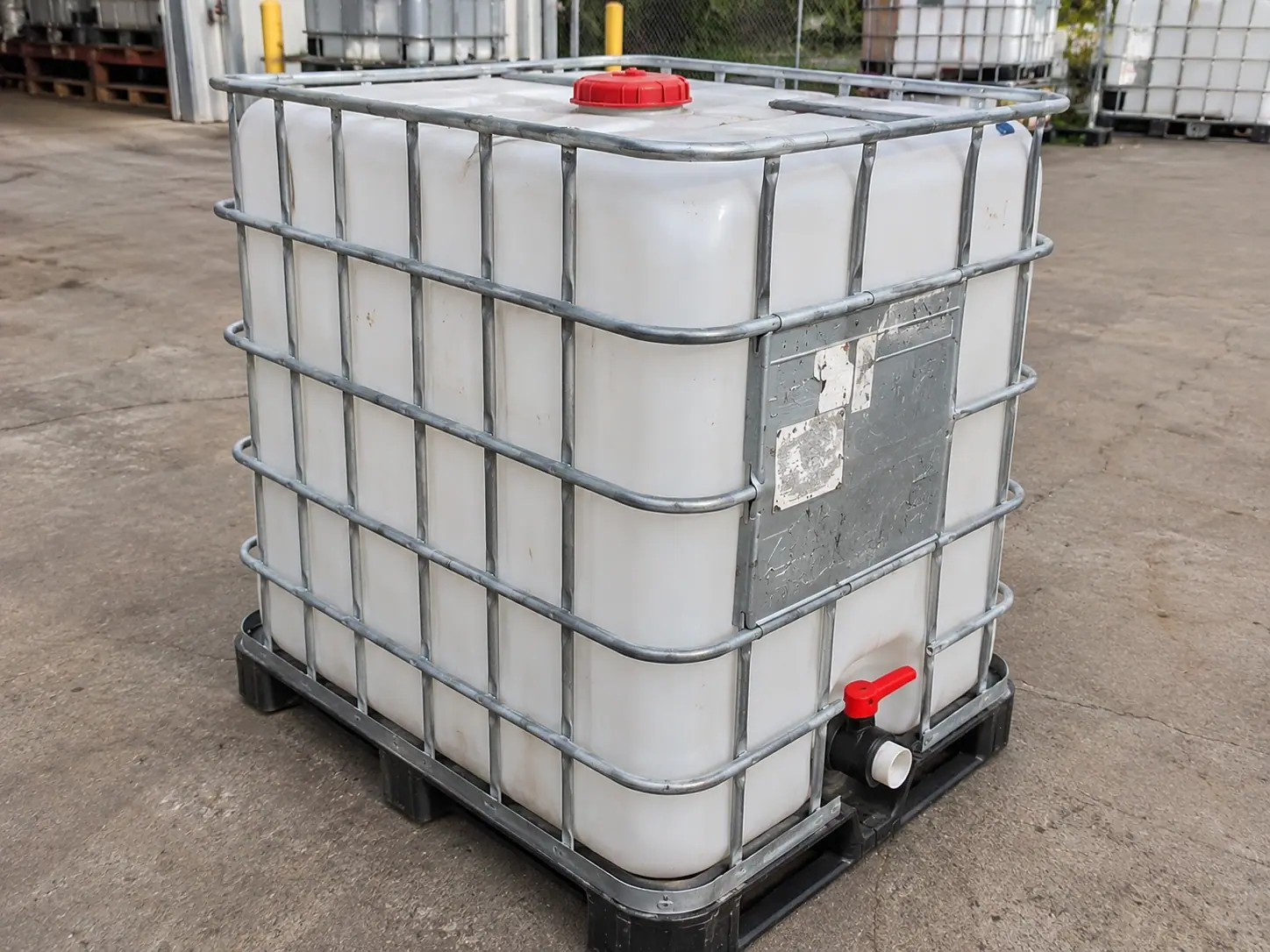
A reconditioned 275 gallon caged composite IBC tote on a black plastic pallet, showing the galvanised cage, the moulded HDPE bottle, the red discharge valve and the six-inch fill capFig. 1
A single 275 gallon unit off the outbound pad. Galvanised tubular cage, blow-moulded HDPE bottle, 2 in S60x6 outlet, six-inch vented fill cap.
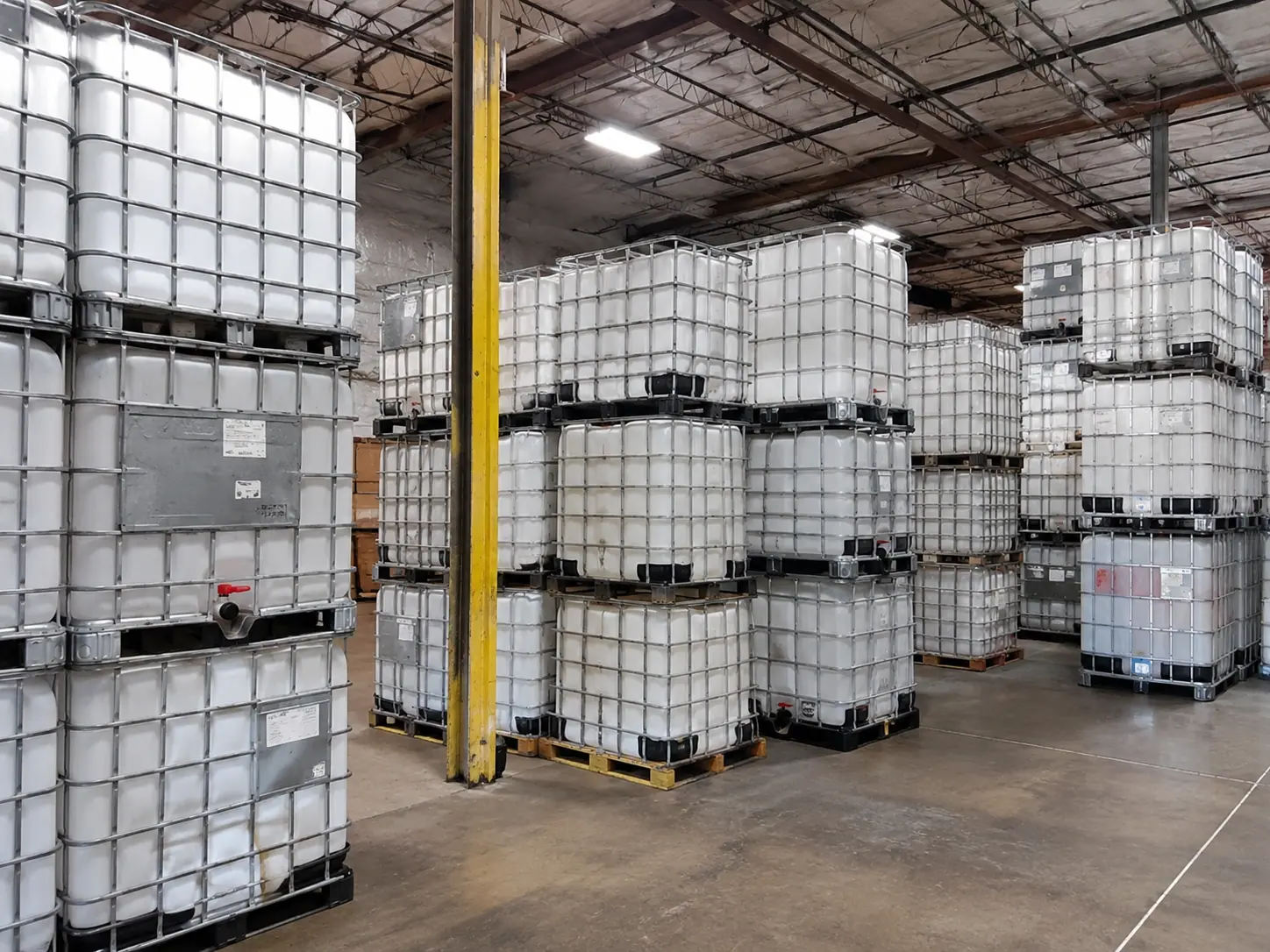
Rows of IBC totes stacked two and three high on pallets inside the Indianapolis warehouseFig. 2
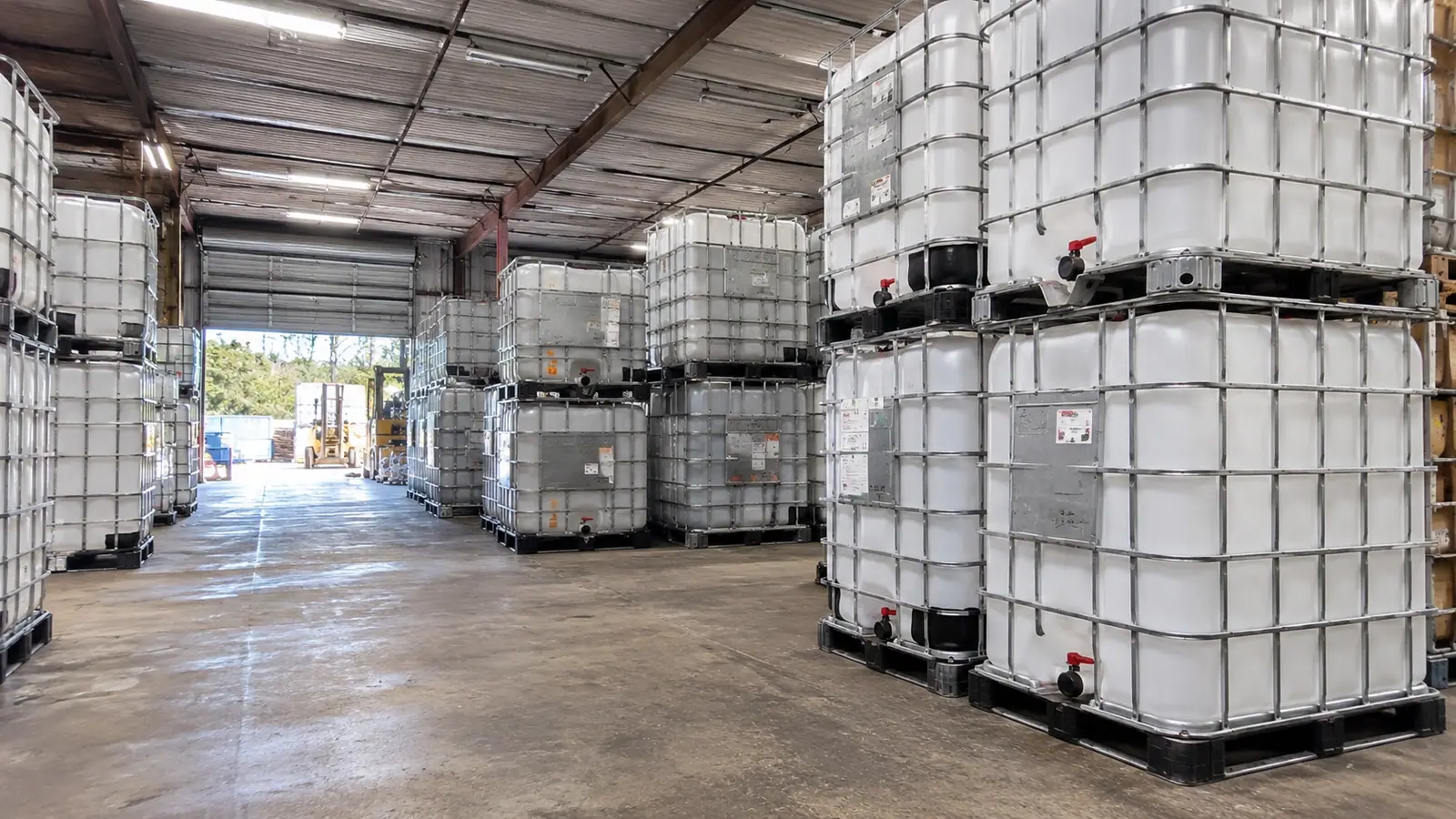
Graded stock under roof, staged two and three high. Loaded units never stack more than two, and never while warm.
Nominal figures. Gross weight assumes water at 8.34 lb/gal — multiply by your cargo's specific gravity, then check it against the maximum permitted gross mass on the unit's own marking.
CapacityLitresFootprintHeightTareGross (water)Stack loaded
275 gal1,04148 × 40 in46 in≈140 lb≈2,435 lb2 high
330 gal1,24948 × 40 in53 in≈155 lb≈2,905 lb2 high
350 gal1,32548 × 40 in56 in≈165 lb≈3,075 lb2 high
120 gal45440 × 32 in38 in≈95 lb≈1,095 lb2 high
180 gal68142 × 36 in42 in≈115 lb≈1,616 lb2 high
550 gal2,08260 × 48 in60 in≈240 lb≈4,830 lb1 high

B / FITTINGS

What threads onto it

Fittings, threads and seat materials

S60x6 is a buttress thread that seals against a flat gasket face, not on the thread flanks. It is not interchangeable with NPT — forcing one into the other is the commonest hidden fault in used containers.
FittingSizeSeals bySeat optionsTypical service
S60x6 butterfly valve2 inFlat gasket faceEPDM, Viton, PTFEThe standard IBC outlet
S70x6 butterfly valve2 inFlat gasket faceEPDM, VitonEuropean and some 330 gal units
2 in NPT ball valve, poly2 inThread flanks + tapeEPDM, VitonRetrofits, metered dispensing
2 in NPT ball valve, stainless2 inThread flanks + tapePTFESolvents, pressure, hot cargo
3 in butterfly valve3 inFlat gasket faceEPDM, VitonViscous cargo, high flow
6 in fill cap6 inGasketed lidEPDM, siliconeVented or solid — choose deliberately
Camlock adapter, type C1.5 / 2 inCam arms + gasketBuna, VitonRepeated connect / disconnect
Bulkhead tap3/4 inBoth-side gasketsBrass, polyRain kits, site water
The valve body rarely fails. The seat does, and it is chosen by cargo rather than by price. Always verify against your specific concentration and temperature.
MaterialGood withAvoid withTemperatureCost
EPDMWater, acids, caustics, brine, ag-chemOils, fuels, aromatics-40 to 250 °FLow
Viton (FKM)Solvents, oils, fuels, aromaticsKetones, amines, hot steam-15 to 400 °FHigh
Nitrile (NBR)Oils, diesel, greases, hydraulicsOzone, strong oxidisers-30 to 250 °FLow
PTFE envelopeAlmost all chemistry, high purityNeeds very flat flange faces-100 to 450 °FHigh
SiliconeFood contact, wide temperatureSolvents, abrasion-60 to 450 °FMedium

C / COMPATIBILITY

Will HDPE hold it?

Sixteen cargo families, rated

HDPE is brilliant at most things and hopeless at a few. Where the answer is C, we will point you at stainless rather than sell you a container that will craze.
A = suitable, B = suitable with limits, C = not recommended in a composite IBC. Guidance only — verify against your own concentration and temperature.
Cargo familyHDPESeatNotes
Water, potable and non-potableAEPDM / siliconeFood-history units for potable
Acids and caustics, aqueousAEPDM / PTFEVent fuming cargo
Liquid fertiliser, UAN, NPKAEPDMSG up to 1.32 — check your lift-gate
Brine and chloride de-icerAEPDMHard on galvanising, kind to HDPE
Food syrups, oils, concentratesASilicone / VitonDocumented food history only
GlycolsAEPDMVery common; SG 1.04–1.11
AlcoholsAViton / PTFEFlammable — bond and vent
Diesel and gas oilBViton / NBRPermeates slowly over long storage
Mineral spiritsBVitonSwells HDPE slowly
Surfactants and detergentsBEPDMOdour fixation risk — dedicate units
Latex, adhesives, water-based paintAEPDMCures if left. Wash promptly.
Ketones, aromatics, chlorinated solventsC—Crazes HDPE. Stainless only.
Gasoline and low-conductivity fuelsC—Static risk. Steel or stainless.
Essential oils, flavour concentratesC—Fixes into the wall permanently. Never.
Hydrogen peroxide above 10%C—Decomposition and pressure risk
Dairy and hot-fill above 140 °FC—Needs CIP and steam. Stainless.

Permeation

Small non-polar molecules pass slowly through HDPE rather than attacking it. The bottle looks perfect and your cargo quietly leaves. It is a storage-duration problem: diesel for a week is fine, diesel for a year is not.

Crazing

Ketones, aromatics and chlorinated solvents cause fine surface cracking that propagates under stress. It is invisible until you hold the wall against a raking light, and it is a critical grading failure.

Odour fixation

Terpenes and some surfactants dissolve into the polymer itself rather than sitting on the surface. No wash removes them. This is why a food-grade tote has to have been a food tote from new.

A wide aisle inside the warehouse with IBC totes stacked on both sides and a roller door open at the far end
Compatibility decides where a container can go next. Everything in this aisle carries a written cargo history.

E / GRADING

A grade is a promise, not a mood

How every unit is scored

We publish the whole system because a grade without written criteria is just an opinion with a price tag. Nineteen points, fixed thresholds, one card per unit, seven years on file.
Every unit is scored against all nineteen. A single critical failure condemns the unit regardless of how the other eighteen score.
#PointCritical?
01Prior cargo declaration — present, written, specificYes
02Residual liquid — any volume at allYes
03Odour after wash — fixed odour by trained noseYes
04Bottle corner stress whiteningNo
05Interior scoring you can feelNo
06Interior crazing — fine surface crackingYes
07Bottle bulge or deformationYes
08Wall thickness at the thinnest pointYes
09Dome port condition and flange flatnessNo
10Outlet threads — cross-threading, chippingYes if crossed
11Valve function, full open and closeNo, replaceable
12Gasket condition — compression set, bloomNo, replaceable
13Cage squareness along the top railNo, pressable
14Cage weld integrity at tube intersectionsYes
15Cage coating and galvanising lossNo
16Pallet condition — cracked feet, rot, corrosionNo, replaceable
17Forklift pocket integrityNo
18UN marking legibility and dateNo, re-markable
19Leak test under our procedureYes

D / ORDERING

Commercial terms, up front

Lead times, minimums and what happens when it goes wrong

Discovering these at invoice stage is nobody's idea of a good relationship, so they are published.
Published so nothing arrives as a surprise at invoice stage. Prices themselves move weekly with resin, scrap steel and freight, which is why we do not publish a list.
ItemDetail
Minimum orderOne unit. No account minimum, no membership.
Stock lead timeGrade A and B 275 gal usually ship the same week
Rebottled lead time2–3 weeks, built to order in bay D
Food-grade lead time1–3 weeks when stock exists; supply-dependent
Full truckload45 on a 48 ft flat, 48 in a 53 ft van, 90 empties double-stacked
Payment, first orderPrepay by ACH or card
Payment, establishedNet 30 on credit approval
Grade guaranteeRegrade or replace, our freight both ways, 14 days
Leak warranty30 days from delivery, normal atmospheric service
CancellationFree until the truck is loaded
Returns14 days on unused stock units, freight at your cost
Sales taxIndiana resale certificates and out-of-state equivalents accepted

F / END OF LIFE

Reuse first, recycle last

What happens when the container is finally finished

Every unit that arrives is assessed down this list, in this order. 99.4% of incoming mass avoided landfill in 2024, and reuse plus repair accounted for over three quarters of it.
Assessed in this order, per unit, every time. The granulator is the fourth choice, not the first. 2024 figures against 2,994,000 lb of inbound mass.
StepOutcomeShare of massCost to us
01Reuse as is — wash and redeploy63.9%11 gal of mostly reclaimed water
02Repair and reuse — valve, gasket, pallet, cage11.4%Parts and bench time
03Rebottle — new bottle, reclaimed steel9.6%A new bottle, two thirds of mass retained
04Upcycle — rain kits, grow beds, wash stations3.2%Fabrication time
05Material recovery — HDPE regrind, steel, wood11.3%Grinding, washing, drying energy
06Residual to licensed disposal0.6%Sludge, gasket rubber, fasteners, laminates
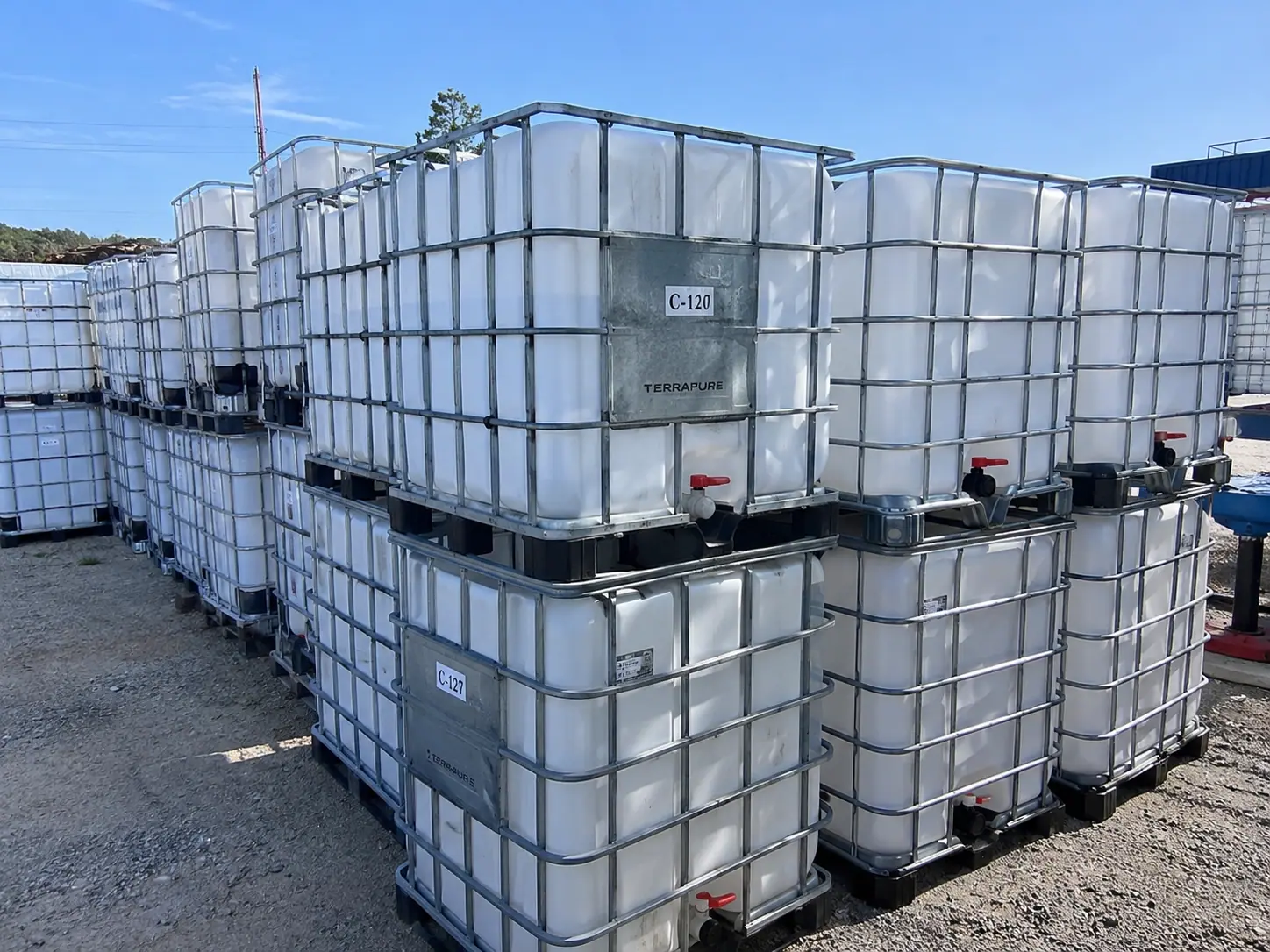
Stacks of used IBC totes under a clear blue sky on the gravel pad, awaiting grading
Inbound. Nothing comes off the trailer before its cargo declaration is read.
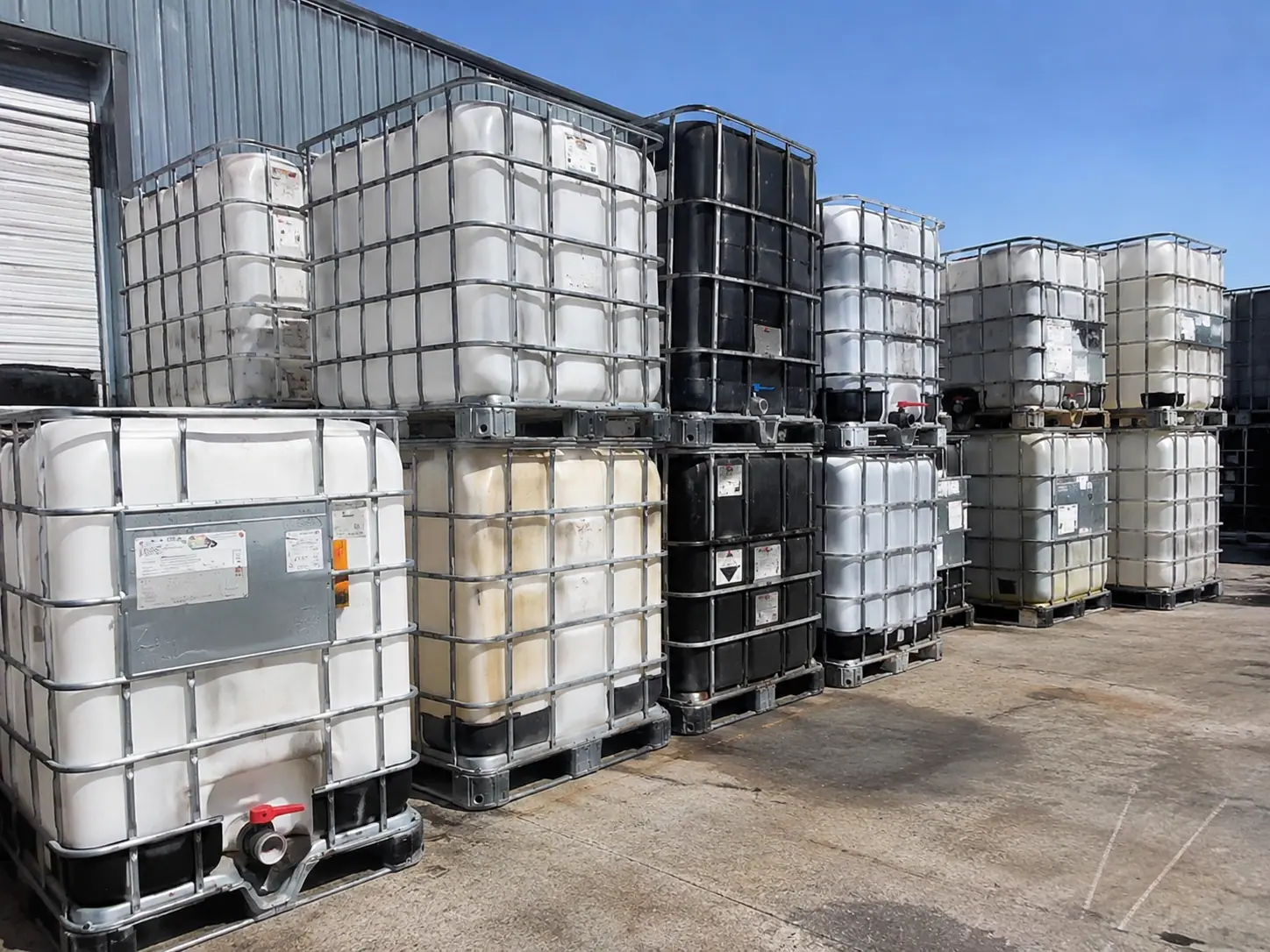
Mixed white and black IBC totes staged beside the loading dock doors
Graded and sorted. Black bottles are UV-stable units destined for outdoor service.
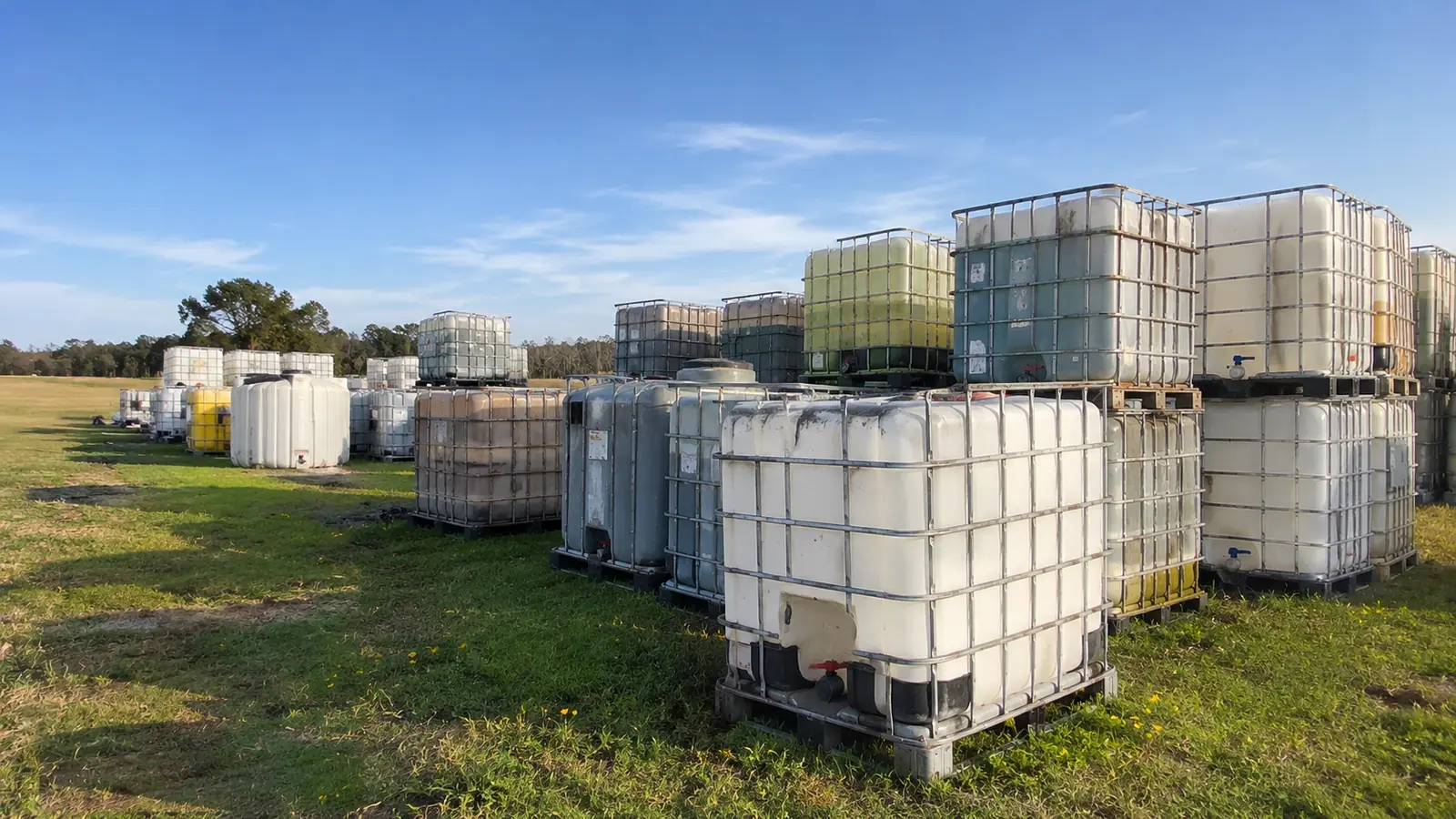
A wide field of IBC totes standing on grass under a blue sky, waiting to be collected
Recovered from a customer yard. Every one of these avoided a crusher.

From reading to ordering

Put it to work.

Quantity, grade and delivery ZIP in the form above gets you a delivered price tomorrow.
Use the form aboveAll posts
Get a quote