Size GuideEco ImpactContact Us

Ecology · 9 min read

The case against crushing your empties

You pay to buy them, you pay to destroy them, and you pay again for the replacement. Three payments, one negative outcome.

October 6, 2025 · Desmond Ayer · ToteOrbit, Indianapolis

Question about this post?

Reply within 1 business day

It goes straight to the bench that wrote it. We answer operator questions whether or not there is an order attached.

US or Canada only — 10 digits, e.g. (317) 204-0100
US ZIP like 46226, or Canadian postal code like M5V 2T6
Whole units, 1 to 100,000

Fields marked * are required. Phone and postal code are checked against real US and Canadian number ranges, so please enter details we can actually reach you on.

I started this company because I watched a plant crush forty perfectly good totes to free up a corner. Forty. Somebody paid to build those and somebody paid to destroy them. Two payments, one negative outcome. Seventeen years later I still do not have a good explanation for it.

The three payments

When a container is crushed rather than recovered, somebody pays three times.

  1. You paid to buy it. Either directly, or bundled into the price of the product that arrived in it. Either way it is on your books.
  2. You pay to destroy it. Crushing equipment, labour, hauling, disposal tickets, and the forklift operator's afternoon.
  3. Somebody pays to make the replacement. 259 pounds of CO₂e, 40 pounds of virgin HDPE, 75 pounds of steel, and the freight from a moulder.

The alternative is that somebody pays you for it and the third payment never happens. It is not a close argument and yet it loses regularly, which tells you the problem is not economic.

Why it happens anyway

Nobody's job includes it

The purchasing department bought the product, not the container. The operations team needs the space. The environmental coordinator is busy with permits. Disposal is the only route anybody is clearly responsible for.

The empties are in the way

This is the real driver, and it is almost always a fire-lane problem rather than a financial one. A corner full of empties is a daily irritation and a crusher is an immediate solution. A buyback is a phone call somebody has to make, and nobody has the time.

“They are not worth anything”

Sometimes true. Frequently not. A food-history unit in clean condition is worth several times what people assume, and even a stained Grade C unit has more value to us than to a scrap dealer, because we can put it back to work rather than melting it.

Disposal feels simpler than a relationship

A crusher does not ask for a cargo declaration. We do, and that is genuine friction. It is also the thing that makes our outbound grades mean anything, so we are not removing it.

What crushing actually destroys

Not plastic. A crushed tote is roughly 40 pounds of HDPE and 100 pounds of steel and wood, and the steel is the part that is genuinely wasteful to lose — galvanised tubular steel that has been through nine trips is usually bent, not worn out, and bending is twelve minutes in a press.

That realisation is why we started rebottling at volume in 2019. A dead bottle no longer condemns 100 pounds of perfectly good frame.

The fix is logistical, not moral

Nobody crushes containers out of indifference to the environment. They crush them because the alternative requires somebody to do something and the crusher does not.

So the fix is to make the alternative require nothing. A standing pickup route is a fixed day, a fixed price and a signed template — after the first setup it needs no decisions from anybody. The empties leave on schedule, the fire lane stays clear, and a cheque arrives instead of an invoice.

Most of our route customers set this up because of the fire lane, not the money. The money is just the part that makes it an easy internal argument.

The number

Last year 21,400 containers came through our yard and 99.4 per cent of the incoming mass avoided landfill. Reuse and repair alone accounted for over three quarters of it — material recovery, which is what most people mean by recycling, was only about eleven per cent.

That ratio is the thing I am actually proud of, and every crushed tote is a unit that was in the wrong column. There is nothing complicated about the argument. It just needs somebody whose job it is.

Making the internal argument

If you are reading this because you want to stop your own site crushing containers, the environmental case is not the one that works. These three do.

The fire lane

Empties staged in a fire lane or an aisle is a safety finding waiting to happen. A standing collection with a fixed day removes the staging problem entirely, which is a safety argument rather than an environmental one and lands differently with operations.

The disposal line

Crushing and hauling appears as a cost in somebody's budget. A buyback appears as income. Converting a recurring cost line into a recurring income line is a conversation finance will engage with.

The labour

Crushing is somebody's afternoon, repeatedly. A collection is a signature and a forklift moving units to a dock. The labour difference across a year is usually larger than the material value either way.

What to do when the empties are genuinely worthless

Sometimes they are. Undocumented cargo, odour-fixing prior contents, or a cargo class we cannot accept — these are real cases and crushing is not automatically wrong.

Even then, there is a better option than landfill. A container we cannot reuse we can still take apart: the bottle becomes HDPE regrind, the cage and pallet go to steel recovery. That is material recovery rather than disposal, and it is worth scrap value rather than costing a disposal ticket.

So the honest hierarchy is: reuse if possible, repair if not, rebottle if the bottle is the problem, upcycle if cargo service is over, and recover material only when all four have failed. Crushing to landfill is not on the list at all. That hierarchy is set out on the eco impact page.

The number that makes the case

One container, 259 pounds of CO₂e to bring into existence. Across a site that destroys a hundred containers a year, that is roughly thirteen tonnes of CO₂e annually that exists purely because nobody was responsible for the reverse logistics.

Thirteen tonnes is not a rounding error on a small site's footprint. It is frequently larger than anything else that site could realistically change, and it costs money to achieve rather than costing money to fix. That inversion is the whole argument.

Where the industry quietly does better than its reputation

It is worth saying that the picture is improving. Fifteen years ago a plant with forty empties in a corner had almost no realistic option other than a scrap dealer or a crusher. Reconditioners existed but the network was thin and the documentation expectations were loose.

Now there is a national collection network, buyback is a normal commercial transaction, and documentation standards are high enough that reconditioned units are specified rather than tolerated. Our own diversion rate went from 78 per cent in 2015 to 99.4 in 2024, and we are not unusual in that direction.

So the crushed tote is less and less a structural inevitability and more and more an organisational oversight. That is progress, and it is also why it is worth writing about.

One more number, for the people who ask

In 2024 we handled 21,400 containers. Reuse and repair together accounted for over three quarters of all incoming mass; material recovery, which is what most people mean by recycling, was about eleven per cent.

That ratio is the thing to aim at. A high recycling rate is a consolation prize. A high reuse rate is the actual objective, and every crushed container is a unit that was in the wrong column. The full mass balance is on the zero-landfill page.
REFERENCE

Reference

The tables behind this post

Dimensions, threads and seat materials in full, so you do not have to go looking. The complete reference is in the size guide.
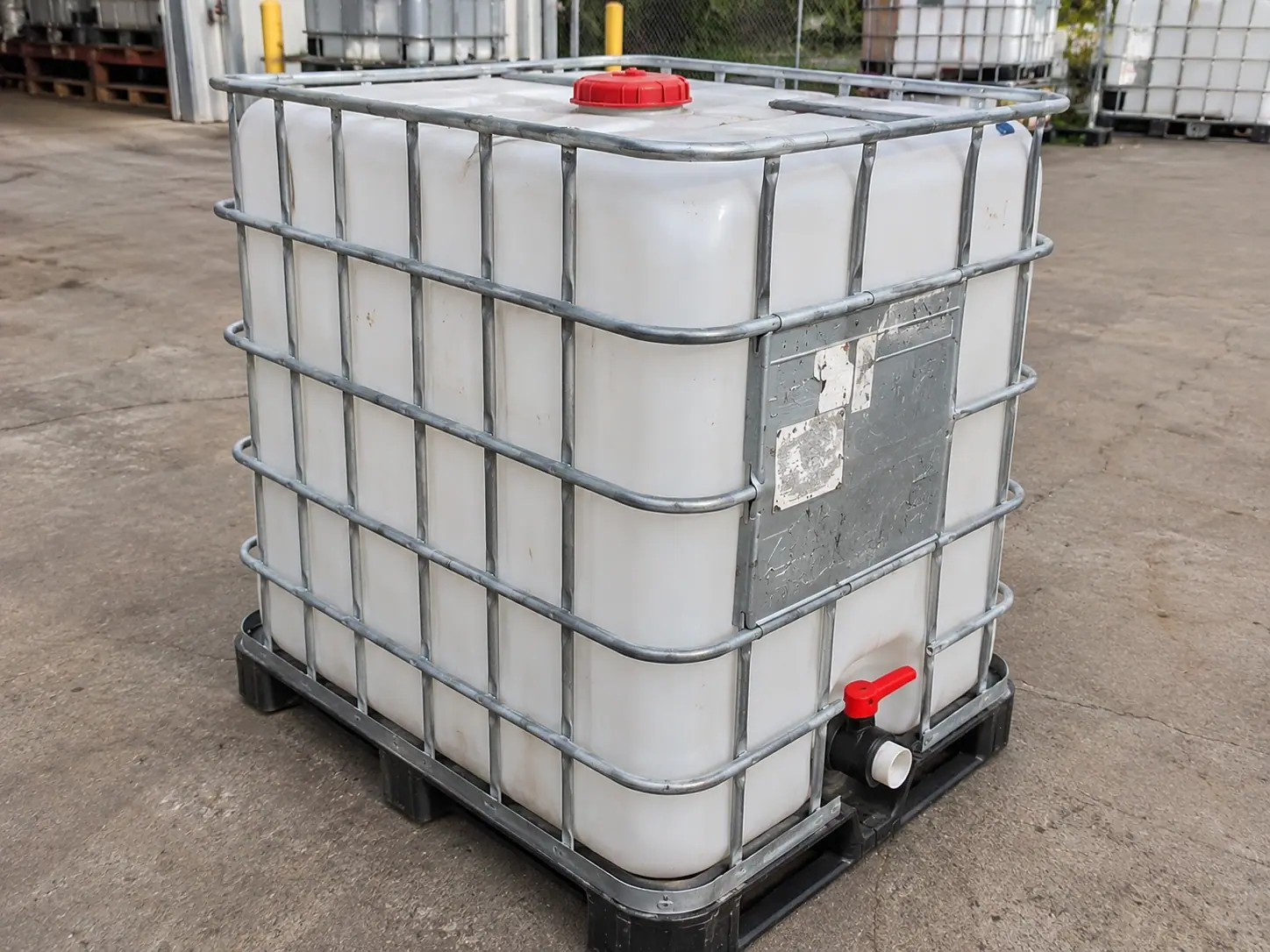
A reconditioned 275 gallon caged composite IBC tote on a black plastic pallet, showing the galvanised cage, the moulded HDPE bottle, the red discharge valve and the six-inch fill capFig. 1
A single 275 gallon unit off the outbound pad. Galvanised tubular cage, blow-moulded HDPE bottle, 2 in S60x6 outlet, six-inch vented fill cap.
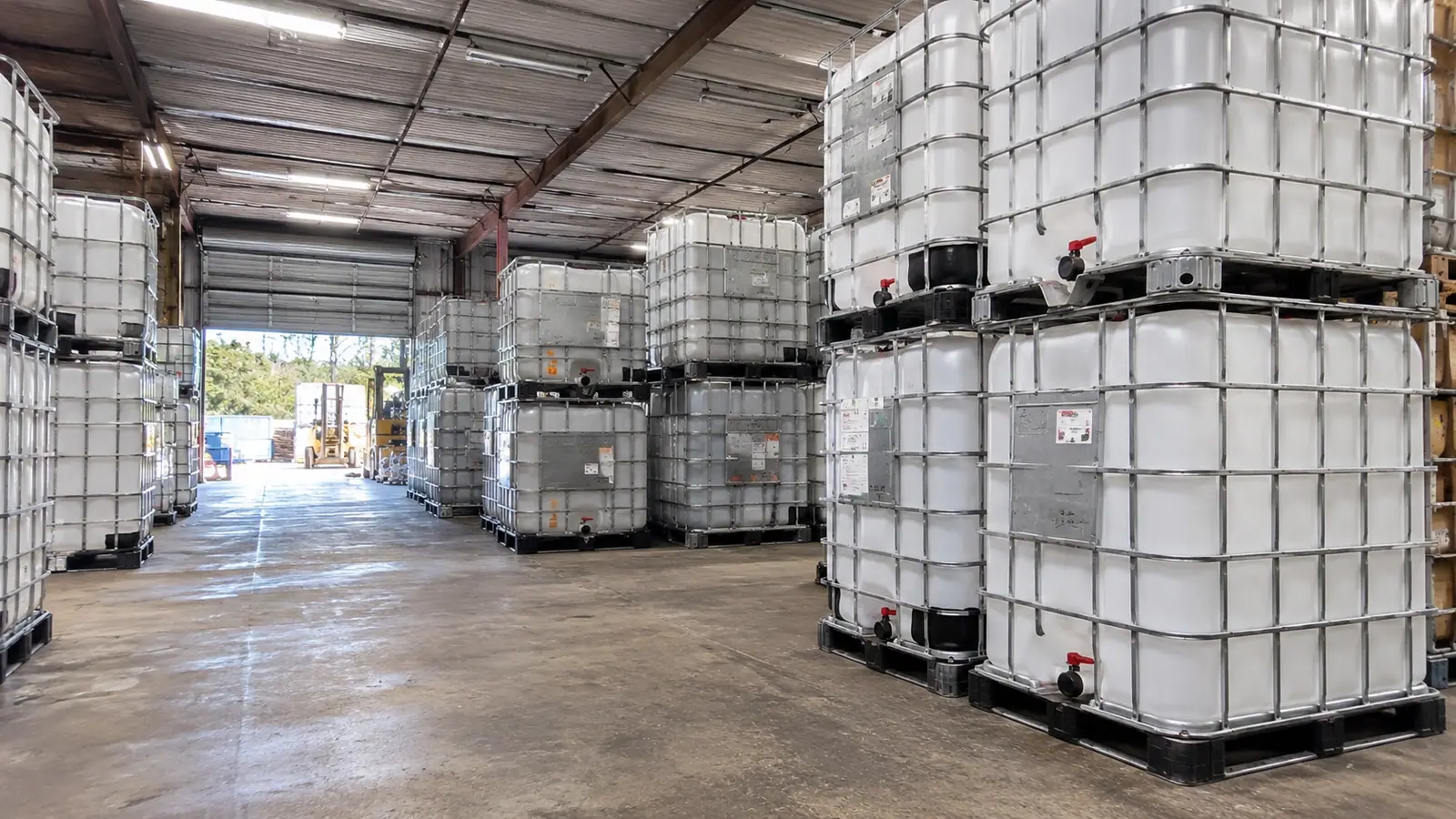
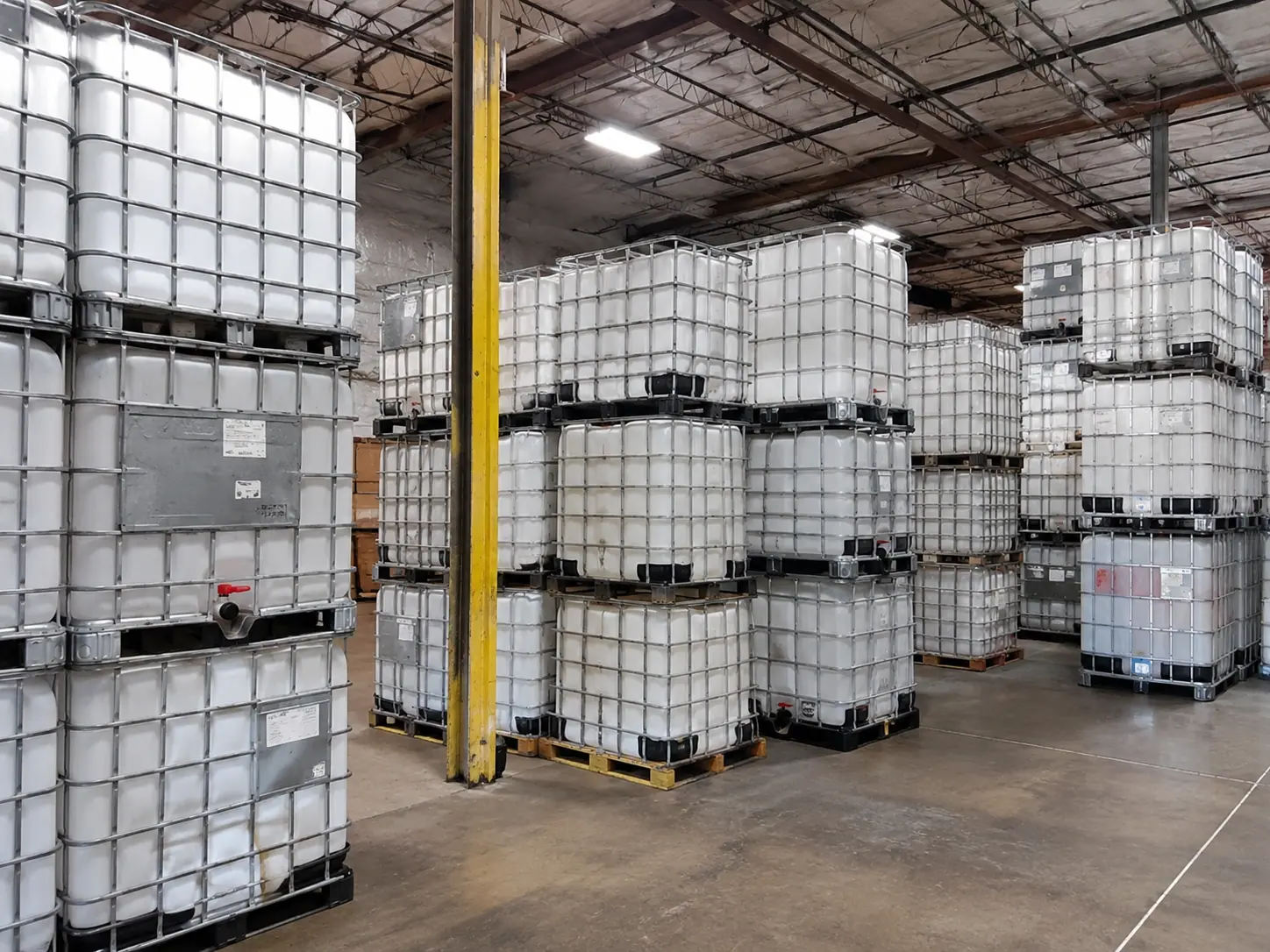
Rows of IBC totes stacked two and three high on pallets inside the Indianapolis warehouseFig. 2
Graded stock under roof, staged two and three high. Loaded units never stack more than two, and never while warm.
Nominal figures. Gross weight assumes water at 8.34 lb/gal — multiply by your cargo's specific gravity, then check it against the maximum permitted gross mass on the unit's own marking.
CapacityLitresFootprintHeightTareGross (water)Stack loaded
275 gal1,04148 × 40 in46 in≈140 lb≈2,435 lb2 high
330 gal1,24948 × 40 in53 in≈155 lb≈2,905 lb2 high
350 gal1,32548 × 40 in56 in≈165 lb≈3,075 lb2 high
120 gal45440 × 32 in38 in≈95 lb≈1,095 lb2 high
180 gal68142 × 36 in42 in≈115 lb≈1,616 lb2 high
550 gal2,08260 × 48 in60 in≈240 lb≈4,830 lb1 high

B / FITTINGS

What threads onto it

Fittings, threads and seat materials

S60x6 is a buttress thread that seals against a flat gasket face, not on the thread flanks. It is not interchangeable with NPT — forcing one into the other is the commonest hidden fault in used containers.
FittingSizeSeals bySeat optionsTypical service
S60x6 butterfly valve2 inFlat gasket faceEPDM, Viton, PTFEThe standard IBC outlet
S70x6 butterfly valve2 inFlat gasket faceEPDM, VitonEuropean and some 330 gal units
2 in NPT ball valve, poly2 inThread flanks + tapeEPDM, VitonRetrofits, metered dispensing
2 in NPT ball valve, stainless2 inThread flanks + tapePTFESolvents, pressure, hot cargo
3 in butterfly valve3 inFlat gasket faceEPDM, VitonViscous cargo, high flow
6 in fill cap6 inGasketed lidEPDM, siliconeVented or solid — choose deliberately
Camlock adapter, type C1.5 / 2 inCam arms + gasketBuna, VitonRepeated connect / disconnect
Bulkhead tap3/4 inBoth-side gasketsBrass, polyRain kits, site water
The valve body rarely fails. The seat does, and it is chosen by cargo rather than by price. Always verify against your specific concentration and temperature.
MaterialGood withAvoid withTemperatureCost
EPDMWater, acids, caustics, brine, ag-chemOils, fuels, aromatics-40 to 250 °FLow
Viton (FKM)Solvents, oils, fuels, aromaticsKetones, amines, hot steam-15 to 400 °FHigh
Nitrile (NBR)Oils, diesel, greases, hydraulicsOzone, strong oxidisers-30 to 250 °FLow
PTFE envelopeAlmost all chemistry, high purityNeeds very flat flange faces-100 to 450 °FHigh
SiliconeFood contact, wide temperatureSolvents, abrasion-60 to 450 °FMedium

C / COMPATIBILITY

Will HDPE hold it?

Sixteen cargo families, rated

HDPE is brilliant at most things and hopeless at a few. Where the answer is C, we will point you at stainless rather than sell you a container that will craze.
A = suitable, B = suitable with limits, C = not recommended in a composite IBC. Guidance only — verify against your own concentration and temperature.
Cargo familyHDPESeatNotes
Water, potable and non-potableAEPDM / siliconeFood-history units for potable
Acids and caustics, aqueousAEPDM / PTFEVent fuming cargo
Liquid fertiliser, UAN, NPKAEPDMSG up to 1.32 — check your lift-gate
Brine and chloride de-icerAEPDMHard on galvanising, kind to HDPE
Food syrups, oils, concentratesASilicone / VitonDocumented food history only
GlycolsAEPDMVery common; SG 1.04–1.11
AlcoholsAViton / PTFEFlammable — bond and vent
Diesel and gas oilBViton / NBRPermeates slowly over long storage
Mineral spiritsBVitonSwells HDPE slowly
Surfactants and detergentsBEPDMOdour fixation risk — dedicate units
Latex, adhesives, water-based paintAEPDMCures if left. Wash promptly.
Ketones, aromatics, chlorinated solventsC—Crazes HDPE. Stainless only.
Gasoline and low-conductivity fuelsC—Static risk. Steel or stainless.
Essential oils, flavour concentratesC—Fixes into the wall permanently. Never.
Hydrogen peroxide above 10%C—Decomposition and pressure risk
Dairy and hot-fill above 140 °FC—Needs CIP and steam. Stainless.

Permeation

Small non-polar molecules pass slowly through HDPE rather than attacking it. The bottle looks perfect and your cargo quietly leaves. It is a storage-duration problem: diesel for a week is fine, diesel for a year is not.

Crazing

Ketones, aromatics and chlorinated solvents cause fine surface cracking that propagates under stress. It is invisible until you hold the wall against a raking light, and it is a critical grading failure.

Odour fixation

Terpenes and some surfactants dissolve into the polymer itself rather than sitting on the surface. No wash removes them. This is why a food-grade tote has to have been a food tote from new.

A wide aisle inside the warehouse with IBC totes stacked on both sides and a roller door open at the far end
Compatibility decides where a container can go next. Everything in this aisle carries a written cargo history.

E / GRADING

A grade is a promise, not a mood

How every unit is scored

We publish the whole system because a grade without written criteria is just an opinion with a price tag. Nineteen points, fixed thresholds, one card per unit, seven years on file.
Every unit is scored against all nineteen. A single critical failure condemns the unit regardless of how the other eighteen score.
#PointCritical?
01Prior cargo declaration — present, written, specificYes
02Residual liquid — any volume at allYes
03Odour after wash — fixed odour by trained noseYes
04Bottle corner stress whiteningNo
05Interior scoring you can feelNo
06Interior crazing — fine surface crackingYes
07Bottle bulge or deformationYes
08Wall thickness at the thinnest pointYes
09Dome port condition and flange flatnessNo
10Outlet threads — cross-threading, chippingYes if crossed
11Valve function, full open and closeNo, replaceable
12Gasket condition — compression set, bloomNo, replaceable
13Cage squareness along the top railNo, pressable
14Cage weld integrity at tube intersectionsYes
15Cage coating and galvanising lossNo
16Pallet condition — cracked feet, rot, corrosionNo, replaceable
17Forklift pocket integrityNo
18UN marking legibility and dateNo, re-markable
19Leak test under our procedureYes

D / ORDERING

Commercial terms, up front

Lead times, minimums and what happens when it goes wrong

Discovering these at invoice stage is nobody's idea of a good relationship, so they are published.
Published so nothing arrives as a surprise at invoice stage. Prices themselves move weekly with resin, scrap steel and freight, which is why we do not publish a list.
ItemDetail
Minimum orderOne unit. No account minimum, no membership.
Stock lead timeGrade A and B 275 gal usually ship the same week
Rebottled lead time2–3 weeks, built to order in bay D
Food-grade lead time1–3 weeks when stock exists; supply-dependent
Full truckload45 on a 48 ft flat, 48 in a 53 ft van, 90 empties double-stacked
Payment, first orderPrepay by ACH or card
Payment, establishedNet 30 on credit approval
Grade guaranteeRegrade or replace, our freight both ways, 14 days
Leak warranty30 days from delivery, normal atmospheric service
CancellationFree until the truck is loaded
Returns14 days on unused stock units, freight at your cost
Sales taxIndiana resale certificates and out-of-state equivalents accepted

F / END OF LIFE

Reuse first, recycle last

What happens when the container is finally finished

Every unit that arrives is assessed down this list, in this order. 99.4% of incoming mass avoided landfill in 2024, and reuse plus repair accounted for over three quarters of it.
Assessed in this order, per unit, every time. The granulator is the fourth choice, not the first. 2024 figures against 2,994,000 lb of inbound mass.
StepOutcomeShare of massCost to us
01Reuse as is — wash and redeploy63.9%11 gal of mostly reclaimed water
02Repair and reuse — valve, gasket, pallet, cage11.4%Parts and bench time
03Rebottle — new bottle, reclaimed steel9.6%A new bottle, two thirds of mass retained
04Upcycle — rain kits, grow beds, wash stations3.2%Fabrication time
05Material recovery — HDPE regrind, steel, wood11.3%Grinding, washing, drying energy
06Residual to licensed disposal0.6%Sludge, gasket rubber, fasteners, laminates
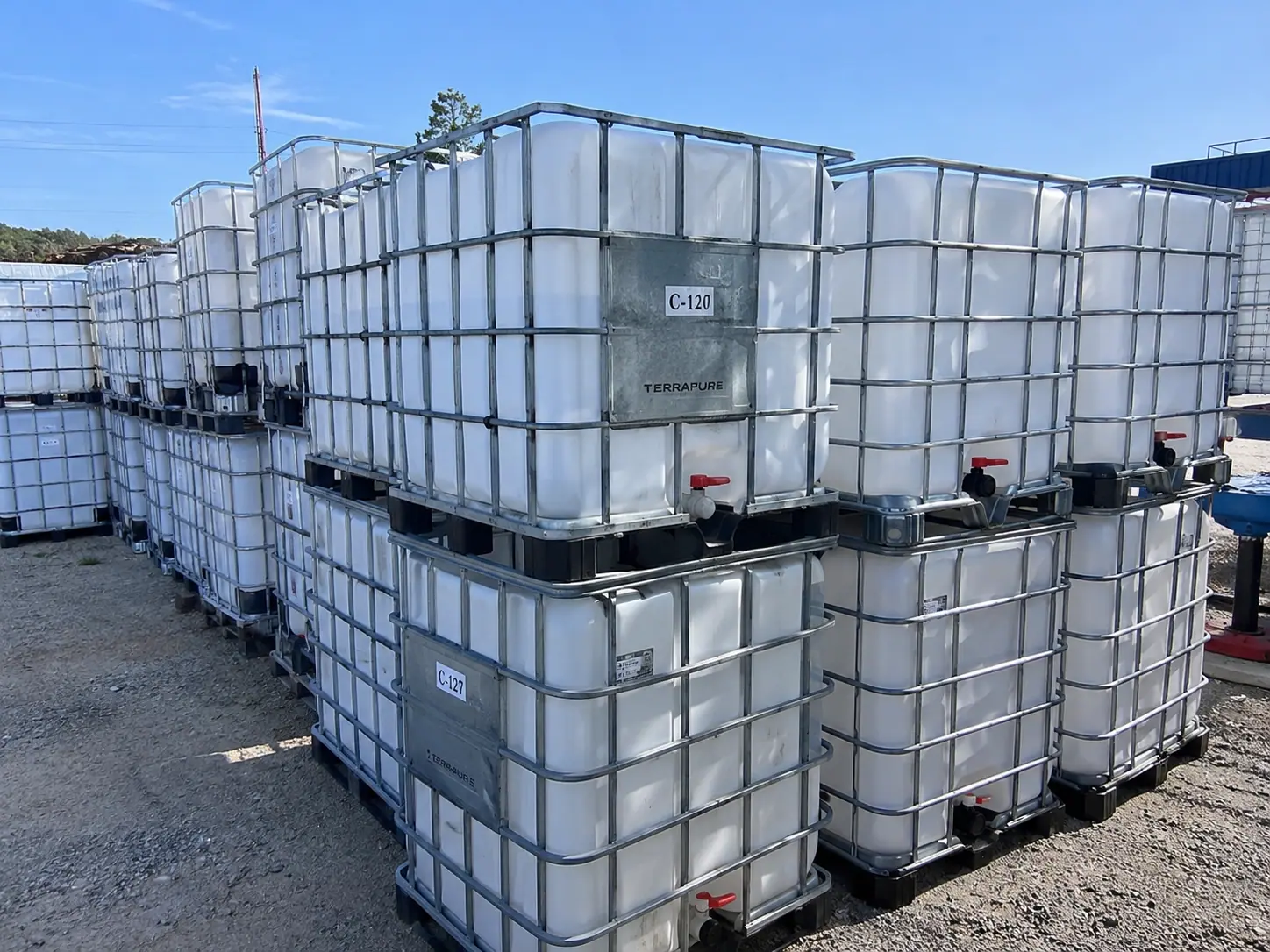
Stacks of used IBC totes under a clear blue sky on the gravel pad, awaiting grading
Inbound. Nothing comes off the trailer before its cargo declaration is read.
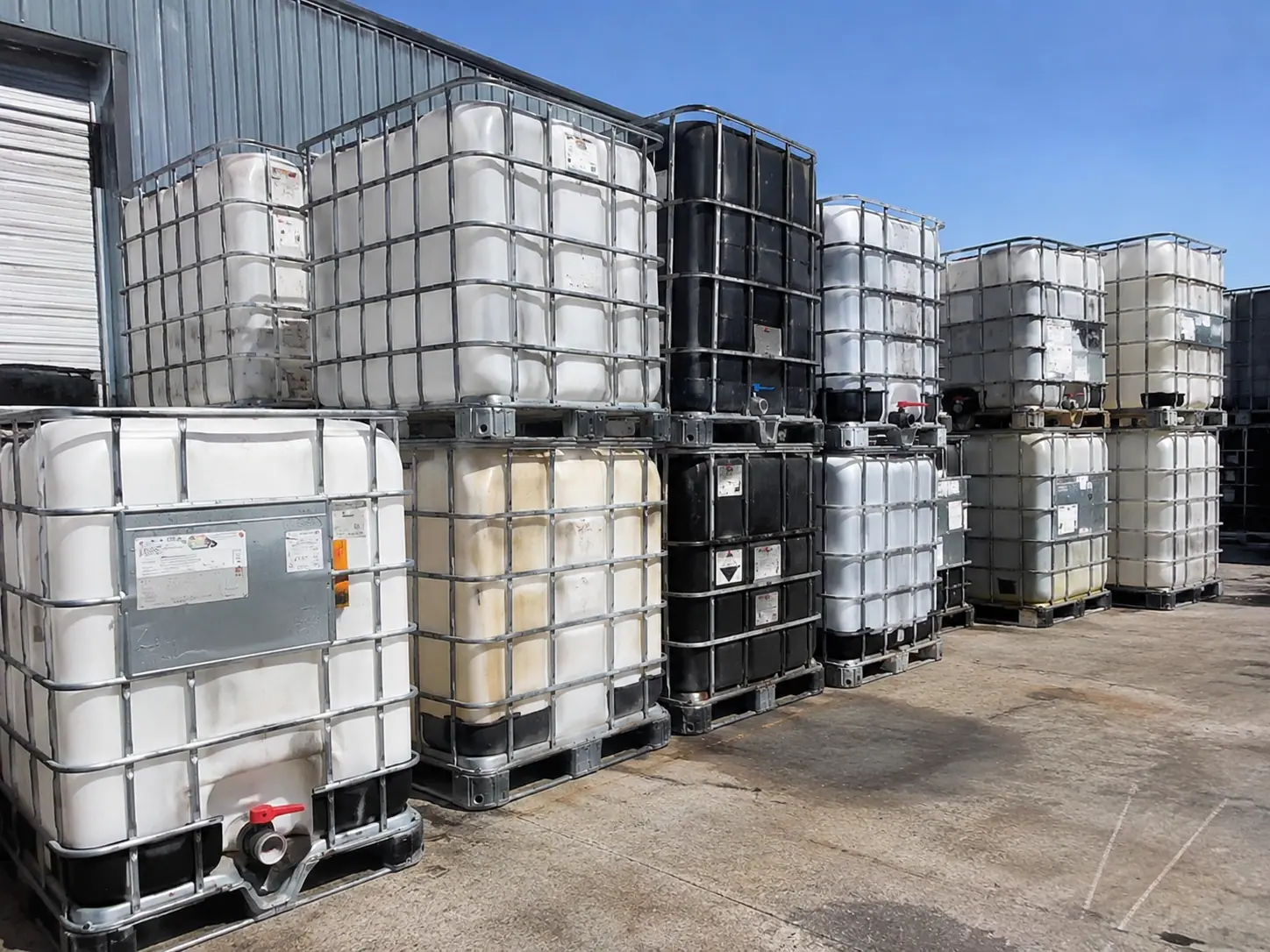
Mixed white and black IBC totes staged beside the loading dock doors
Graded and sorted. Black bottles are UV-stable units destined for outdoor service.
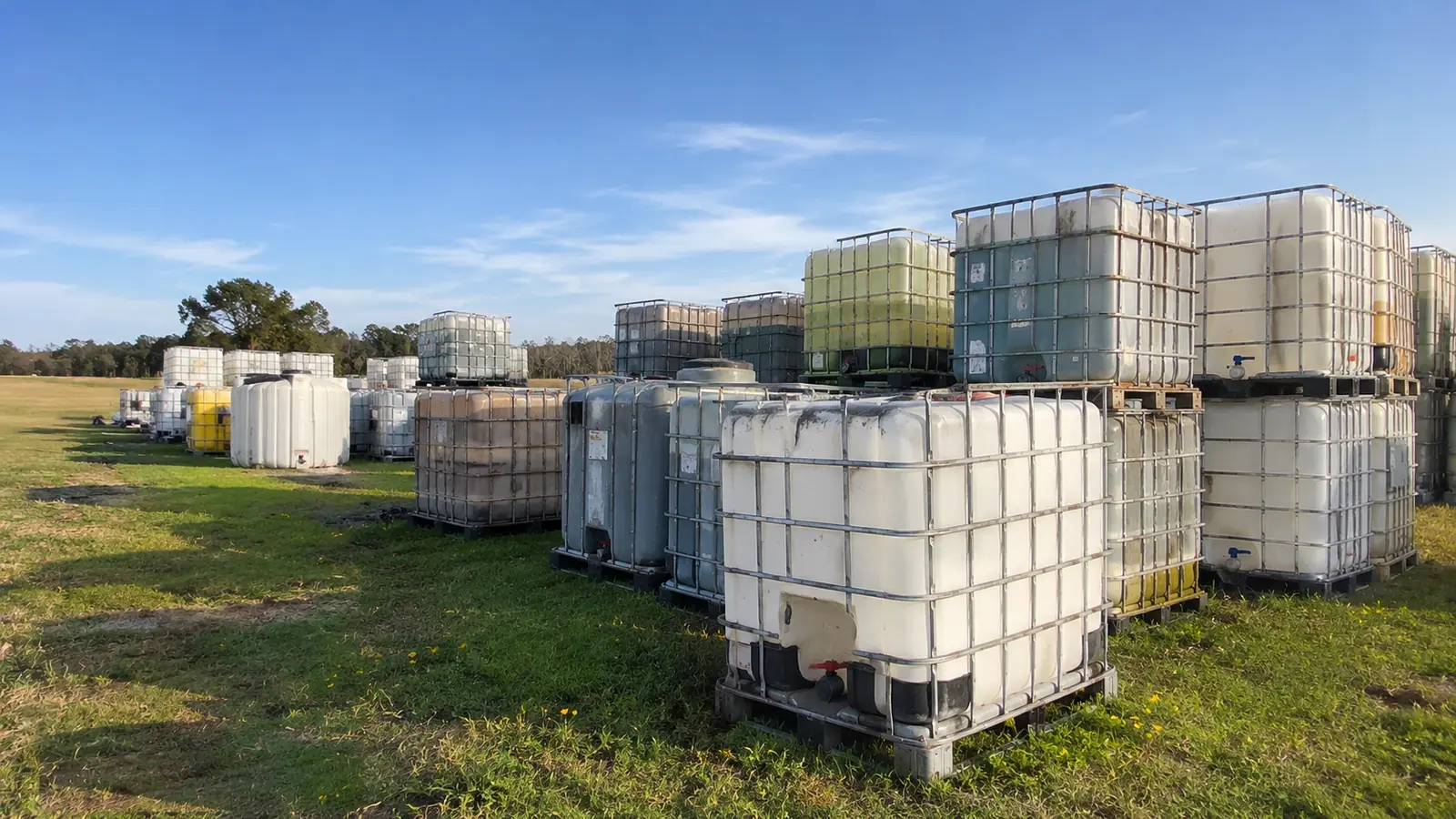
A wide field of IBC totes standing on grass under a blue sky, waiting to be collected
Recovered from a customer yard. Every one of these avoided a crusher.

From reading to ordering

Put it to work.

Quantity, grade and delivery ZIP in the form above gets you a delivered price tomorrow.
Use the form aboveAll posts
Get a quote