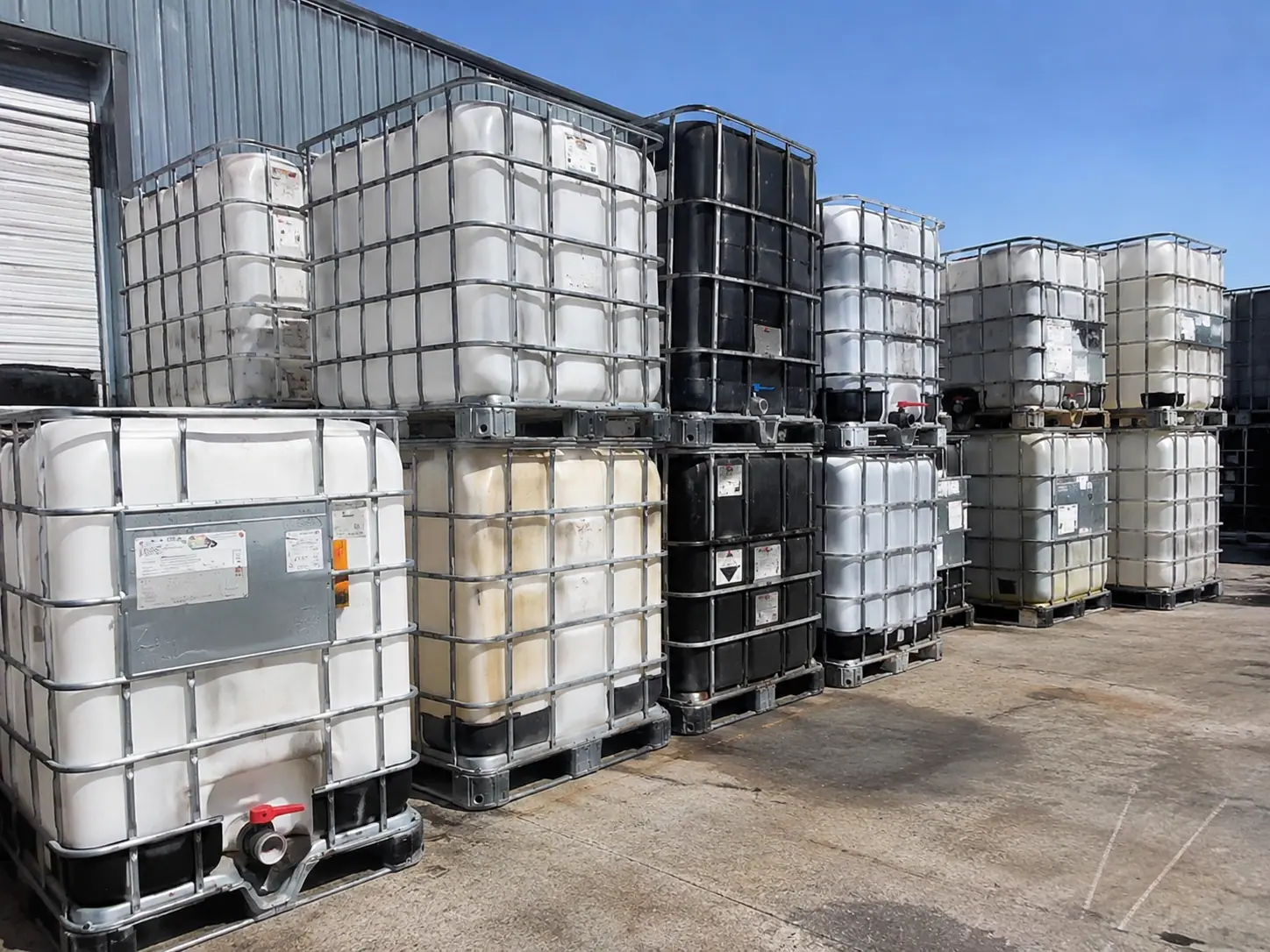
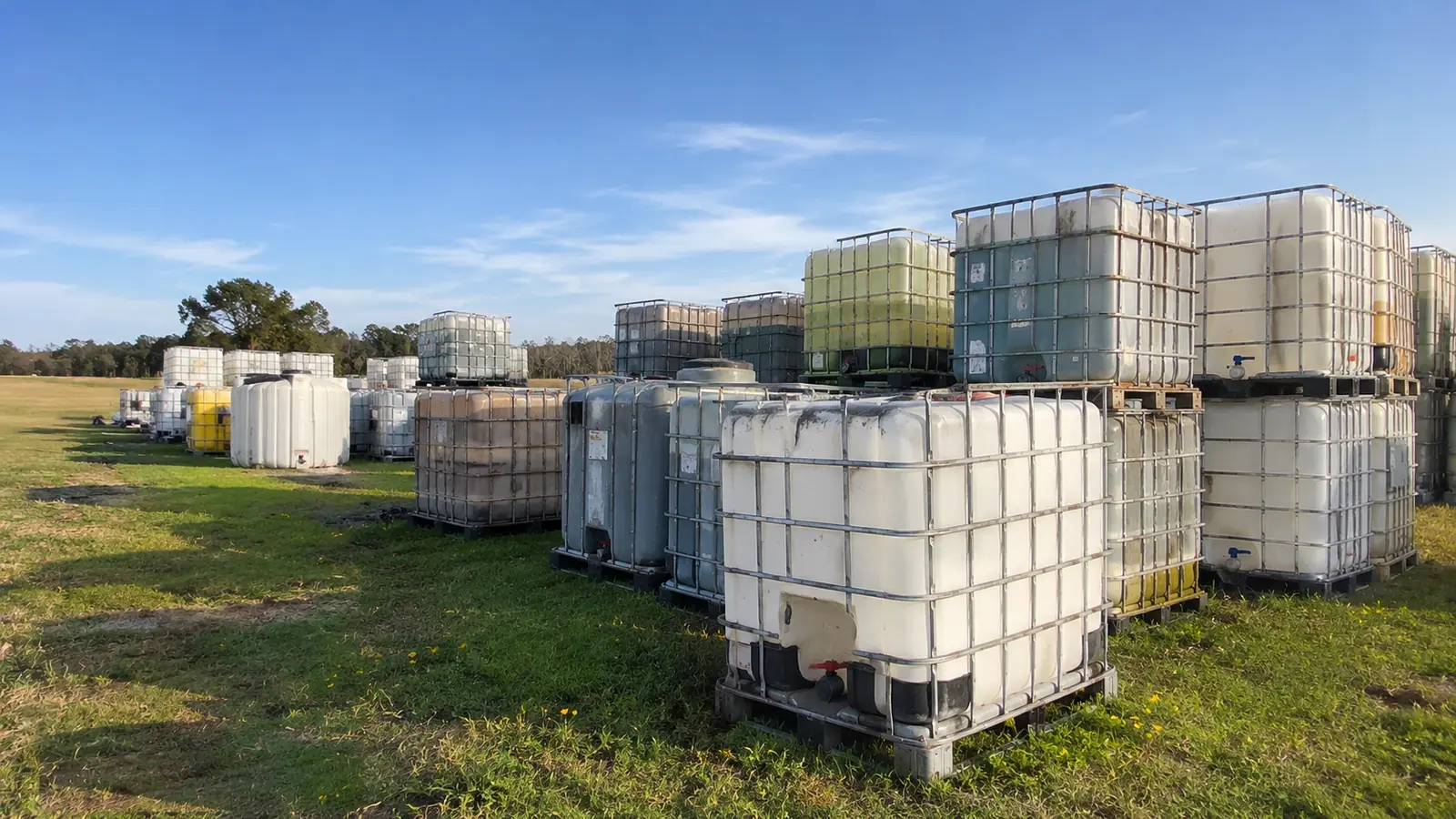
Molasses, liquid sugar, heavy oils and some resins will not flow out of a tote in February. Heating them is routine, and it is also the application where people most frequently damage a container — because HDPE stops being structural long before it melts.
The temperatures that matter
- Up to 120 °F: continuous service, no concern.
- 120 to 140 °F: short-term only. Do not stack, do not move while warm.
- Above 140 °F: the wall softens materially and creep accelerates. You are outside sensible composite IBC territory.
- Localised hot spots: dangerous at any bulk temperature. A band heater in direct contact with a dry wall can take a small area far above the bulk figure.
The failure mode is almost never a dramatic melt. It is creep: the warm wall deforms slowly under the weight of the cargo, bulges between the cage bars, and does not fully return when it cools.
The three heating methods
Band heaters
A heated band wrapped around the lower portion of the tote, usually 120 V or 240 V. They are cheap and effective and they are also the method most likely to cause damage, because they concentrate heat into a narrow strip.
Two rules: always use a thermostat, and never run a band heater against a dry wall. If the liquid level is below the band, the heat has nothing to conduct into and the wall takes it all.
Full-wrap insulating jackets
A jacket that surrounds the whole tote, with distributed heating elements and a controller. More expensive, considerably safer, and much faster in practice because you are heating the whole mass rather than a strip and waiting for convection.
For anything you heat regularly, this is the correct tool. A jacket with a decent controller set low and left for hours beats a band heater set high and watched for minutes, every time.
Hot room
If you heat a lot of totes, a warm room at 100 to 110 °F overnight is the gentlest method available and uses no equipment attached to the container at all. Slow, uniform, and essentially impossible to get wrong.
Things not to do
- No open flame. Ever, near HDPE, for any reason.
- No steam lance into the bottle. Steam is well above the softening point.
- No heating a frozen or solid tote fast. You will melt the wall next to the heater long before the core moves.
- No stacking warm units. This is where most creep damage originates.
- No moving a hot full tote. The cage is carrying load through a softened wall. Let it cool.
Help the heat with geometry
Viscous cargo conducts heat badly, so the material next to the heater warms while the core stays solid. Two things help enormously:
Circulate. Draw from the outlet and return through the lid with a pump rated for the viscosity. Even gentle circulation transforms the heating time, because you are moving warm material into the cold mass instead of waiting for conduction.
Heat trace the discharge. The commonest complaint is not that the tote will not warm, it is that the product congeals in the valve and the hose on the way out. A heat-traced discharge line solves a problem that no amount of tote heating will.
Which unit to buy for heated duty
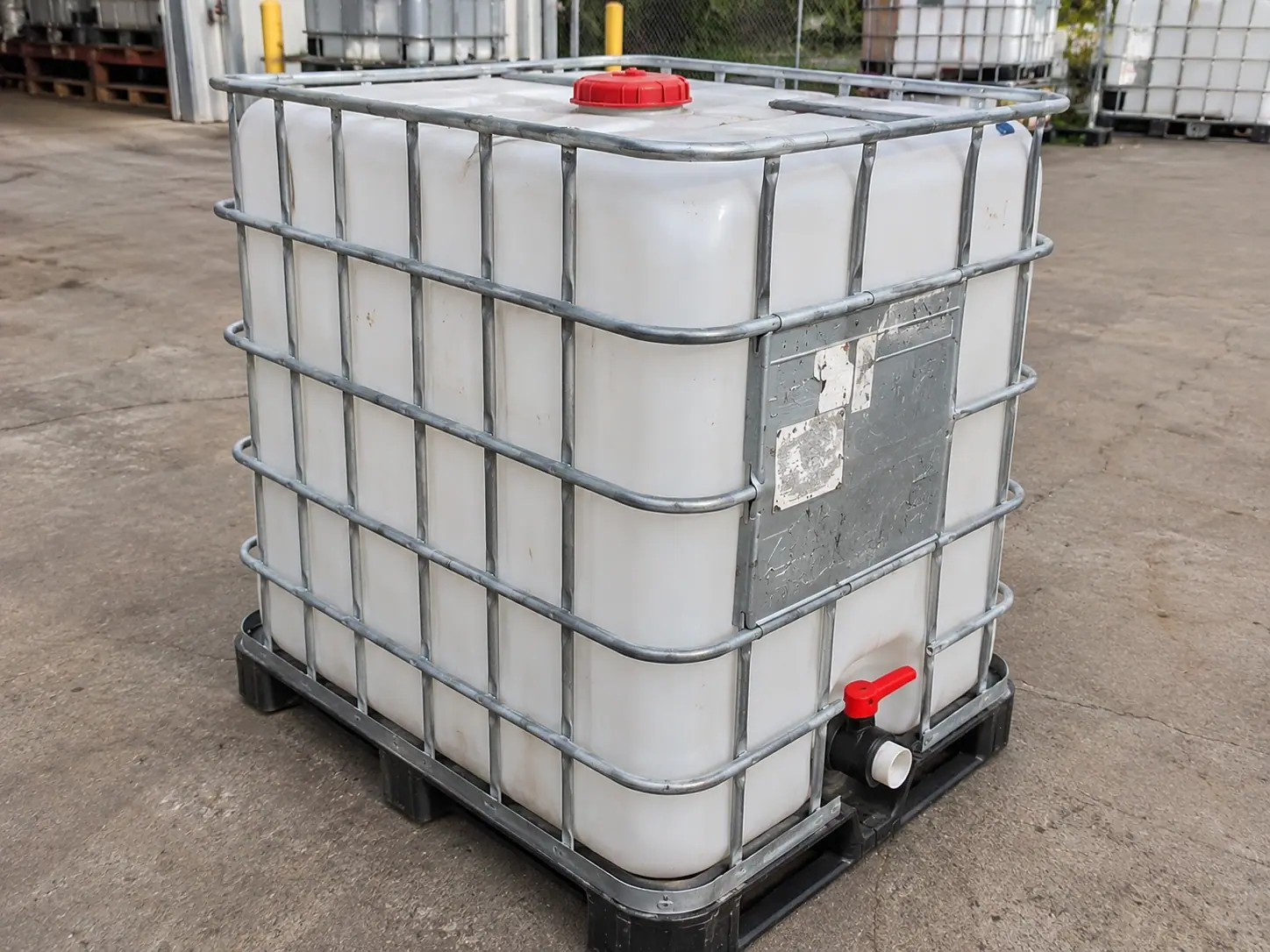
Grade B or better, with a sound cage — the frame is doing more work than usual here. Steel pallet rather than plastic, since plastic feet soften too. A vented lid unless the cargo demands otherwise, because heating a sealed container raises pressure as well as temperature.
If you heat above 140 °F routinely, buy stainless. It takes steam, takes pressure, and has no creep behaviour worth worrying about in this range. The cost-per-trip comparison is in HDPE vs stainless.
We stock band heaters, jackets and heat-traced discharge kits — all on the accessories page.
Viscosity and temperature, roughly
Most viscous cargoes thin dramatically with modest heating — the relationship is exponential rather than linear, which is why a small temperature rise produces a disproportionate improvement in flow.
Molasses at 50 °F is close to unpumpable; at 100 °F it moves readily; at 120 °F it pours. You do not need to get anywhere near the limits of HDPE to transform the handling, which is the useful insight. The temptation is to push the temperature because flow improves, and the correct approach is to find the lowest temperature that works and stop there.
Time versus temperature
A full 275 gallon tote is roughly a tonne of material with poor thermal conductivity. Heating it uniformly is a matter of hours regardless of how much power you apply, because the limiting factor is conduction through the cargo rather than energy input.
Which means applying more power does not heat it faster — it heats the material adjacent to the heater faster, while the core stays cold. That is precisely the failure mode: a softened wall next to a heater and a solid core in the middle.
Plan for overnight. A jacket at a modest setting for twelve hours beats a band heater at maximum for three, every time, and it will not damage the container.
Circulation changes everything
If you can move the cargo, you can halve the heating time. Draw from the outlet and return through the lid, and you are transporting warm material into the cold mass rather than waiting for it to conduct.
The practical difficulty is that a viscous cold cargo is hard to pump, which is the problem you are trying to solve. The usual approach is to warm enough to get flow started — a jacket for a few hours — then start circulating, at which point the process accelerates sharply.
A progressive cavity or lobe pump handles viscosity far better than a diaphragm pump. If you do this routinely, the pump choice matters more than the heater choice.
Heat tracing the discharge, which is the real fix
The commonest complaint is not that the tote will not warm. It is that the product congeals in the valve and the first few feet of hose on the way out, and then nothing moves regardless of how warm the tote is.
A heat-traced discharge line with insulation solves a problem that no amount of tote heating addresses. For sugar syrups, molasses and heavy oils it is frequently the only thing you actually need. It is also considerably cheaper than a full jacket.
Thermostats and the sensor position
Every heater needs a thermostat, and where the sensor sits determines whether the thermostat protects anything.
A sensor on the heater measures the heater. A sensor on the outside of the bottle, under the insulation but away from the element, measures something much closer to the wall temperature you care about. That second position is what you want, and it is routinely got wrong.
Set the limit by what the wall tolerates, not by what the cargo wants. Those are different numbers and the wall is the one that fails.
The cage carries more load when the wall is warm
Worth being explicit about. A warm bottle transfers more of its load to the cage, because the wall is less able to hold its own shape. That has three consequences:
- Do not stack a warm tote, or anything on top of one.
- Do not move a hot full tote. Let it cool first.
- Buy units with sound, square cages for heated duty. This is not a Grade C application.
When to stop using composite
If your process routinely needs more than about 140 °F, stop fighting it. Stainless takes steam, takes pressure, has no meaningful creep behaviour in that range and can be jacketed properly for steady heated service.
The cost-per-trip comparison is in HDPE vs stainless, and the practical upshot is that heated duty is one of the applications where stainless earns its price fastest. Band heaters, jackets and heat-traced kits for everything below that threshold are on the accessories page.