Carbon math
Show the working, or do not make the claim.
TABLE 01
Step 1 — mass inventory of a new 275 gallon composite IBC
| Component | Material | Mass | Share |
|---|---|---|---|
| Bottle | Virgin HDPE | 40 lb | 28.6% |
| Cage | Galvanised tubular steel | 75 lb | 53.6% |
| Pallet | Composite, steel + plastic | 22 lb | 15.7% |
| Valve, lid, gaskets | PP, EPDM | 3 lb | 2.1% |
| Total tare | — | 140 lb | 100% |
TABLE 02
Step 2 — manufacturing intensities applied
| Material | Intensity used | Range in literature | Why this value |
|---|---|---|---|
| Virgin HDPE | 1.9 kg CO₂e / kg | 1.8 – 2.6 | Low end of range, North American resin |
| Galvanised steel tube | 1.9 kg CO₂e / kg | 1.8 – 3.1 | Low end, includes galvanising |
| Composite pallet | 1.6 kg CO₂e / kg | 1.4 – 2.4 | Mixed-material estimate |
| Polypropylene fittings | 1.9 kg CO₂e / kg | 1.7 – 2.3 | Low end of range |
| Moulding and assembly energy | Included in above | — | Gate figures already include conversion |
TABLE 03
Step 3 — the new-unit baseline
| Component | Mass (kg) | × intensity | CO₂e (kg) | CO₂e (lb) |
|---|---|---|---|---|
| Bottle | 18.1 | 1.9 | 34.4 | 76 |
| Cage | 34.0 | 1.9 | 64.6 | 142 |
| Pallet | 10.0 | 1.6 | 16.0 | 35 |
| Fittings | 1.4 | 1.9 | 2.7 | 6 |
| Baseline total | 63.5 | — | 117.7 | 259 |
TABLE 04
Step 4 — the wash-cycle burden subtracted
| Input | Quantity per unit | CO₂e (lb) | Note |
|---|---|---|---|
| Fresh water | 1.5 gal | 0.1 | 86% of line draw is reclaimed |
| Thermal energy, caustic heating | — | 11.4 | Natural gas, metered per batch |
| Electricity, pumps and air | — | 4.6 | Indiana grid mix |
| Caustic chemistry | — | 2.1 | Consumption logged per batch |
| Sludge disposal | — | 0.6 | Dewatered, licensed handler |
| Wash burden total | — | 18.8 | Subtracted from baseline |
| Published net saving | — | ≈240 | 259 − 19, rounded down |
TABLE 05
Step 5 — water and landfill figures
| Figure | Value | Derivation |
|---|---|---|
| Process water avoided | 290 gal | Resin and steel production water, less 11 gal wash draw |
| Virgin HDPE avoided | 52 lb | 40 lb bottle + 12 lb attributable moulding scrap and purge |
| Landfill mass avoided | 168 lb | 140 lb tare + 28 lb typical packaging and dunnage |
| Rebottled variant | 118 lb CO₂e | Baseline less the new bottle's 76 lb, less wash burden |
| Recycled variant | 96 lb CO₂e | Avoided virgin resin credit, less grinding and washing burden |
EXCLUSIONS
The honest part
What we exclude, and why
| Excluded | Reason | Effect on our figure |
|---|---|---|
| Freight to customer | Depends entirely on your lane | Would reduce savings; we exclude both baselines equally |
| Freight of inbound empties | Usually paired with outbound delivery | Small; conservatively ignored |
| End-of-life credit for the avoided new unit | Double counting risk | Would increase our figure; excluded |
| Capital equipment amortisation | Spread across 180,000+ units | Negligible per unit |
| Office and administrative energy | Not attributable per unit | Negligible |
| Carbon in the cargo | Not ours to count | Out of scope entirely |
NOTES
Four principles we hold to
- Use the low end of every range. Where literature gives 1.8 to 2.6 kg CO₂e per kg of HDPE, we use 1.8 to 1.9. Our savings figures are therefore understated, which is the correct direction for a company selling the saving.
- Subtract our own burden. The wash cycle costs energy, water and chemistry. It comes off the figure before we publish it. A saving that ignores the cost of achieving it is not a saving.
- No credits, no offsets, no removals. Everything here is avoided impact. We do not buy credits and we do not describe anything we sell as neutral.
- Publish the exclusions. Any carbon claim can be improved by quietly dropping an inconvenient boundary. Listing ours is the only defence against doing that accidentally.
Review cycle
This page is reviewed every January against the previous year's metered energy, water and chemistry consumption, and against any updated published intensity figures. When a number changes, we change it here and note the change — we do not retroactively improve old claims.
F / END OF LIFE
Reuse first, recycle last
What happens when the container is finally finished
| Step | Outcome | Share of mass | Cost to us |
|---|---|---|---|
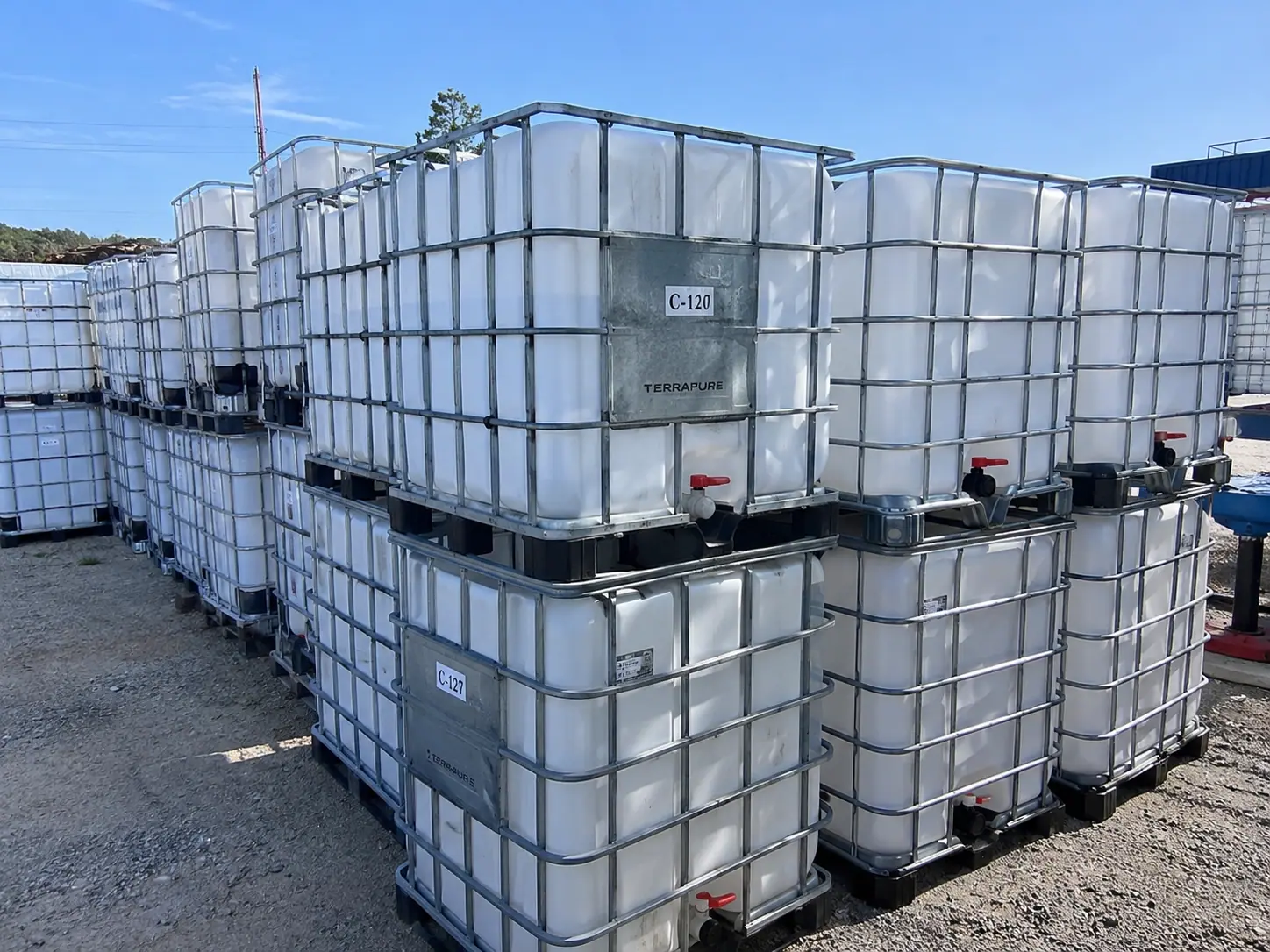
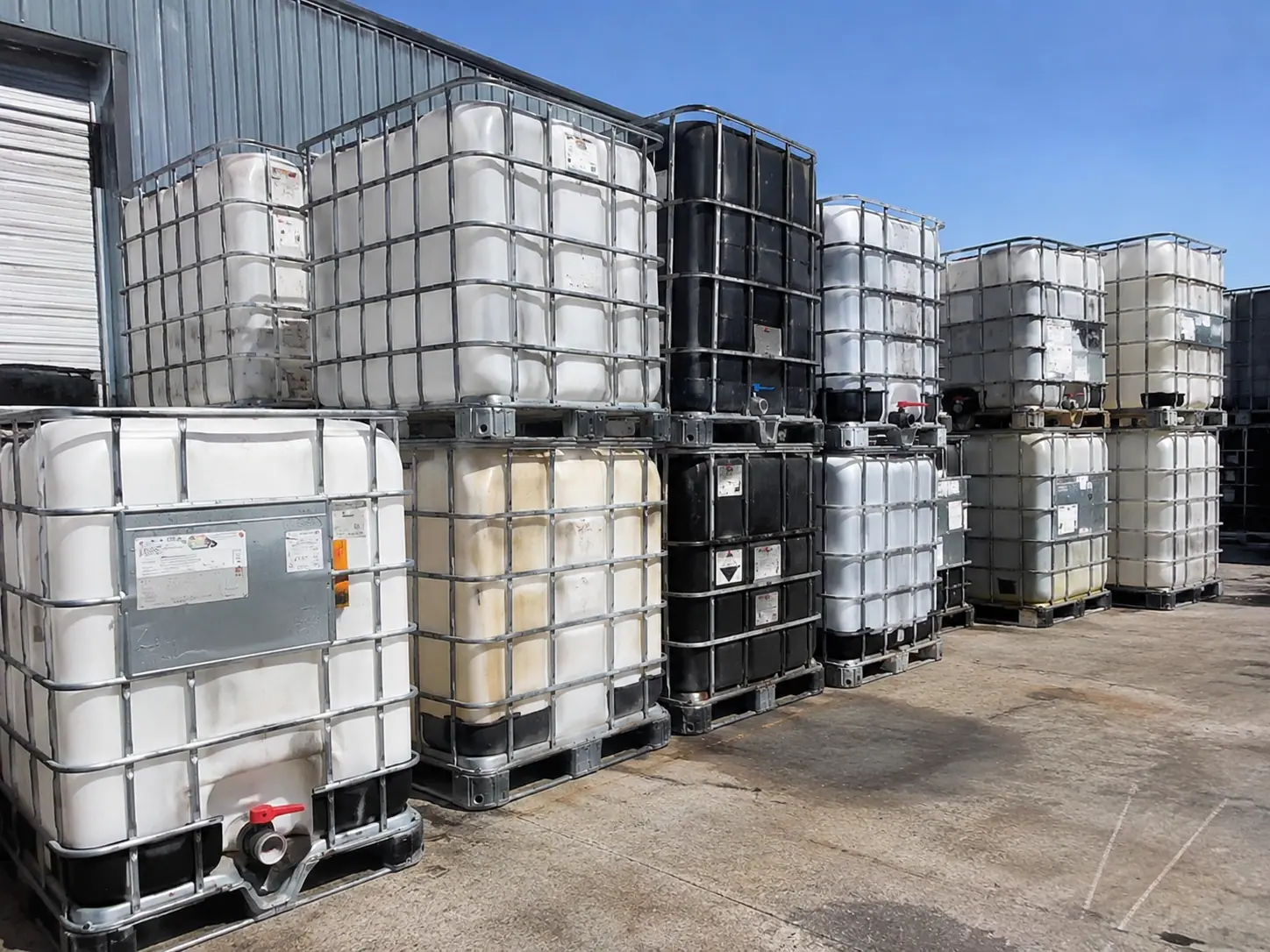
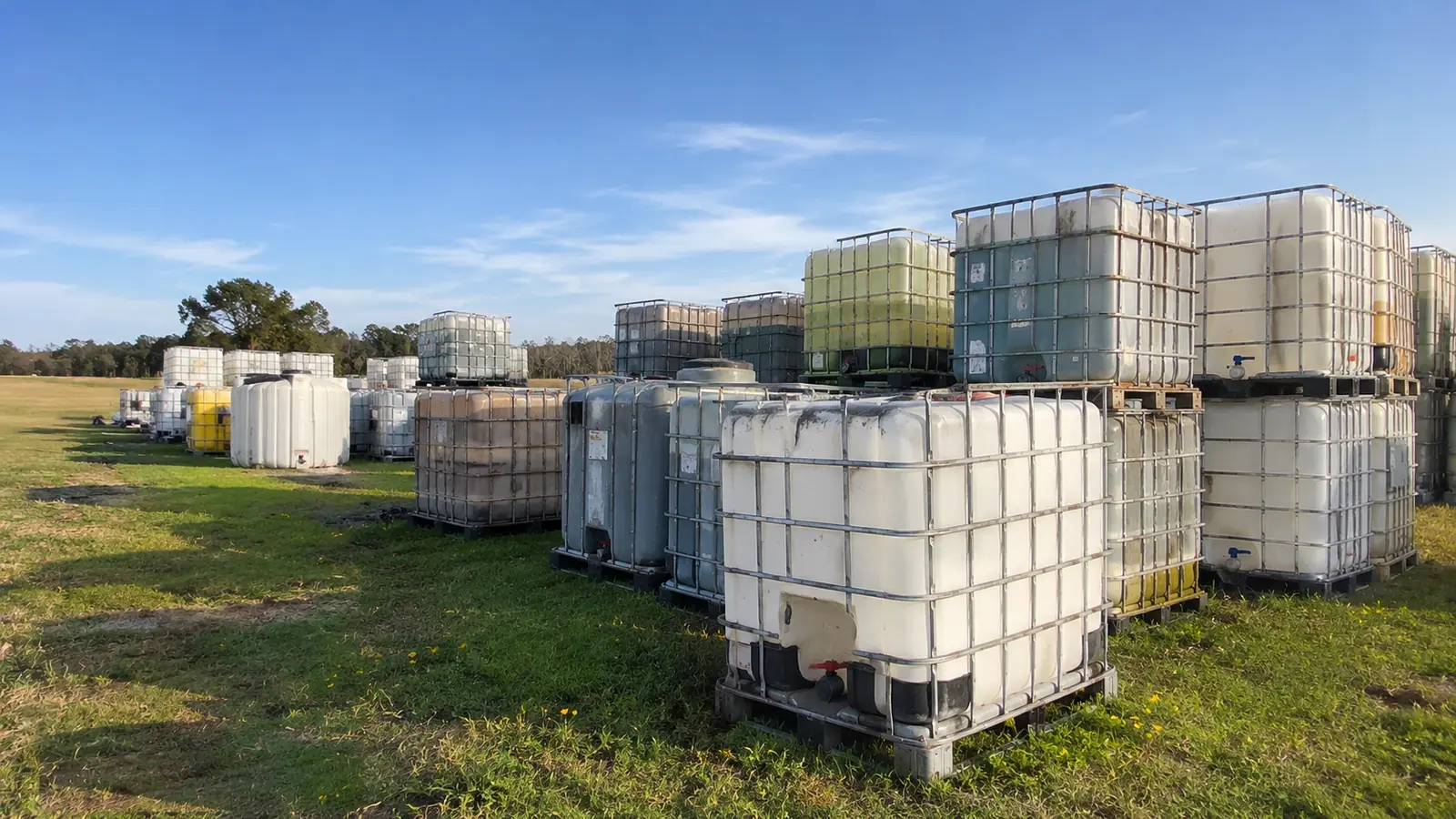
| 01 | Reuse as is — wash and redeploy | 63.9% | 11 gal of mostly reclaimed water |
| 02 | Repair and reuse — valve, gasket, pallet, cage | 11.4% | Parts and bench time |
| 03 | Rebottle — new bottle, reclaimed steel | 9.6% | A new bottle, two thirds of mass retained |
| 04 | Upcycle — rain kits, grow beds, wash stations | 3.2% | Fabrication time |
| 05 | Material recovery — HDPE regrind, steel, wood | 11.3% | Grinding, washing, drying energy |
| 06 | Residual to licensed disposal | 0.6% | Sludge, gasket rubber, fasteners, laminates |
E / GRADING
A grade is a promise, not a mood
How every unit is scored
| # | Point | Critical? |
|---|---|---|
| 01 | Prior cargo declaration — present, written, specific | Yes |
| 02 | Residual liquid — any volume at all | Yes |
| 03 | Odour after wash — fixed odour by trained nose | Yes |
| 04 | Bottle corner stress whitening | No |
| 05 | Interior scoring you can feel | No |
| 06 | Interior crazing — fine surface cracking | Yes |
| 07 | Bottle bulge or deformation | Yes |
| 08 | Wall thickness at the thinnest point | Yes |
| 09 | Dome port condition and flange flatness | No |
| 10 | Outlet threads — cross-threading, chipping | Yes if crossed |
| 11 | Valve function, full open and close | No, replaceable |
| 12 | Gasket condition — compression set, bloom | No, replaceable |
| 13 | Cage squareness along the top rail | No, pressable |
| 14 | Cage weld integrity at tube intersections | Yes |
| 15 | Cage coating and galvanising loss | No |
| 16 | Pallet condition — cracked feet, rot, corrosion | No, replaceable |
| 17 | Forklift pocket integrity | No |
| 18 | UN marking legibility and date | No, re-markable |
| 19 | Leak test under our procedure | Yes |
A / SPECIFICATION
Reference
Dimensions, fittings and seat materials
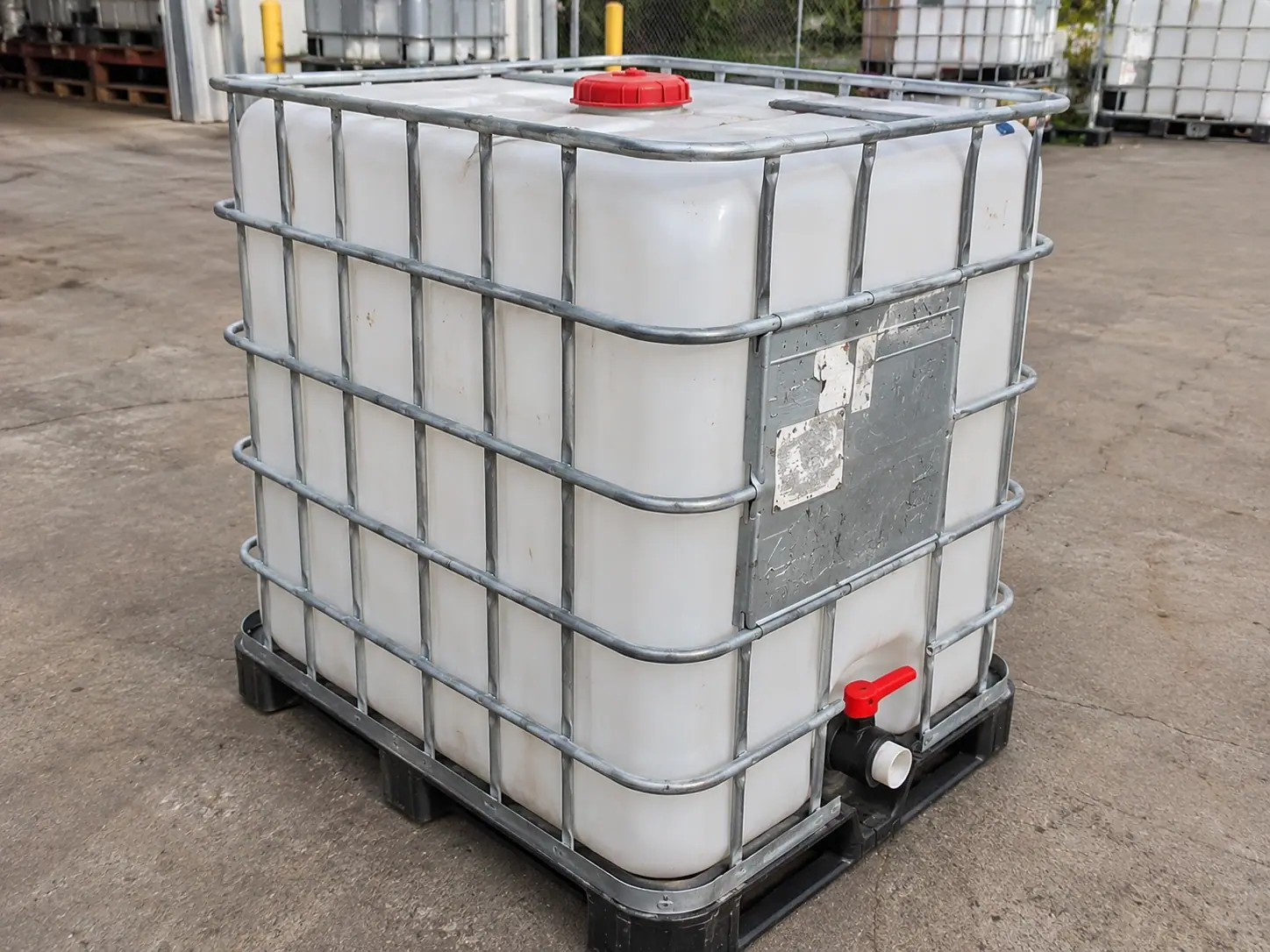 Fig. 1
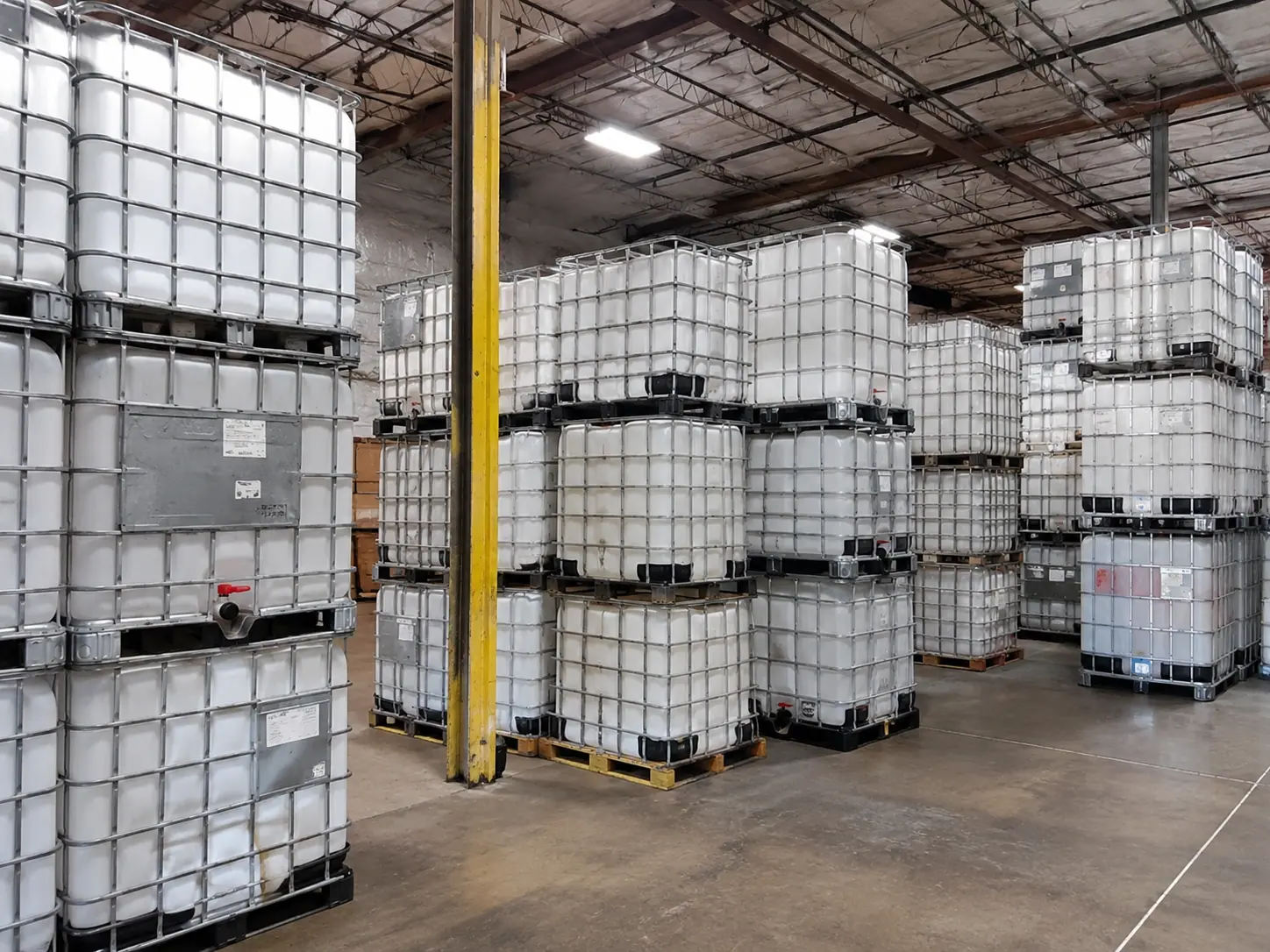 Fig. 2
| Capacity | Litres | Footprint | Height | Tare | Gross (water) | Stack loaded |
|---|---|---|---|---|---|---|
| 275 gal | 1,041 | 48 × 40 in | 46 in | ≈140 lb | ≈2,435 lb | 2 high |
| 330 gal | 1,249 | 48 × 40 in | 53 in | ≈155 lb | ≈2,905 lb | 2 high |
| 350 gal | 1,325 | 48 × 40 in | 56 in | ≈165 lb | ≈3,075 lb | 2 high |
| 120 gal | 454 | 40 × 32 in | 38 in | ≈95 lb | ≈1,095 lb | 2 high |
| 180 gal | 681 | 42 × 36 in | 42 in | ≈115 lb | ≈1,616 lb | 2 high |
| 550 gal | 2,082 | 60 × 48 in | 60 in | ≈240 lb | ≈4,830 lb | 1 high |
B / FITTINGS
What threads onto it
Fittings, threads and seat materials
| Fitting | Size | Seals by | Seat options | Typical service |
|---|---|---|---|---|
| S60x6 butterfly valve | 2 in | Flat gasket face | EPDM, Viton, PTFE | The standard IBC outlet |
| S70x6 butterfly valve | 2 in | Flat gasket face | EPDM, Viton | European and some 330 gal units |
| 2 in NPT ball valve, poly | 2 in | Thread flanks + tape | EPDM, Viton | Retrofits, metered dispensing |
| 2 in NPT ball valve, stainless | 2 in | Thread flanks + tape | PTFE | Solvents, pressure, hot cargo |
| 3 in butterfly valve | 3 in | Flat gasket face | EPDM, Viton | Viscous cargo, high flow |
| 6 in fill cap | 6 in | Gasketed lid | EPDM, silicone | Vented or solid — choose deliberately |
| Camlock adapter, type C | 1.5 / 2 in | Cam arms + gasket | Buna, Viton | Repeated connect / disconnect |
| Bulkhead tap | 3/4 in | Both-side gaskets | Brass, poly | Rain kits, site water |
| Material | Good with | Avoid with | Temperature | Cost |
|---|---|---|---|---|
| EPDM | Water, acids, caustics, brine, ag-chem | Oils, fuels, aromatics | -40 to 250 °F | Low |
| Viton (FKM) | Solvents, oils, fuels, aromatics | Ketones, amines, hot steam | -15 to 400 °F | High |
| Nitrile (NBR) | Oils, diesel, greases, hydraulics | Ozone, strong oxidisers | -30 to 250 °F | Low |
| PTFE envelope | Almost all chemistry, high purity | Needs very flat flange faces | -100 to 450 °F | High |
| Silicone | Food contact, wide temperature | Solvents, abrasion | -60 to 450 °F | Medium |
C / COMPATIBILITY
Will HDPE hold it?
Sixteen cargo families, rated
| Cargo family | HDPE | Seat | Notes |
|---|---|---|---|
| Water, potable and non-potable | A | EPDM / silicone | Food-history units for potable |
| Acids and caustics, aqueous | A | EPDM / PTFE | Vent fuming cargo |
| Liquid fertiliser, UAN, NPK | A | EPDM | SG up to 1.32 — check your lift-gate |
| Brine and chloride de-icer | A | EPDM | Hard on galvanising, kind to HDPE |
| Food syrups, oils, concentrates | A | Silicone / Viton | Documented food history only |
| Glycols | A | EPDM | Very common; SG 1.04–1.11 |
| Alcohols | A | Viton / PTFE | Flammable — bond and vent |
| Diesel and gas oil | B | Viton / NBR | Permeates slowly over long storage |
| Mineral spirits | B | Viton | Swells HDPE slowly |
| Surfactants and detergents | B | EPDM | Odour fixation risk — dedicate units |
| Latex, adhesives, water-based paint | A | EPDM | Cures if left. Wash promptly. |
| Ketones, aromatics, chlorinated solvents | C | — | Crazes HDPE. Stainless only. |
| Gasoline and low-conductivity fuels | C | — | Static risk. Steel or stainless. |
| Essential oils, flavour concentrates | C | — | Fixes into the wall permanently. Never. |
| Hydrogen peroxide above 10% | C | — | Decomposition and pressure risk |
| Dairy and hot-fill above 140 °F | C | — | Needs CIP and steam. Stainless. |
Permeation
Small non-polar molecules pass slowly through HDPE rather than attacking it. The bottle looks perfect and your cargo quietly leaves. It is a storage-duration problem: diesel for a week is fine, diesel for a year is not.
Crazing
Ketones, aromatics and chlorinated solvents cause fine surface cracking that propagates under stress. It is invisible until you hold the wall against a raking light, and it is a critical grading failure.
Odour fixation
Terpenes and some surfactants dissolve into the polymer itself rather than sitting on the surface. No wash removes them. This is why a food-grade tote has to have been a food tote from new.
D / ORDERING
Commercial terms, up front
Lead times, minimums and what happens when it goes wrong
| Item | Detail |
|---|---|
| Minimum order | One unit. No account minimum, no membership. |
| Stock lead time | Grade A and B 275 gal usually ship the same week |
| Rebottled lead time | 2–3 weeks, built to order in bay D |
| Food-grade lead time | 1–3 weeks when stock exists; supply-dependent |
| Full truckload | 45 on a 48 ft flat, 48 in a 53 ft van, 90 empties double-stacked |
| Payment, first order | Prepay by ACH or card |
| Payment, established | Net 30 on credit approval |
| Grade guarantee | Regrade or replace, our freight both ways, 14 days |
| Leak warranty | 30 days from delivery, normal atmospheric service |
| Cancellation | Free until the truck is loaded |
| Returns | 14 days on unused stock units, freight at your cost |
| Sales tax | Indiana resale certificates and out-of-state equivalents accepted |
G / PITFALLS
Learned the expensive way
Five mistakes that cost people money
Ordering a 330 without measuring the ceiling
A 275 and a 330 share a footprint; the 330 is seven inches taller. Two 330s stacked is 110 inches against 96 for two 275s, and most sprinkler regimes want eighteen inches of clearance below the deflector. That seven inches is frequently the whole margin.
Forcing an NPT fitting into an S60x6 port
Both are roughly two inches, so it bites and feels tight. It is not sealing, it is chewing the buttress thread. The joint weeps two days later, usually in transit, and cross-threading is one of the few faults that condemns an otherwise perfect bottle.
Reusing a flange gasket
A gasket is a one-use part the moment it has taken a compression set. Reusing one is the cause of most 'the new valve still leaks' emails we get. They cost a couple of dollars. Keep a box at the fill point.
Specifying a solid lid on a tote that sees sun
Sealed container, rising temperature, nowhere for the expansion to go. The bottle bulges between the cage bars and does not fully return. A vented lid is the cheapest risk control in this industry.
Ignoring specific gravity
A full 275 of water is 2,435 lb. The same tote of UAN 32 is 3,168 lb, and a 330 is 3,785 lb. Plenty of lift-gates are rated at 2,500 or 3,000 lb, and the rating assumes a centred load.
Peer review welcome