Locations & service area
One yard in Indianapolis. Forty-eight states on the road.
01 / FREIGHT BANDS
Distance decides almost everything
What your location changes
| Distance | Transit | How it runs | Equipment |
|---|---|---|---|
| Indianapolis metro | Same day | Local delivery or yard pickup the same day, during yard hours. | Flatbed, box truck or your own trailer at our dock. |
| under 300 miles | Next day | A single-driver run from our dock, usually delivered the next business morning. | Company flatbed or dry van, 45 to 48 units single-stacked. |
| under 500 miles | 1 – 2 days | Comfortably inside a one-day drive, so delivery windows are firm and freight is cheap per unit. | Company truck on a full load, partner carrier for LTL. |
| under 800 miles | 2 – 3 days | A two-day lane we run most weeks, frequently paired with a buyback collection on the return leg. | Company truck on full truckloads, vetted partner carrier below 24 units. |
| under 1300 miles | 3 – 4 days | Partner carrier territory. Full truckloads are far more economical than LTL at this distance. | Partner flatbed or dry van, 45 to 90 units depending on configuration. |
| 1,500+ miles | 4 – 6 days | A long lane, so we quote full truckloads and consolidate buyback collections into the same trip. | Partner carrier, full truckload strongly preferred. |
02 / MIDWEST
12 states
Midwest service area
Illinois
12 cities · next day
Open INIndiana
12 cities · home yard
Open IAIowa
8 cities · 1 – 2 days
Open KSKansas
8 cities · 2 – 3 days
Open MIMichigan
10 cities · 1 – 2 days
Open MNMinnesota
8 cities · 2 – 3 days
Open MOMissouri
8 cities · next day
Open NENebraska
8 cities · 2 – 3 days
Open NDNorth Dakota
7 cities · 2 – 3 days
Open OHOhio
12 cities · next day
Open SDSouth Dakota
7 cities · 2 – 3 days
Open WIWisconsin
10 cities · 1 – 2 days
Open03 / NORTHEAST
12 states
Northeast service area
Connecticut
8 cities · 2 – 3 days
Open DEDelaware
6 cities · 2 – 3 days
Open DCDistrict of Columbia
1 cities · 2 – 3 days
Open MEMaine
6 cities · 3 – 4 days
Open MDMaryland
8 cities · 2 – 3 days
Open MAMassachusetts
8 cities · 3 – 4 days
Open NHNew Hampshire
6 cities · 3 – 4 days
Open NJNew Jersey
10 cities · 2 – 3 days
Open NYNew York
12 cities · 2 – 3 days
Open PAPennsylvania
12 cities · 2 – 3 days
Open RIRhode Island
6 cities · 2 – 3 days
Open VTVermont
6 cities · 3 – 4 days
Open04 / SOUTH
14 states
South service area
Alabama
8 cities · 1 – 2 days
Open ARArkansas
8 cities · 2 – 3 days
Open FLFlorida
10 cities · 3 – 4 days
Open GAGeorgia
10 cities · 2 – 3 days
Open KYKentucky
8 cities · next day
Open LALouisiana
8 cities · 2 – 3 days
Open MSMississippi
8 cities · 2 – 3 days
Open NCNorth Carolina
10 cities · 2 – 3 days
Open OKOklahoma
8 cities · 2 – 3 days
Open SCSouth Carolina
8 cities · 2 – 3 days
Open TNTennessee
8 cities · 1 – 2 days
Open TXTexas
12 cities · 3 – 4 days
Open VAVirginia
10 cities · 2 – 3 days
Open WVWest Virginia
7 cities · 1 – 2 days
Open05 / WEST
13 states
West service area
Alaska
6 cities · 4 – 6 days
Open AZArizona
8 cities · 4 – 6 days
Open CACalifornia
12 cities · 4 – 6 days
Open COColorado
8 cities · 3 – 4 days
Open HIHawaii
6 cities · 4 – 6 days
Open IDIdaho
7 cities · 4 – 6 days
Open MTMontana
7 cities · 3 – 4 days
Open NVNevada
7 cities · 4 – 6 days
Open NMNew Mexico
8 cities · 3 – 4 days
Open OROregon
8 cities · 4 – 6 days
Open UTUtah
7 cities · 4 – 6 days
Open WAWashington
10 cities · 4 – 6 days
Open WYWyoming
7 cities · 3 – 4 days
Open06 / NOT ON THE LIST
Alaska, Hawaii and everywhere else
If your town has no page, we still serve it
A / SPECIFICATION
Reference
Dimensions, fittings and seat materials
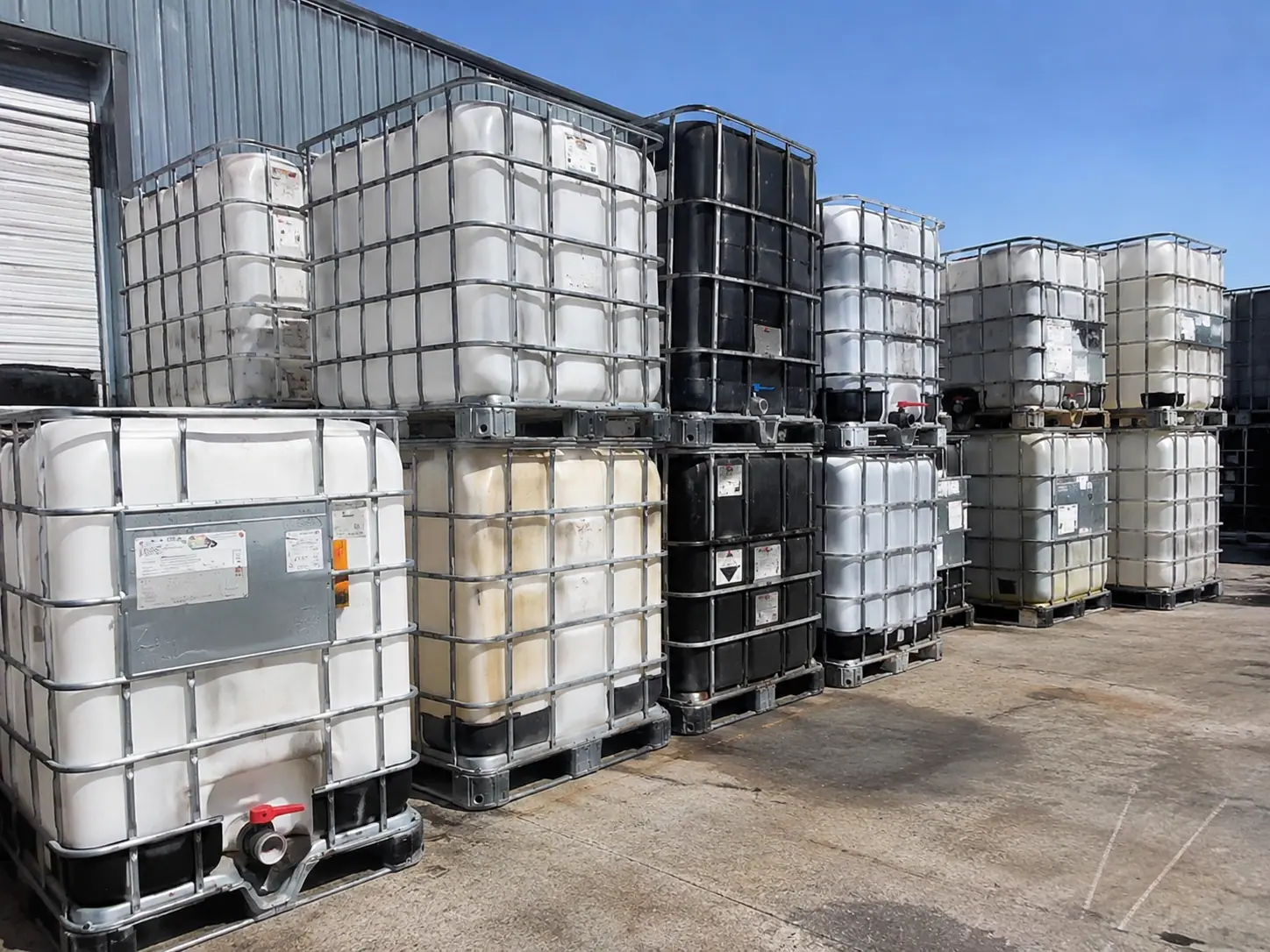
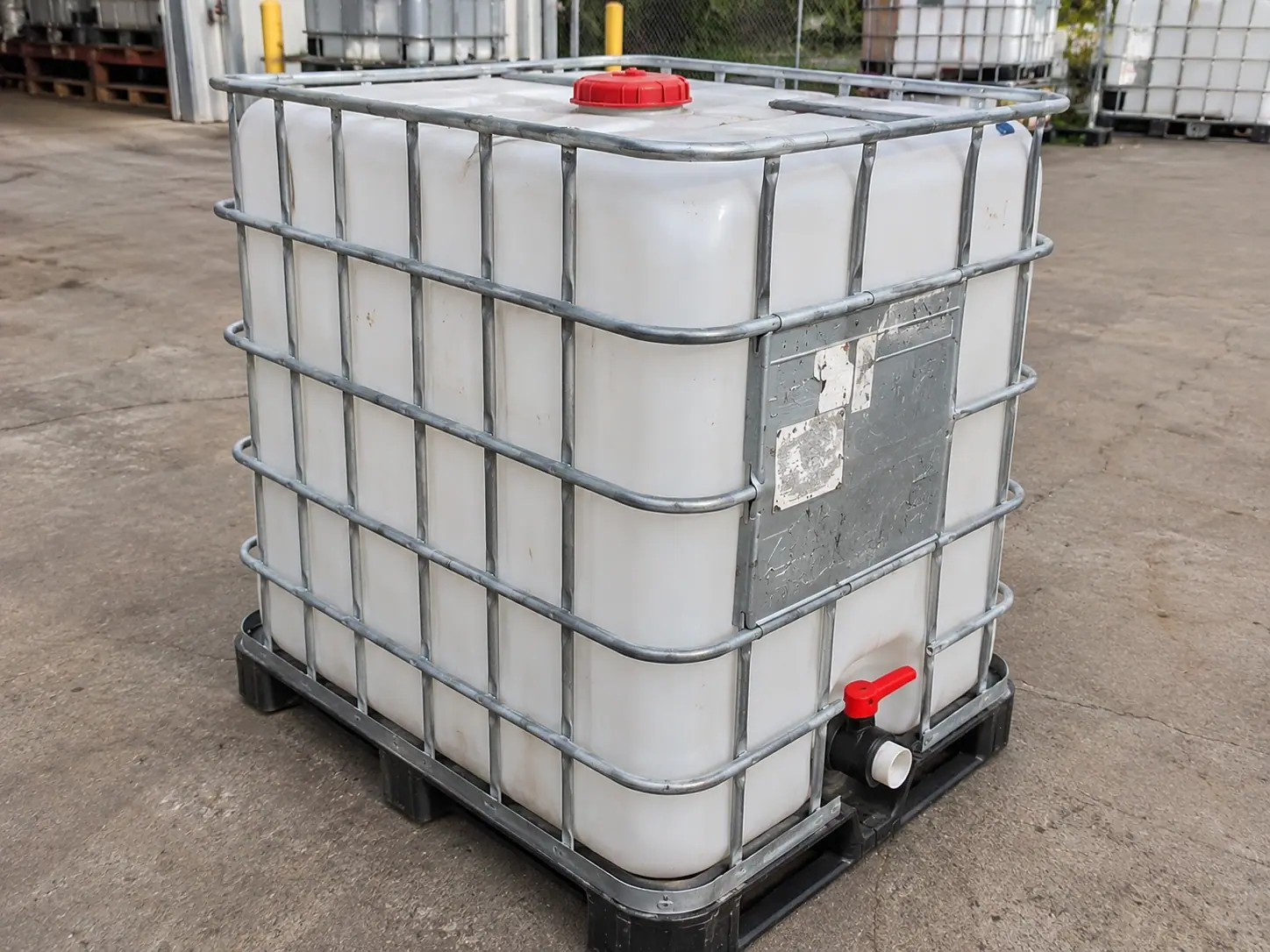 Fig. 1
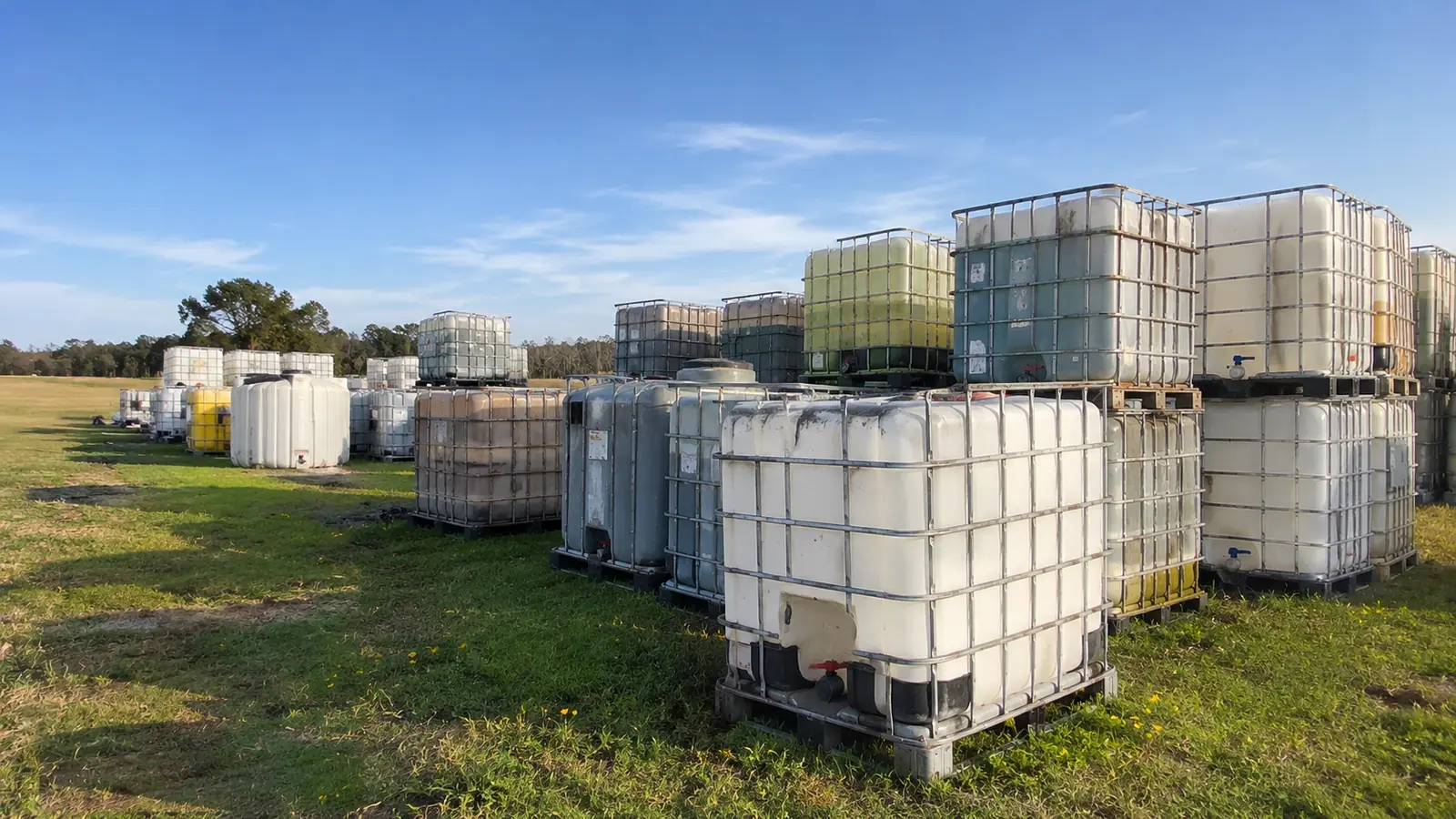
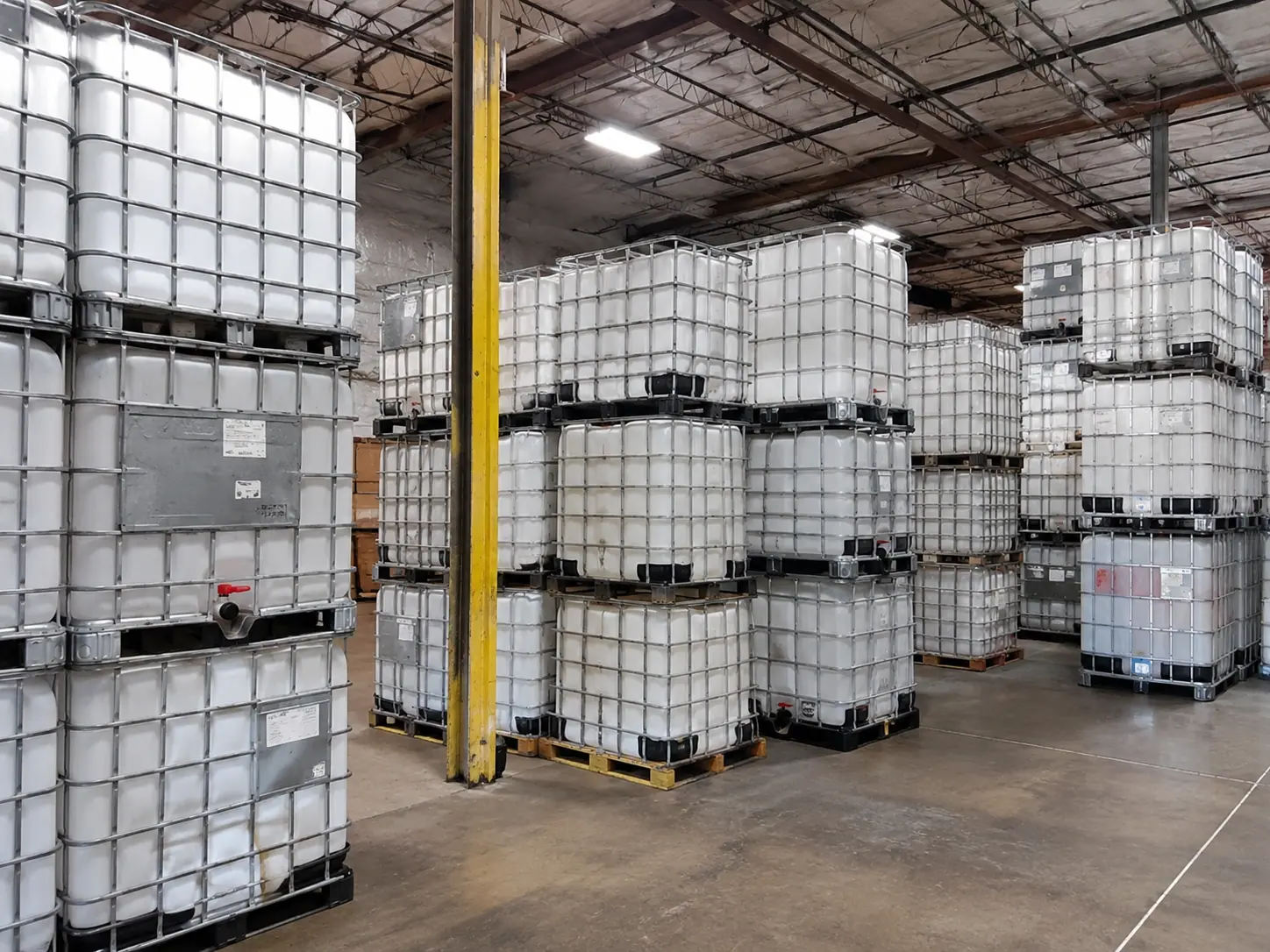 Fig. 2
| Capacity | Litres | Footprint | Height | Tare | Gross (water) | Stack loaded |
|---|---|---|---|---|---|---|
| 275 gal | 1,041 | 48 × 40 in | 46 in | ≈140 lb | ≈2,435 lb | 2 high |
| 330 gal | 1,249 | 48 × 40 in | 53 in | ≈155 lb | ≈2,905 lb | 2 high |
| 350 gal | 1,325 | 48 × 40 in | 56 in | ≈165 lb | ≈3,075 lb | 2 high |
| 120 gal | 454 | 40 × 32 in | 38 in | ≈95 lb | ≈1,095 lb | 2 high |
| 180 gal | 681 | 42 × 36 in | 42 in | ≈115 lb | ≈1,616 lb | 2 high |
| 550 gal | 2,082 | 60 × 48 in | 60 in | ≈240 lb | ≈4,830 lb | 1 high |
B / FITTINGS
What threads onto it
Fittings, threads and seat materials
| Fitting | Size | Seals by | Seat options | Typical service |
|---|---|---|---|---|
| S60x6 butterfly valve | 2 in | Flat gasket face | EPDM, Viton, PTFE | The standard IBC outlet |
| S70x6 butterfly valve | 2 in | Flat gasket face | EPDM, Viton | European and some 330 gal units |
| 2 in NPT ball valve, poly | 2 in | Thread flanks + tape | EPDM, Viton | Retrofits, metered dispensing |
| 2 in NPT ball valve, stainless | 2 in | Thread flanks + tape | PTFE | Solvents, pressure, hot cargo |
| 3 in butterfly valve | 3 in | Flat gasket face | EPDM, Viton | Viscous cargo, high flow |
| 6 in fill cap | 6 in | Gasketed lid | EPDM, silicone | Vented or solid — choose deliberately |
| Camlock adapter, type C | 1.5 / 2 in | Cam arms + gasket | Buna, Viton | Repeated connect / disconnect |
| Bulkhead tap | 3/4 in | Both-side gaskets | Brass, poly | Rain kits, site water |
| Material | Good with | Avoid with | Temperature | Cost |
|---|---|---|---|---|
| EPDM | Water, acids, caustics, brine, ag-chem | Oils, fuels, aromatics | -40 to 250 °F | Low |
| Viton (FKM) | Solvents, oils, fuels, aromatics | Ketones, amines, hot steam | -15 to 400 °F | High |
| Nitrile (NBR) | Oils, diesel, greases, hydraulics | Ozone, strong oxidisers | -30 to 250 °F | Low |
| PTFE envelope | Almost all chemistry, high purity | Needs very flat flange faces | -100 to 450 °F | High |
| Silicone | Food contact, wide temperature | Solvents, abrasion | -60 to 450 °F | Medium |
C / COMPATIBILITY
Will HDPE hold it?
Sixteen cargo families, rated
| Cargo family | HDPE | Seat | Notes |
|---|---|---|---|
| Water, potable and non-potable | A | EPDM / silicone | Food-history units for potable |
| Acids and caustics, aqueous | A | EPDM / PTFE | Vent fuming cargo |
| Liquid fertiliser, UAN, NPK | A | EPDM | SG up to 1.32 — check your lift-gate |
| Brine and chloride de-icer | A | EPDM | Hard on galvanising, kind to HDPE |
| Food syrups, oils, concentrates | A | Silicone / Viton | Documented food history only |
| Glycols | A | EPDM | Very common; SG 1.04–1.11 |
| Alcohols | A | Viton / PTFE | Flammable — bond and vent |
| Diesel and gas oil | B | Viton / NBR | Permeates slowly over long storage |
| Mineral spirits | B | Viton | Swells HDPE slowly |
| Surfactants and detergents | B | EPDM | Odour fixation risk — dedicate units |
| Latex, adhesives, water-based paint | A | EPDM | Cures if left. Wash promptly. |
| Ketones, aromatics, chlorinated solvents | C | — | Crazes HDPE. Stainless only. |
| Gasoline and low-conductivity fuels | C | — | Static risk. Steel or stainless. |
| Essential oils, flavour concentrates | C | — | Fixes into the wall permanently. Never. |
| Hydrogen peroxide above 10% | C | — | Decomposition and pressure risk |
| Dairy and hot-fill above 140 °F | C | — | Needs CIP and steam. Stainless. |
Permeation
Small non-polar molecules pass slowly through HDPE rather than attacking it. The bottle looks perfect and your cargo quietly leaves. It is a storage-duration problem: diesel for a week is fine, diesel for a year is not.
Crazing
Ketones, aromatics and chlorinated solvents cause fine surface cracking that propagates under stress. It is invisible until you hold the wall against a raking light, and it is a critical grading failure.
Odour fixation
Terpenes and some surfactants dissolve into the polymer itself rather than sitting on the surface. No wash removes them. This is why a food-grade tote has to have been a food tote from new.
06 / SPECIFICATION
Match the grade to the duty
Do not buy more container than the job needs
| Duty | Grade | Seat | Lid | Why |
|---|---|---|---|---|
| Liquid fertiliser, ag-chem | B | EPDM | Vented | Cosmetics have no value in a muddy field |
| Food, beverage, edible cargo | A, food history | Silicone / EPDM | Solid, sealed | History and documentation, not appearance |
| Industrial chemistry, regulated | A, re-marked | Viton / PTFE | Vented if fuming | A current UN marking is the deliverable |
| Solvents, oils, fuels | A or B | Viton | Vented | EPDM swells in oils |
| De-icer and brine | B or C | EPDM | Solid | Chloride is kind to HDPE, harsh on steel |
| Jobsite and non-potable water | C | EPDM | Vented | Sound, stained, cheapest thing we sell |
| Dust suppression, irrigation | C | EPDM | Vented | Grade C's natural home |
| Rain capture, planters, builds | C | Brass tap | Screened | Units that failed cargo grading |
| Glycol, CIP chemistry | B / C | EPDM | Vented for peracid | Dedicate the unit, never rotate |
E / GRADING
A grade is a promise, not a mood
How every unit is scored
| # | Point | Critical? |
|---|---|---|
| 01 | Prior cargo declaration — present, written, specific | Yes |
| 02 | Residual liquid — any volume at all | Yes |
| 03 | Odour after wash — fixed odour by trained nose | Yes |
| 04 | Bottle corner stress whitening | No |
| 05 | Interior scoring you can feel | No |
| 06 | Interior crazing — fine surface cracking | Yes |
| 07 | Bottle bulge or deformation | Yes |
| 08 | Wall thickness at the thinnest point | Yes |
| 09 | Dome port condition and flange flatness | No |
| 10 | Outlet threads — cross-threading, chipping | Yes if crossed |
| 11 | Valve function, full open and close | No, replaceable |
| 12 | Gasket condition — compression set, bloom | No, replaceable |
| 13 | Cage squareness along the top rail | No, pressable |
| 14 | Cage weld integrity at tube intersections | Yes |
| 15 | Cage coating and galvanising loss | No |
| 16 | Pallet condition — cracked feet, rot, corrosion | No, replaceable |
| 17 | Forklift pocket integrity | No |
| 18 | UN marking legibility and date | No, re-markable |
| 19 | Leak test under our procedure | Yes |
08 / DOCUMENTATION
Paperwork is part of the product
What arrives with the load
| Document | Scope | What it proves |
|---|---|---|
| Grade card | Per unit | Nineteen inspection points, inspector initials, date, grade |
| Wash record | Per unit | Cargo class, chemistry, temperature, dwell, rinse, operator |
| Prior-cargo declaration | Per unit | Everything the container has ever held, verbatim |
| Leak test result | Per re-marked unit | Pass value and method under 49 CFR 178.801 |
| Chain-of-custody letter | On request | Where the container came from and where it went |
| Diversion certificate | Quarterly, on request | Mass diverted and emissions avoided, on letterhead |
D / ORDERING
Commercial terms, up front
Lead times, minimums and what happens when it goes wrong
| Item | Detail |
|---|---|
| Minimum order | One unit. No account minimum, no membership. |
| Stock lead time | Grade A and B 275 gal usually ship the same week |
| Rebottled lead time | 2–3 weeks, built to order in bay D |
| Food-grade lead time | 1–3 weeks when stock exists; supply-dependent |
| Full truckload | 45 on a 48 ft flat, 48 in a 53 ft van, 90 empties double-stacked |
| Payment, first order | Prepay by ACH or card |
| Payment, established | Net 30 on credit approval |
| Grade guarantee | Regrade or replace, our freight both ways, 14 days |
| Leak warranty | 30 days from delivery, normal atmospheric service |
| Cancellation | Free until the truck is loaded |
| Returns | 14 days on unused stock units, freight at your cost |
| Sales tax | Indiana resale certificates and out-of-state equivalents accepted |
F / END OF LIFE
Reuse first, recycle last
What happens when the container is finally finished
| Step | Outcome | Share of mass | Cost to us |
|---|---|---|---|
| 01 | Reuse as is — wash and redeploy | 63.9% | 11 gal of mostly reclaimed water |
| 02 | Repair and reuse — valve, gasket, pallet, cage | 11.4% | Parts and bench time |
| 03 | Rebottle — new bottle, reclaimed steel | 9.6% | A new bottle, two thirds of mass retained |
| 04 | Upcycle — rain kits, grow beds, wash stations | 3.2% | Fabrication time |
| 05 | Material recovery — HDPE regrind, steel, wood | 11.3% | Grinding, washing, drying energy |
| 06 | Residual to licensed disposal | 0.6% | Sludge, gasket rubber, fasteners, laminates |
48 states
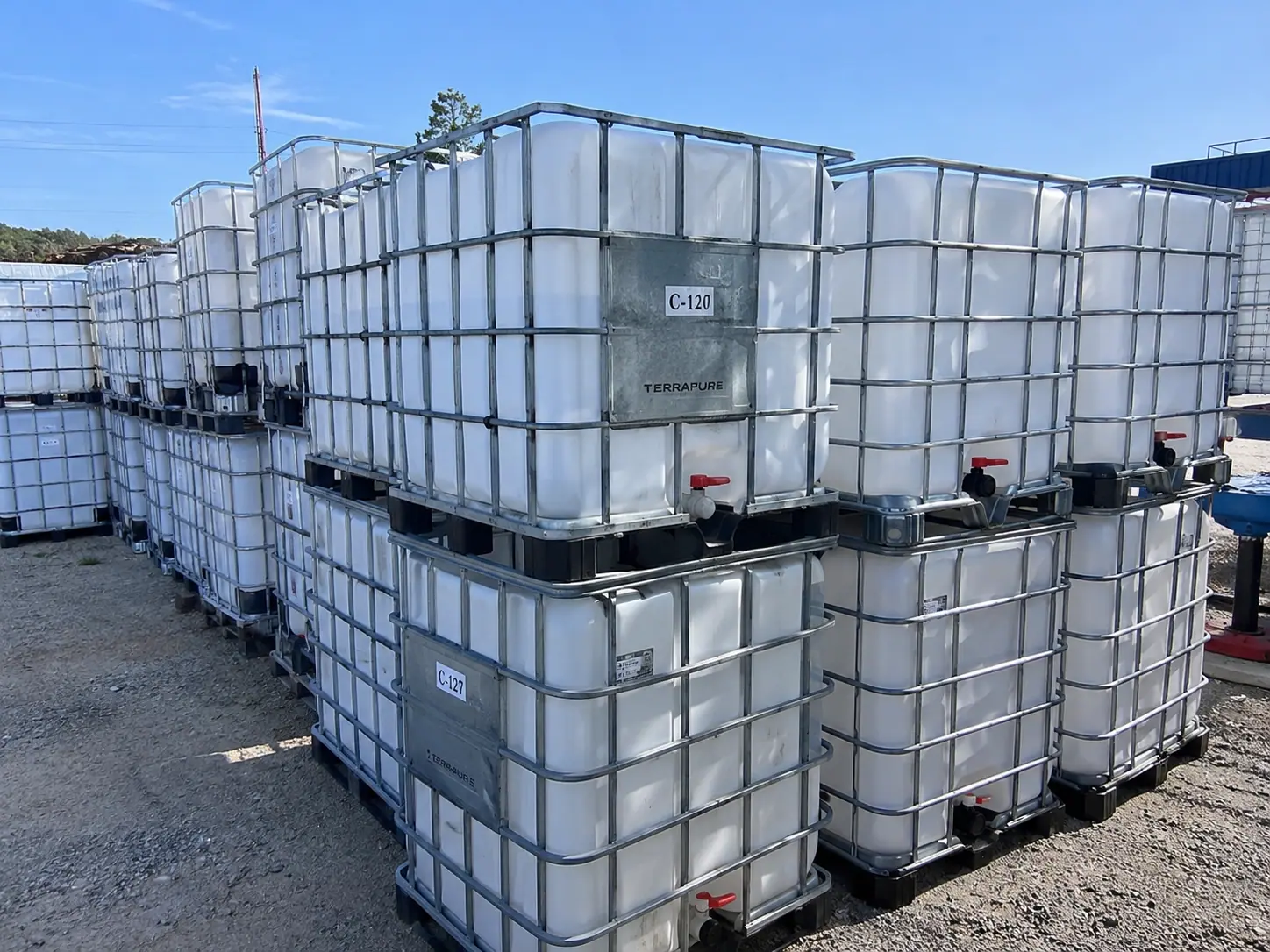
One yard in Indiana. Containers recovered from everywhere.
A single release collected out of state. Dispatch pairs a run like this with an outbound delivery into the same region wherever the geography allows.
Delivered pricing