Size GuideEco ImpactContact Us

Ecology · 10 min read

Pallet nails, gasket rubber and the last 0.6%

Getting from 97% diversion to 99.4% was engineering. Getting to 100% is a different kind of problem.

November 7, 2025 · Tobias Lindgren · ToteOrbit, Indianapolis

Question about this post?

Reply within 1 business day

It goes straight to the bench that wrote it. We answer operator questions whether or not there is an order attached.

US or Canada only — 10 digits, e.g. (317) 204-0100
US ZIP like 46226, or Canadian postal code like M5V 2T6
Whole units, 1 to 100,000

Fields marked * are required. Phone and postal code are checked against real US and Canadian number ranges, so please enter details we can actually reach you on.

Getting from 78 per cent landfill diversion to 97 was engineering: buy a granulator, build a water reclaim skid, start rebottling. Getting from 97 to 99.4 was detail work. Getting to 100 is a different kind of problem entirely, and I am not sure we can.

What the 0.6 per cent is

In 2024 we handled 2,994,000 pounds of inbound mass and sent 18,000 pounds to licensed disposal. Here is all of it, itemised, because naming it is the only way to shrink it.

Residual streams, 2024. Total 18,000 lb against 2,994,000 lb inbound.
StreamMassWhy it is stuck
Dewatered wash sludge11,400 lbMixed organic and inorganic residue, no viable outlet
Fouled gasket rubber3,200 lbCross-linked elastomer carrying chemical residue
Mixed fasteners and pallet nails1,900 lbToo small and too mixed for economic separation
Labels, liners and adhesive1,100 lbMulti-material laminates
Contaminated PPE and absorbents400 lbRegulated by contact rather than by material

Wash sludge is nearly two thirds of it

Everything that comes off the inside of a container ends up in the settling tank, gets dewatered, and goes out as a cake. It is a genuine mixture — residues from hundreds of different cargoes, plus the solids that were already in our water.

There are two routes out and I do not like either. Thermal treatment moves the problem into an incinerator and lets us call it diversion, which is the kind of boundary redefinition this whole page exists to avoid. The other route is changing the wash chemistry so the residue is recoverable, which is a genuine research project and is what we are actually working on.

That is a 2027 line item, honestly stated. It may not work.

Gasket rubber is small and stubborn

We replace every gasket on every unit — reusing a flange gasket is the single most common cause of a leak, so it is not negotiable. That generates three thousand-odd pounds a year of cross-linked elastomer that has been in contact with chemistry we cannot always identify.

Cross-linked rubber does not remelt. Cryogenic grinding into crumb rubber is possible in principle and uneconomic at our volume, and the chemical contact history makes most buyers nervous. We are investigating it rather than claiming to have solved it.

Pallet nails, which are almost funny

Nineteen hundred pounds of nails, staples and assorted fasteners from wooden pallets. Individually trivial, collectively a real number, and genuinely difficult because they arrive embedded in wood fibre.

A magnetic sort trial is running on the chipper output. It should recover most of it, which would take the residual from 0.6 to roughly 0.54 per cent. Not a headline, but it is the only honest kind of progress left at this end of the curve.

This is also a small argument for composite and plastic pallets over wood, which we make on the pallets page for other reasons too.

Labels and liners, which are a supplier problem

Multi-material laminates — paper bonded to film bonded to adhesive — are not recoverable by any route available to us. The only real fix is upstream: single-material labels that survive a caustic wash and then recycle with the substrate.

We raise this with suppliers and it moves slowly. It is a classic case of a problem that is cheap to fix at design and expensive to fix at end of life.

Why we do not round it to zero

Plenty of operations describe themselves as zero waste at diversion rates below ours. They get there by redefining boundaries: counting waste-to-energy as recovery, excluding “non-process” waste, or measuring units instead of mass.

We measure inbound mass, we count incineration as disposal, and we include everything — including the PPE and the absorbents. That is why the number is 99.4 and not 100, and why it is going to stay honest even when it stops improving.

The full mass balance is published on the zero-landfill page, updated every January.

Why mass is the right denominator

Diversion rates can be computed several ways and the choice changes the headline substantially. Three common bases:

  • By unit. Count containers diverted versus landfilled. Flattering, because the residual streams are not containers — they are sludge and rubber, which have no unit count.
  • By volume. Also flattering, because a dewatered cake is dense and a reused tote is bulky.
  • By mass. What we use. Every pound in, every pound accounted for.

Mass is the only basis where the answer cannot be improved by choosing a different measuring stick, which is why we use it and why our number is lower than some competitors' claims.

The waste-to-energy question

We count incineration as disposal. A great many diversion figures count it as recovery, and that single accounting choice is the difference between 99.4 per cent and a claim of zero waste.

There is a real argument on the other side: energy recovery displaces fossil generation and avoids landfill methane. We are not saying it is worthless. We are saying it destroys the material, and a company whose entire premise is keeping material in use should not count destroying material as a success.

It also conveniently solves our wash sludge problem on paper without solving it in fact, which is exactly the kind of boundary shift this page exists to avoid.

What we tried that did not work

Three dead ends, because the failures are more informative than the wins.

Composting the sludge

Attempted in 2022. The organic fraction is genuinely compostable; the inorganic fraction and the unpredictable chemical content are not, and no composter would take a feedstock they could not characterise. Abandoned.

Cryogenic grinding of gasket rubber

Technically feasible, economically absurd at 3,200 pounds a year. The capital cost would never be recovered and shipping it to somebody who already has the equipment runs into the same problem composting did: nobody wants a crumb rubber feedstock with an unknown chemical contact history.

Pallet wood to biomass fuel

Would have worked and we chose not to, because by our own accounting burning it is disposal rather than recovery. The wood now goes to chipping for landscaping and animal bedding markets, which is a genuine material use at slightly lower value.

What is actually in progress

  • Magnetic fastener recovery on the chipper output. Should recover most of the 1,900 pounds of nails and take the residual to roughly 0.54 per cent.
  • Wash chemistry reformulation so the residue is characterisable and therefore placeable. This is the big one and it is a genuine research project with no guaranteed outcome.
  • Supplier pressure on labels. Single-material labels that survive a caustic wash and then recycle with the substrate. Slow, and the right fix.
  • Gasket material review. If we can standardise on fewer elastomer types with better end-of-life routes, the stream becomes characterisable. Under evaluation.

The curve flattens, and that is the honest story

78 per cent to 97 took equipment: a granulator, a reclaim skid, a rebottling line. Each purchase moved the number several points.

97 to 99.4 took detail work: better sorting, the upcycle bay, tighter pallet handling. Each intervention moved it a fraction of a point.

99.4 to anything higher needs chemistry we do not have and markets that do not exist. That may take years, it may not happen, and saying so is more useful than announcing a target we cannot support.

The figures are reviewed every January against metered consumption and published on the zero-landfill page. When a number gets worse we leave it on the page with the miss written next to it, because removing it would defeat the point of publishing it at all.
REFERENCE

Reference

The tables behind this post

Dimensions, threads and seat materials in full, so you do not have to go looking. The complete reference is in the size guide.
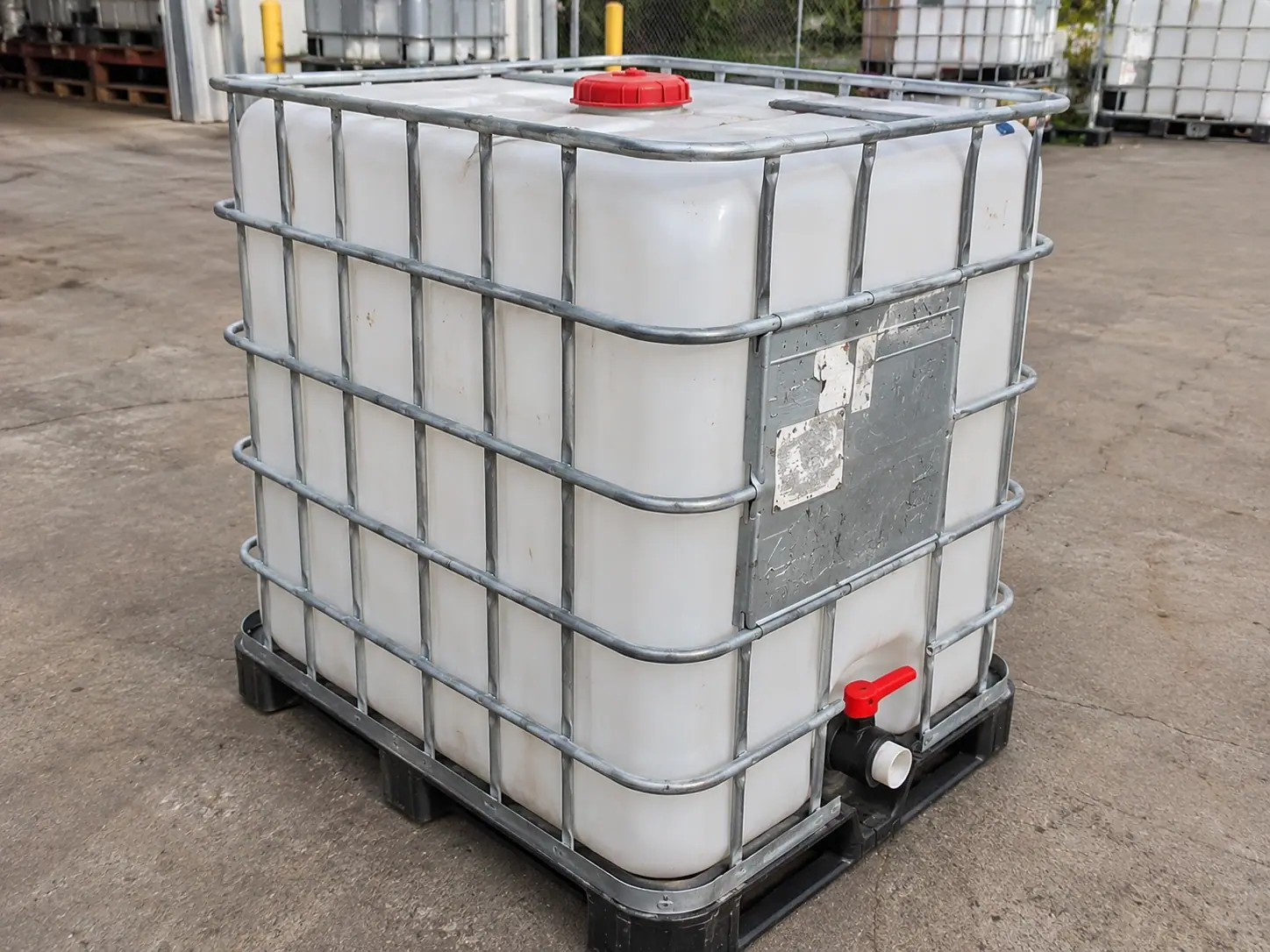
A reconditioned 275 gallon caged composite IBC tote on a black plastic pallet, showing the galvanised cage, the moulded HDPE bottle, the red discharge valve and the six-inch fill capFig. 1
A single 275 gallon unit off the outbound pad. Galvanised tubular cage, blow-moulded HDPE bottle, 2 in S60x6 outlet, six-inch vented fill cap.
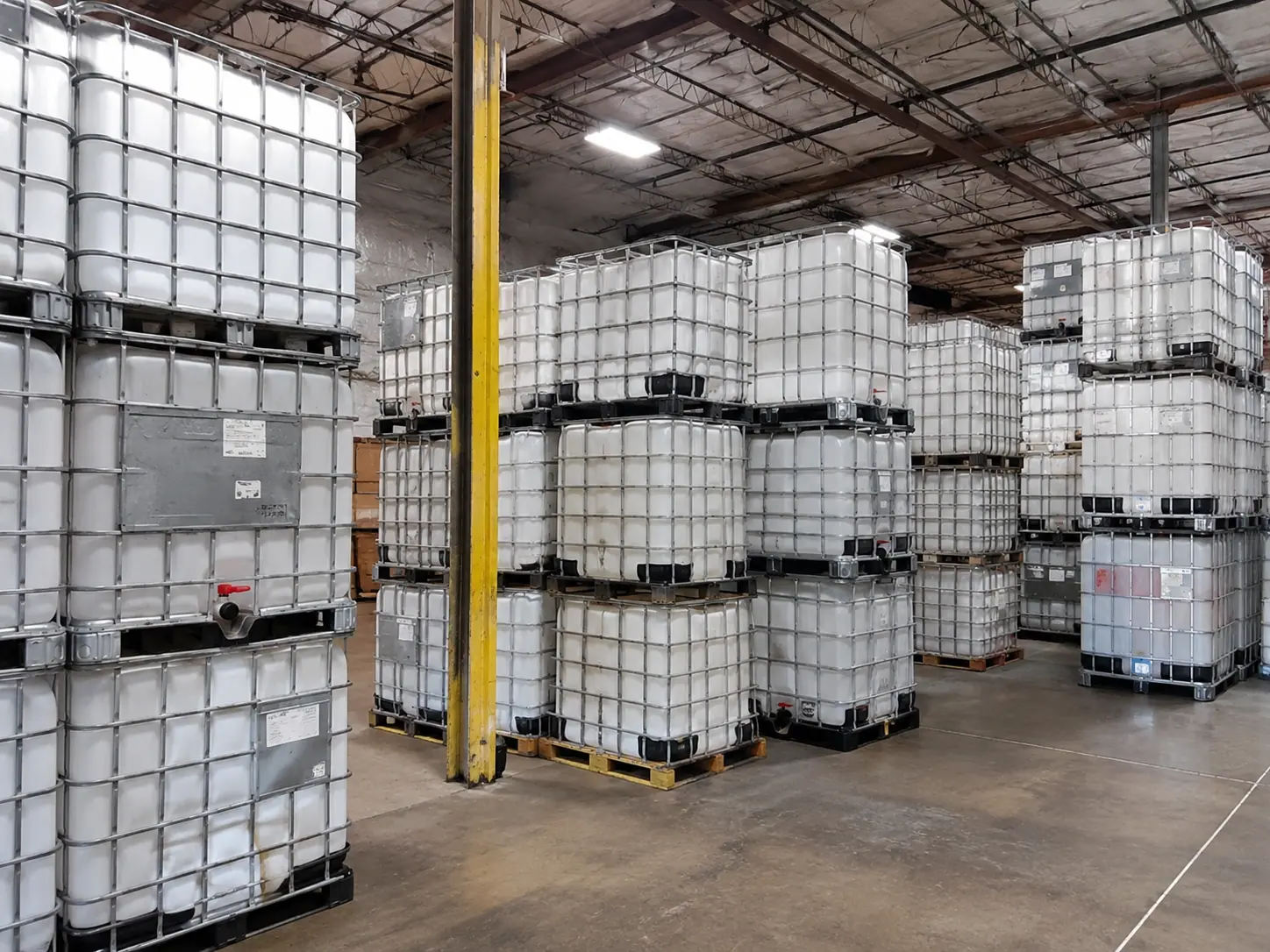
Rows of IBC totes stacked two and three high on pallets inside the Indianapolis warehouseFig. 2
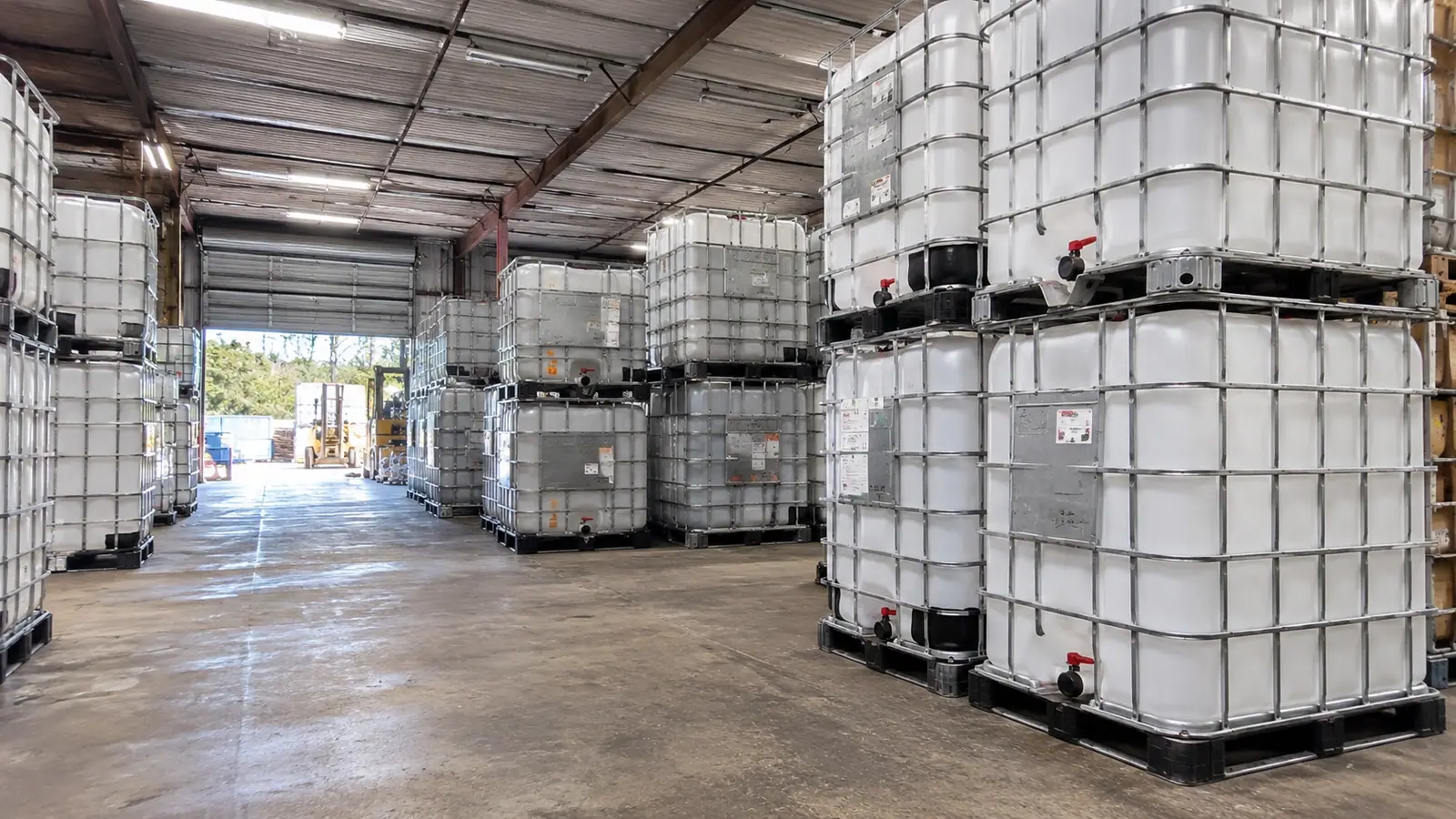
Graded stock under roof, staged two and three high. Loaded units never stack more than two, and never while warm.
Nominal figures. Gross weight assumes water at 8.34 lb/gal — multiply by your cargo's specific gravity, then check it against the maximum permitted gross mass on the unit's own marking.
CapacityLitresFootprintHeightTareGross (water)Stack loaded
275 gal1,04148 × 40 in46 in≈140 lb≈2,435 lb2 high
330 gal1,24948 × 40 in53 in≈155 lb≈2,905 lb2 high
350 gal1,32548 × 40 in56 in≈165 lb≈3,075 lb2 high
120 gal45440 × 32 in38 in≈95 lb≈1,095 lb2 high
180 gal68142 × 36 in42 in≈115 lb≈1,616 lb2 high
550 gal2,08260 × 48 in60 in≈240 lb≈4,830 lb1 high

B / FITTINGS

What threads onto it

Fittings, threads and seat materials

S60x6 is a buttress thread that seals against a flat gasket face, not on the thread flanks. It is not interchangeable with NPT — forcing one into the other is the commonest hidden fault in used containers.
FittingSizeSeals bySeat optionsTypical service
S60x6 butterfly valve2 inFlat gasket faceEPDM, Viton, PTFEThe standard IBC outlet
S70x6 butterfly valve2 inFlat gasket faceEPDM, VitonEuropean and some 330 gal units
2 in NPT ball valve, poly2 inThread flanks + tapeEPDM, VitonRetrofits, metered dispensing
2 in NPT ball valve, stainless2 inThread flanks + tapePTFESolvents, pressure, hot cargo
3 in butterfly valve3 inFlat gasket faceEPDM, VitonViscous cargo, high flow
6 in fill cap6 inGasketed lidEPDM, siliconeVented or solid — choose deliberately
Camlock adapter, type C1.5 / 2 inCam arms + gasketBuna, VitonRepeated connect / disconnect
Bulkhead tap3/4 inBoth-side gasketsBrass, polyRain kits, site water
The valve body rarely fails. The seat does, and it is chosen by cargo rather than by price. Always verify against your specific concentration and temperature.
MaterialGood withAvoid withTemperatureCost
EPDMWater, acids, caustics, brine, ag-chemOils, fuels, aromatics-40 to 250 °FLow
Viton (FKM)Solvents, oils, fuels, aromaticsKetones, amines, hot steam-15 to 400 °FHigh
Nitrile (NBR)Oils, diesel, greases, hydraulicsOzone, strong oxidisers-30 to 250 °FLow
PTFE envelopeAlmost all chemistry, high purityNeeds very flat flange faces-100 to 450 °FHigh
SiliconeFood contact, wide temperatureSolvents, abrasion-60 to 450 °FMedium

C / COMPATIBILITY

Will HDPE hold it?

Sixteen cargo families, rated

HDPE is brilliant at most things and hopeless at a few. Where the answer is C, we will point you at stainless rather than sell you a container that will craze.
A = suitable, B = suitable with limits, C = not recommended in a composite IBC. Guidance only — verify against your own concentration and temperature.
Cargo familyHDPESeatNotes
Water, potable and non-potableAEPDM / siliconeFood-history units for potable
Acids and caustics, aqueousAEPDM / PTFEVent fuming cargo
Liquid fertiliser, UAN, NPKAEPDMSG up to 1.32 — check your lift-gate
Brine and chloride de-icerAEPDMHard on galvanising, kind to HDPE
Food syrups, oils, concentratesASilicone / VitonDocumented food history only
GlycolsAEPDMVery common; SG 1.04–1.11
AlcoholsAViton / PTFEFlammable — bond and vent
Diesel and gas oilBViton / NBRPermeates slowly over long storage
Mineral spiritsBVitonSwells HDPE slowly
Surfactants and detergentsBEPDMOdour fixation risk — dedicate units
Latex, adhesives, water-based paintAEPDMCures if left. Wash promptly.
Ketones, aromatics, chlorinated solventsC—Crazes HDPE. Stainless only.
Gasoline and low-conductivity fuelsC—Static risk. Steel or stainless.
Essential oils, flavour concentratesC—Fixes into the wall permanently. Never.
Hydrogen peroxide above 10%C—Decomposition and pressure risk
Dairy and hot-fill above 140 °FC—Needs CIP and steam. Stainless.

Permeation

Small non-polar molecules pass slowly through HDPE rather than attacking it. The bottle looks perfect and your cargo quietly leaves. It is a storage-duration problem: diesel for a week is fine, diesel for a year is not.

Crazing

Ketones, aromatics and chlorinated solvents cause fine surface cracking that propagates under stress. It is invisible until you hold the wall against a raking light, and it is a critical grading failure.

Odour fixation

Terpenes and some surfactants dissolve into the polymer itself rather than sitting on the surface. No wash removes them. This is why a food-grade tote has to have been a food tote from new.

A wide aisle inside the warehouse with IBC totes stacked on both sides and a roller door open at the far end
Compatibility decides where a container can go next. Everything in this aisle carries a written cargo history.

E / GRADING

A grade is a promise, not a mood

How every unit is scored

We publish the whole system because a grade without written criteria is just an opinion with a price tag. Nineteen points, fixed thresholds, one card per unit, seven years on file.
Every unit is scored against all nineteen. A single critical failure condemns the unit regardless of how the other eighteen score.
#PointCritical?
01Prior cargo declaration — present, written, specificYes
02Residual liquid — any volume at allYes
03Odour after wash — fixed odour by trained noseYes
04Bottle corner stress whiteningNo
05Interior scoring you can feelNo
06Interior crazing — fine surface crackingYes
07Bottle bulge or deformationYes
08Wall thickness at the thinnest pointYes
09Dome port condition and flange flatnessNo
10Outlet threads — cross-threading, chippingYes if crossed
11Valve function, full open and closeNo, replaceable
12Gasket condition — compression set, bloomNo, replaceable
13Cage squareness along the top railNo, pressable
14Cage weld integrity at tube intersectionsYes
15Cage coating and galvanising lossNo
16Pallet condition — cracked feet, rot, corrosionNo, replaceable
17Forklift pocket integrityNo
18UN marking legibility and dateNo, re-markable
19Leak test under our procedureYes

D / ORDERING

Commercial terms, up front

Lead times, minimums and what happens when it goes wrong

Discovering these at invoice stage is nobody's idea of a good relationship, so they are published.
Published so nothing arrives as a surprise at invoice stage. Prices themselves move weekly with resin, scrap steel and freight, which is why we do not publish a list.
ItemDetail
Minimum orderOne unit. No account minimum, no membership.
Stock lead timeGrade A and B 275 gal usually ship the same week
Rebottled lead time2–3 weeks, built to order in bay D
Food-grade lead time1–3 weeks when stock exists; supply-dependent
Full truckload45 on a 48 ft flat, 48 in a 53 ft van, 90 empties double-stacked
Payment, first orderPrepay by ACH or card
Payment, establishedNet 30 on credit approval
Grade guaranteeRegrade or replace, our freight both ways, 14 days
Leak warranty30 days from delivery, normal atmospheric service
CancellationFree until the truck is loaded
Returns14 days on unused stock units, freight at your cost
Sales taxIndiana resale certificates and out-of-state equivalents accepted

F / END OF LIFE

Reuse first, recycle last

What happens when the container is finally finished

Every unit that arrives is assessed down this list, in this order. 99.4% of incoming mass avoided landfill in 2024, and reuse plus repair accounted for over three quarters of it.
Assessed in this order, per unit, every time. The granulator is the fourth choice, not the first. 2024 figures against 2,994,000 lb of inbound mass.
StepOutcomeShare of massCost to us
01Reuse as is — wash and redeploy63.9%11 gal of mostly reclaimed water
02Repair and reuse — valve, gasket, pallet, cage11.4%Parts and bench time
03Rebottle — new bottle, reclaimed steel9.6%A new bottle, two thirds of mass retained
04Upcycle — rain kits, grow beds, wash stations3.2%Fabrication time
05Material recovery — HDPE regrind, steel, wood11.3%Grinding, washing, drying energy
06Residual to licensed disposal0.6%Sludge, gasket rubber, fasteners, laminates
Stacks of used IBC totes under a clear blue sky on the gravel pad, awaiting grading
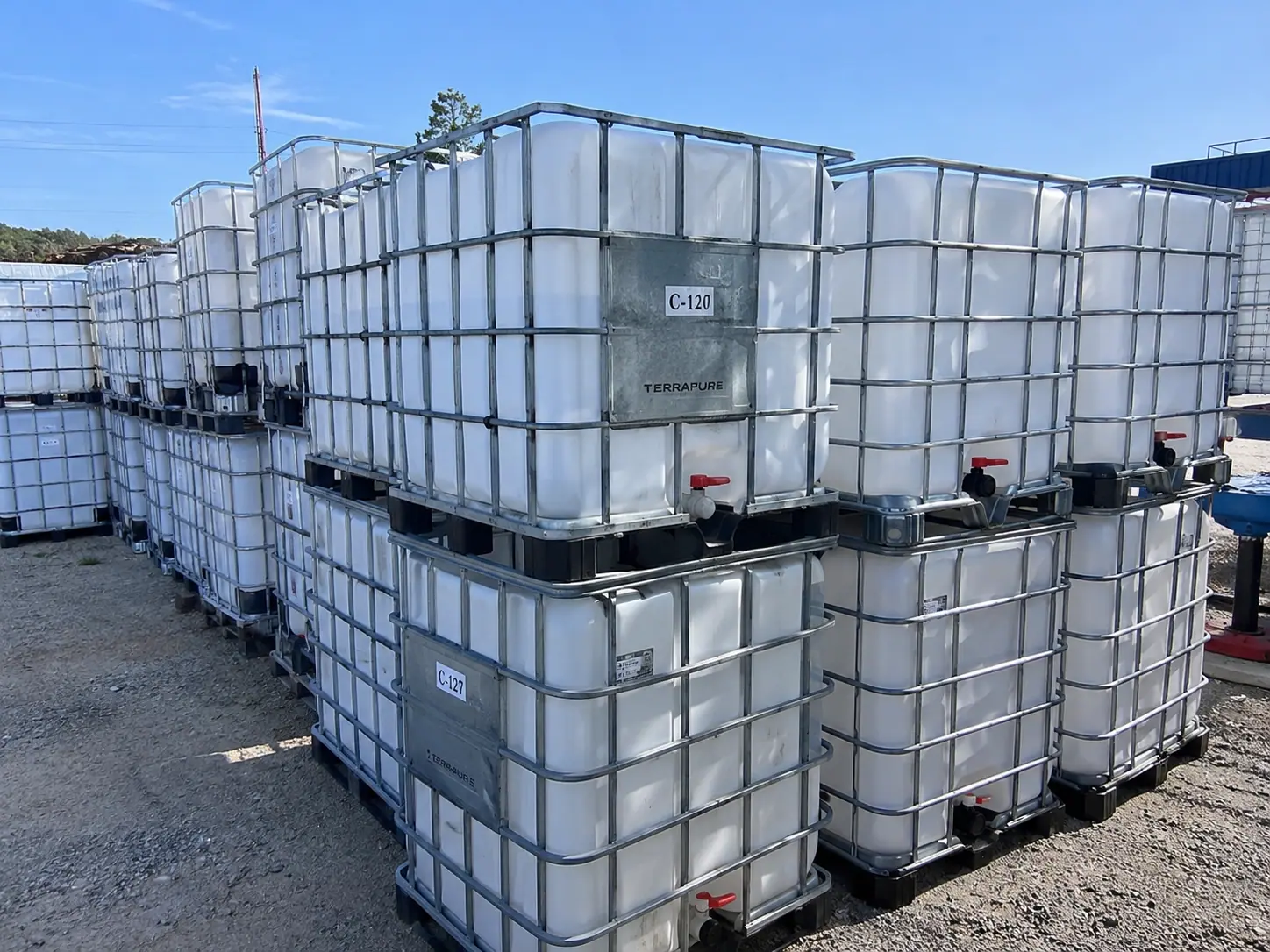
Inbound. Nothing comes off the trailer before its cargo declaration is read.
Mixed white and black IBC totes staged beside the loading dock doors
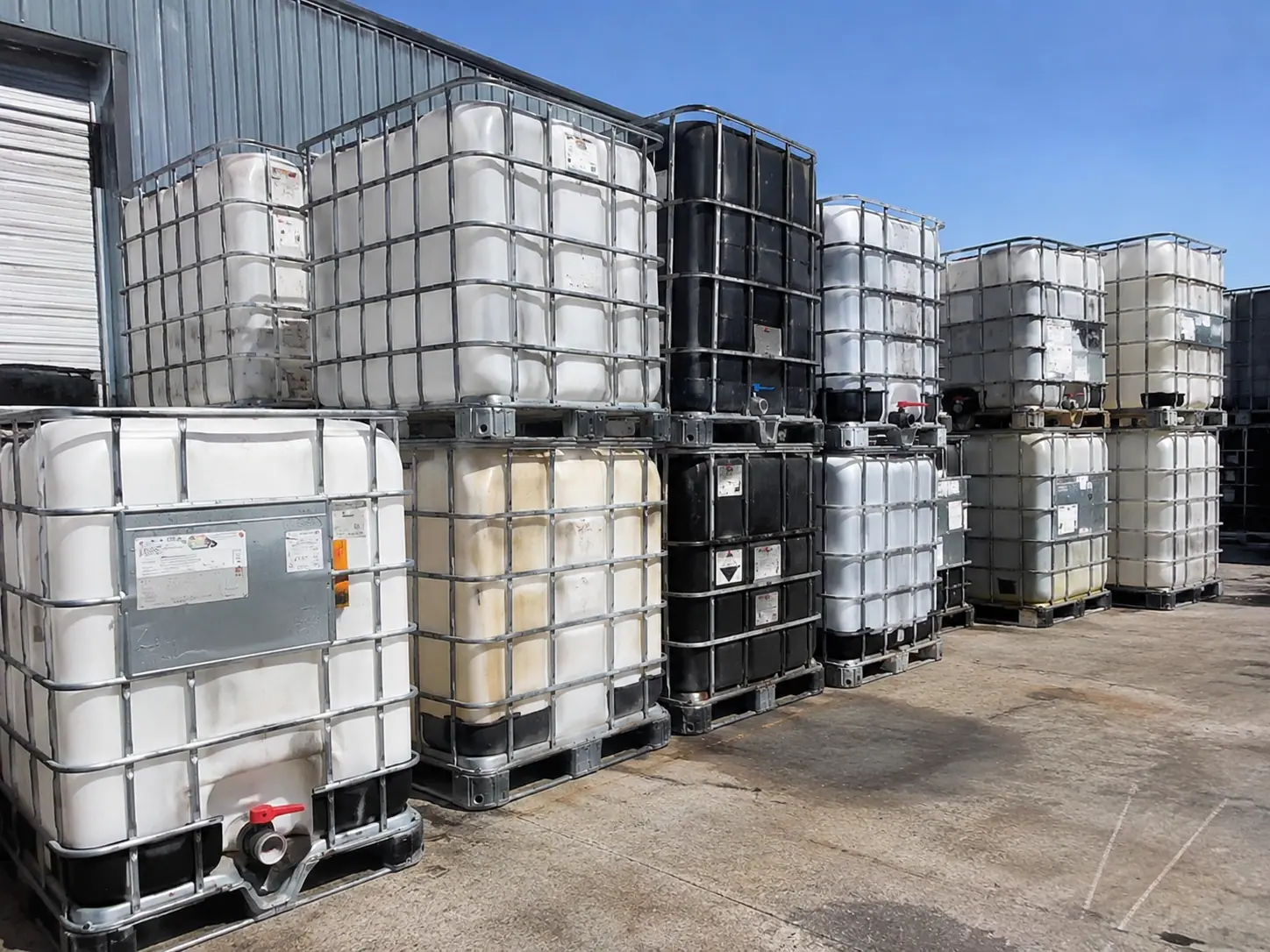
Graded and sorted. Black bottles are UV-stable units destined for outdoor service.
A wide field of IBC totes standing on grass under a blue sky, waiting to be collected
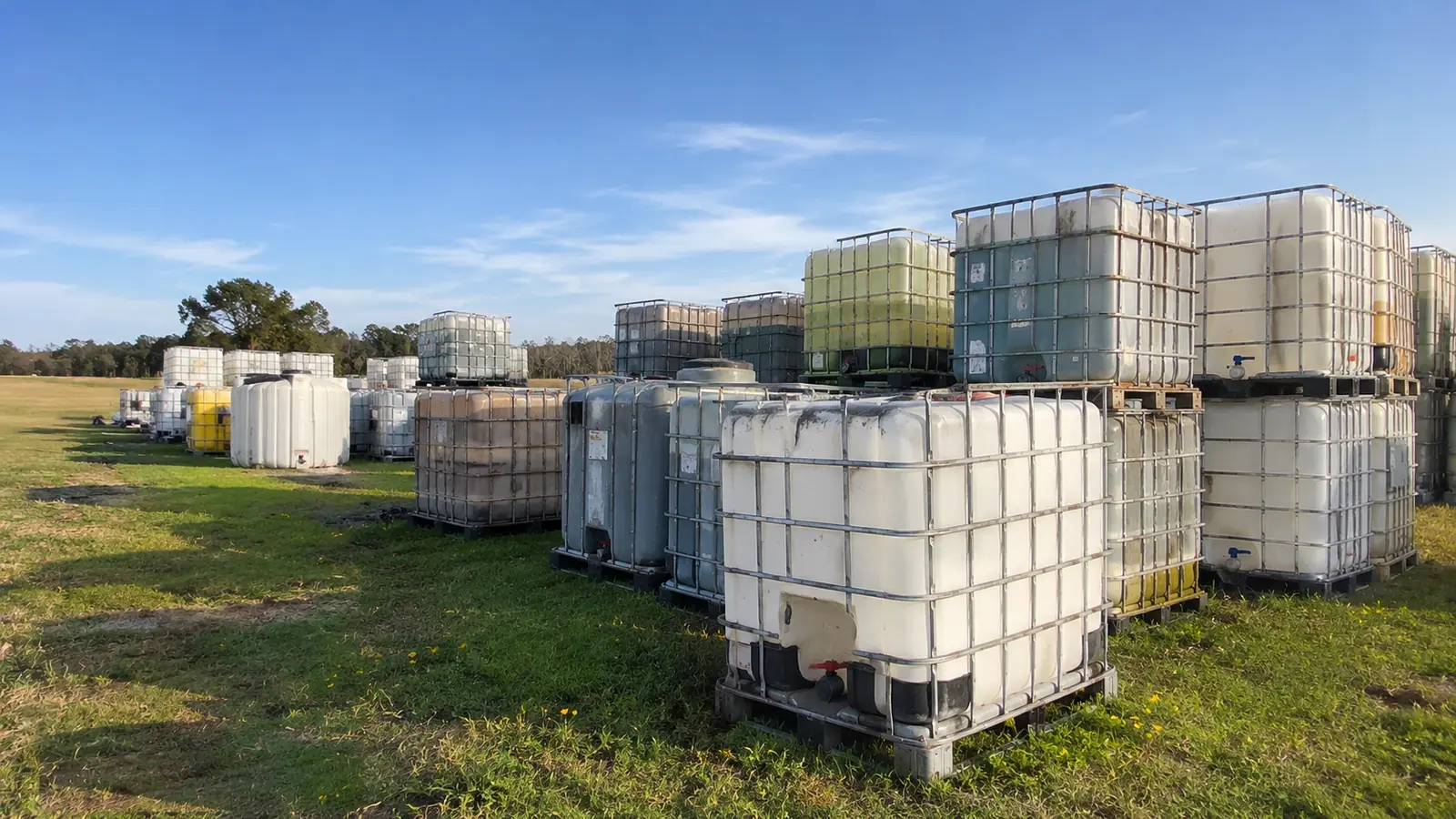
Recovered from a customer yard. Every one of these avoided a crusher.

From reading to ordering

Put it to work.

Quantity, grade and delivery ZIP in the form above gets you a delivered price tomorrow.
Use the form aboveAll posts
Get a quote