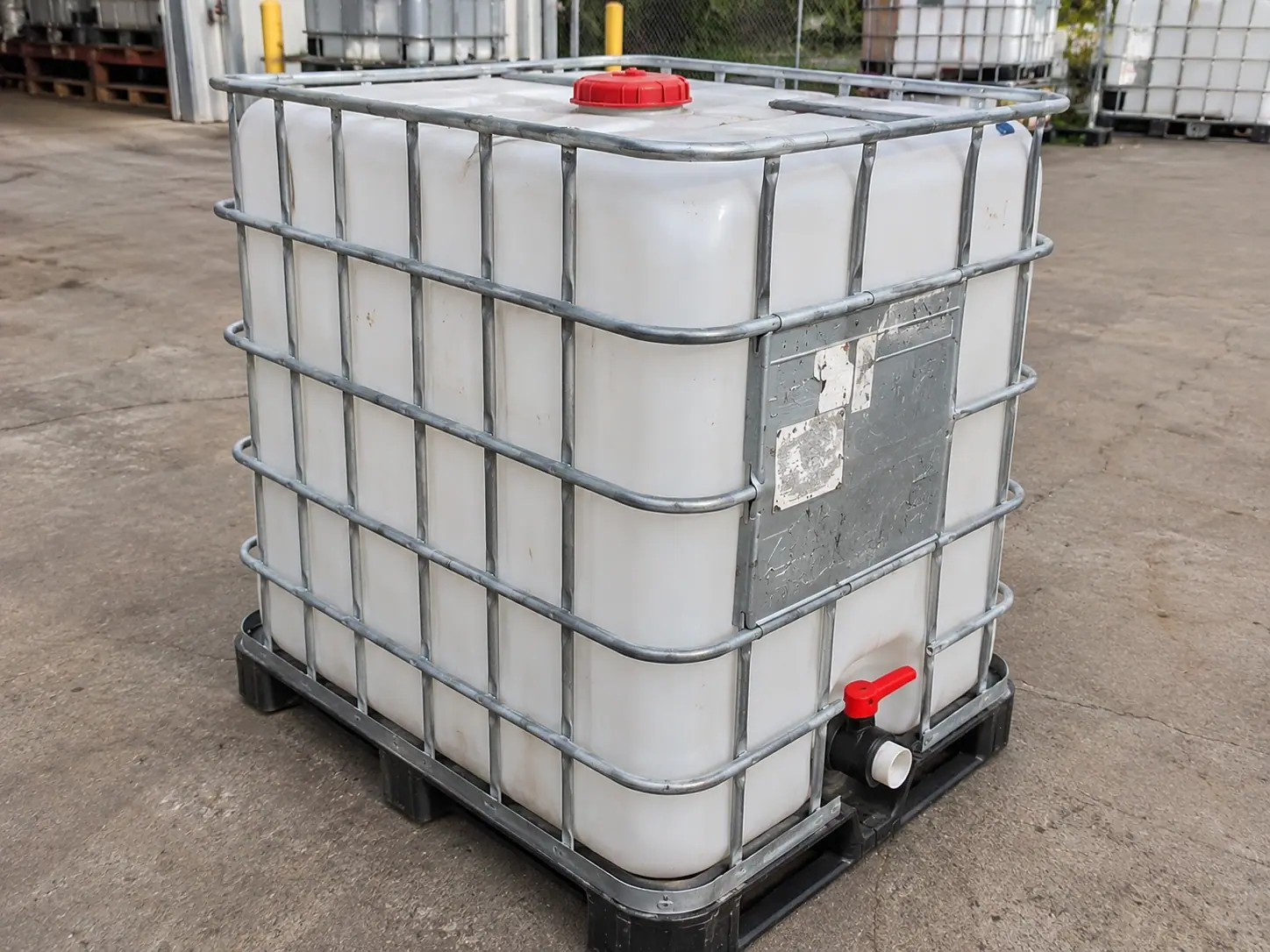
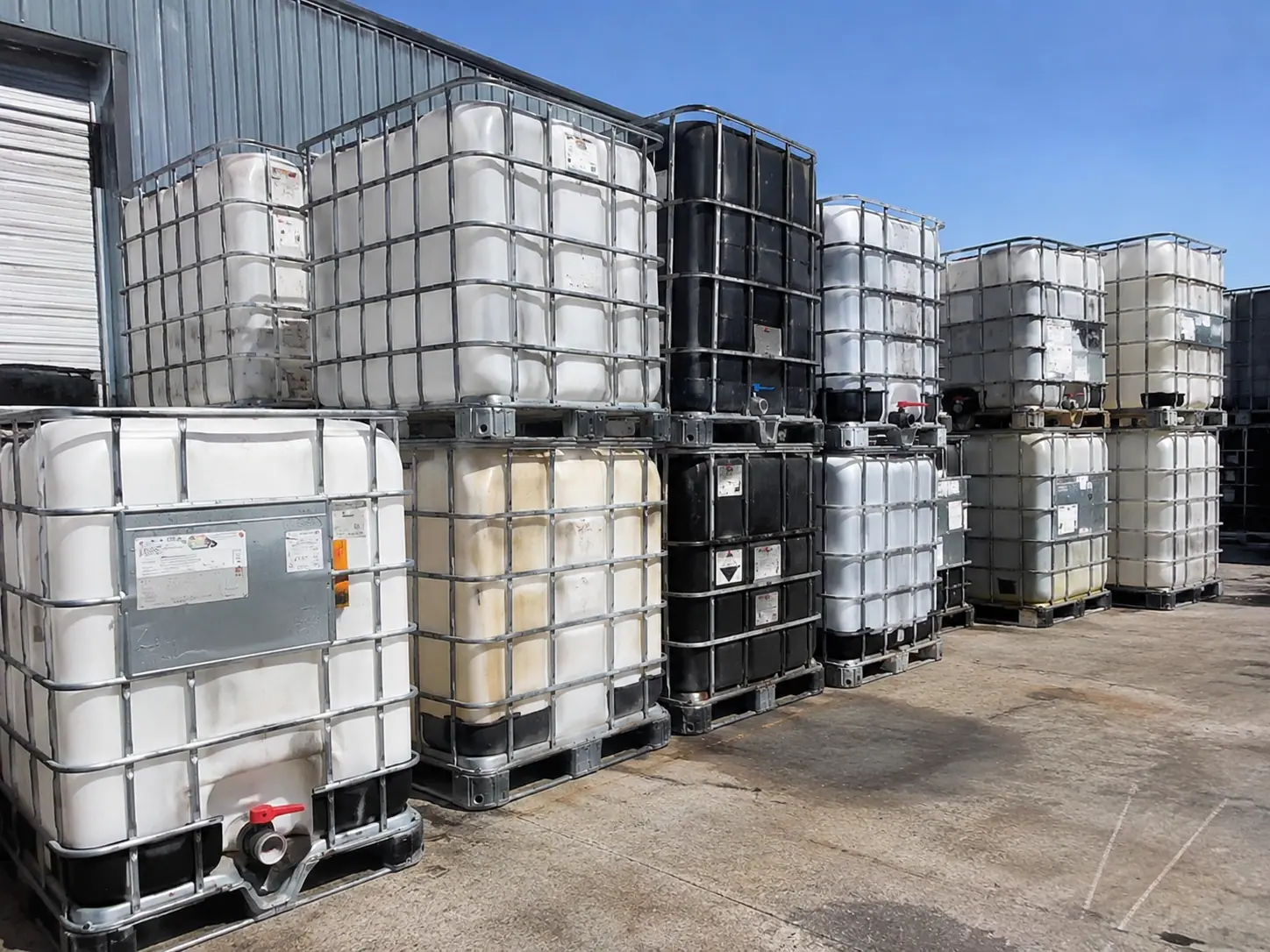
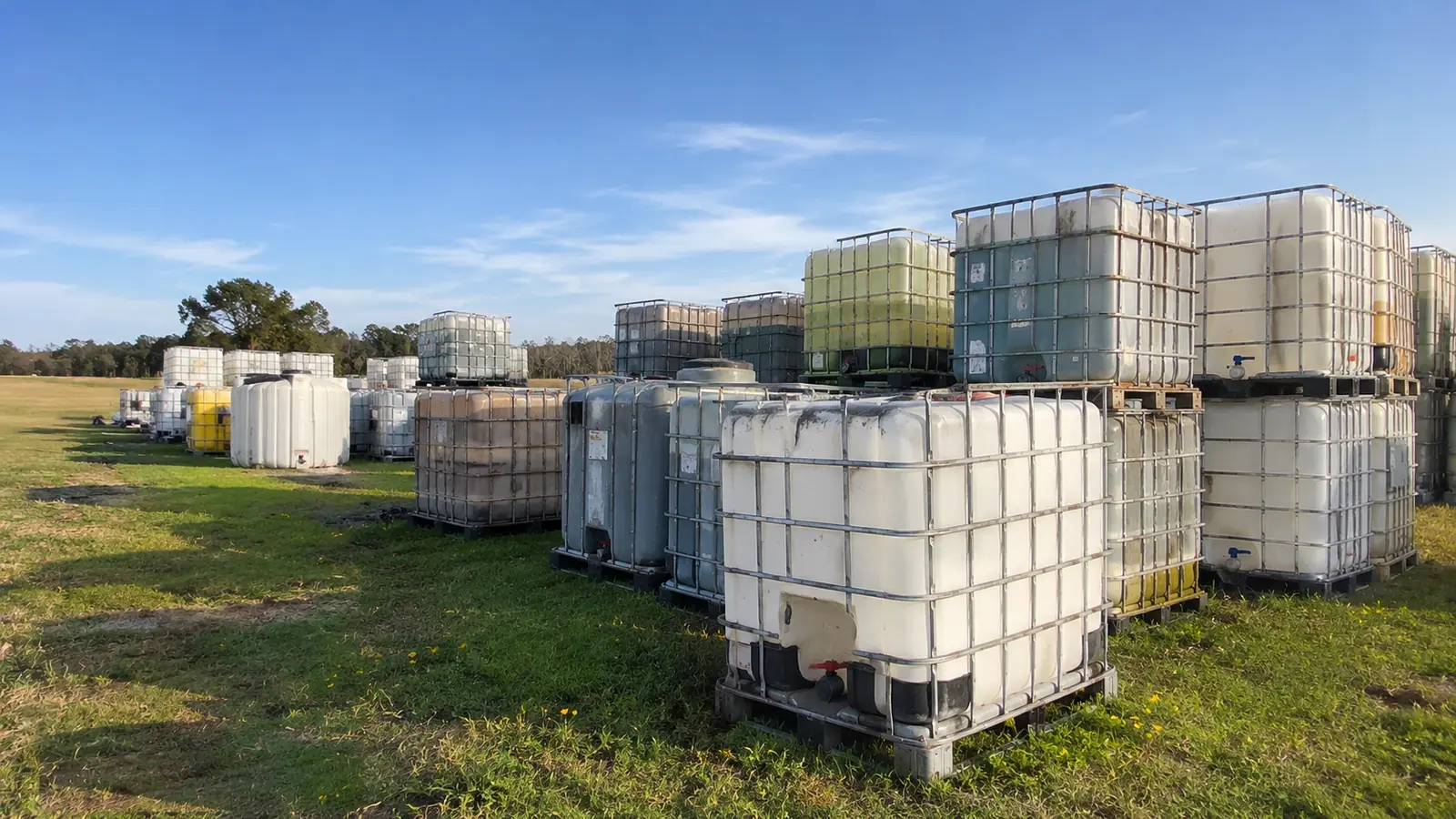
Everybody knows a tote holds 275 gallons. Rather fewer people have worked out what 275 gallons of their particular cargo weighs, and that gap is responsible for more bent lift-gates, refused deliveries and over-mass violations than any other single thing in this industry.
The arithmetic, which takes ten seconds
Water weighs 8.34 pounds per gallon. Multiply gallons by 8.34, multiply again by your cargo's specific gravity, add the tare weight of the container, and you have your gross.
| Cargo | Typical SG | Liquid weight | Gross (275 gal) |
|---|---|---|---|
| Water | 1.00 | 2,294 lb | 2,434 lb |
| Diesel | 0.85 | 1,950 lb | 2,090 lb |
| Isopropyl alcohol | 0.79 | 1,812 lb | 1,952 lb |
| Propylene glycol | 1.04 | 2,386 lb | 2,526 lb |
| Ethylene glycol | 1.11 | 2,546 lb | 2,686 lb |
| Liquid sugar / syrup | 1.33 | 3,051 lb | 3,191 lb |
| UAN 32 solution | 1.32 | 3,028 lb | 3,168 lb |
| Calcium chloride brine 32% | 1.29 | 2,959 lb | 3,099 lb |
| Sulphuric acid 93% | 1.83 | 4,198 lb | 4,338 lb |
Where it goes wrong
Lift-gates
A great many lift-gates are rated at 2,500 or 3,000 pounds, and that figure assumes a centred load with the deck fully supported. Water in a 275 is fine. UAN 32 in a 330 is 3,785 pounds and is not. If your site has no dock and you are ordering heavy cargo, the weight is a procurement constraint, not an afterthought.
Stacking
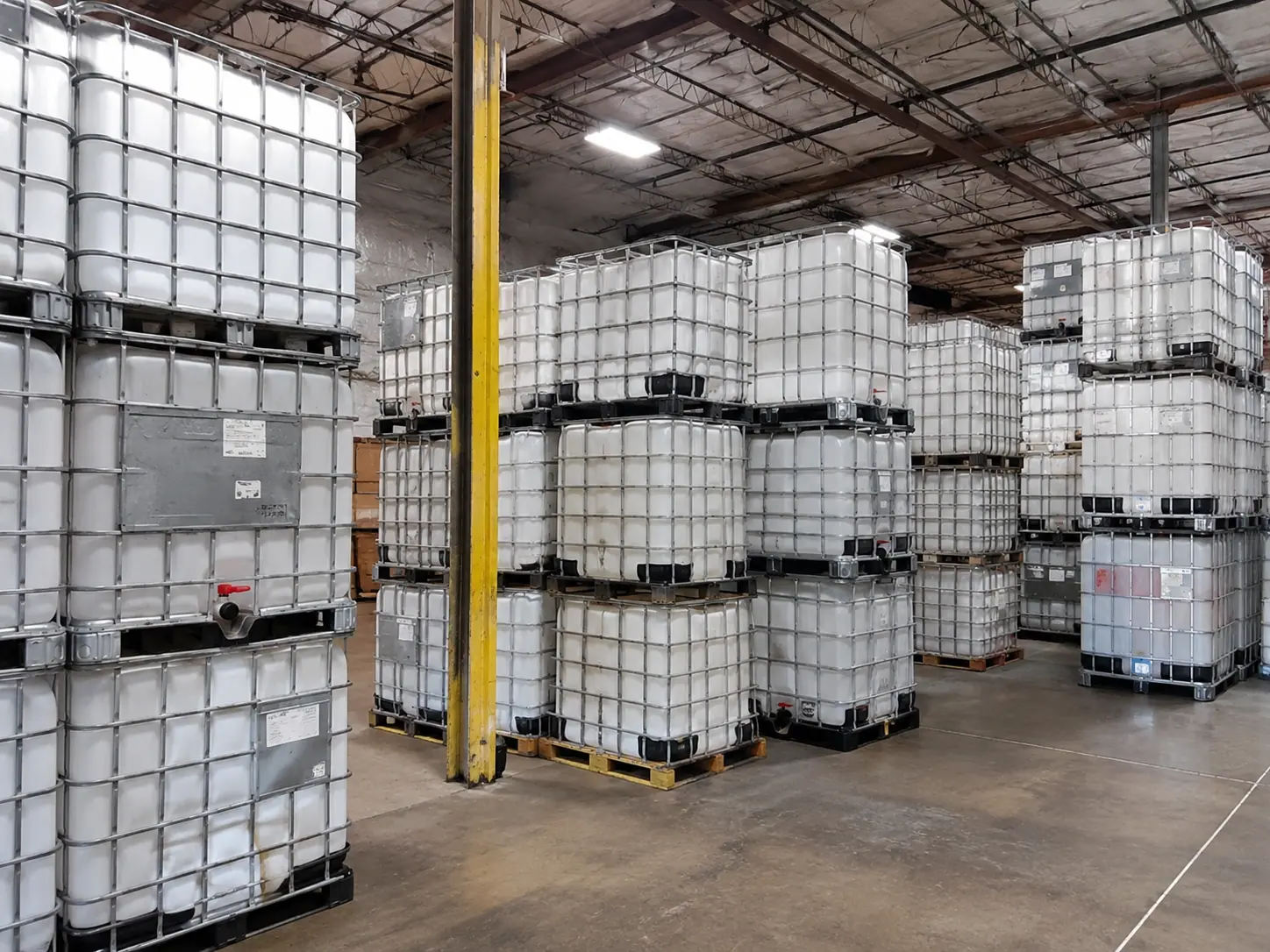
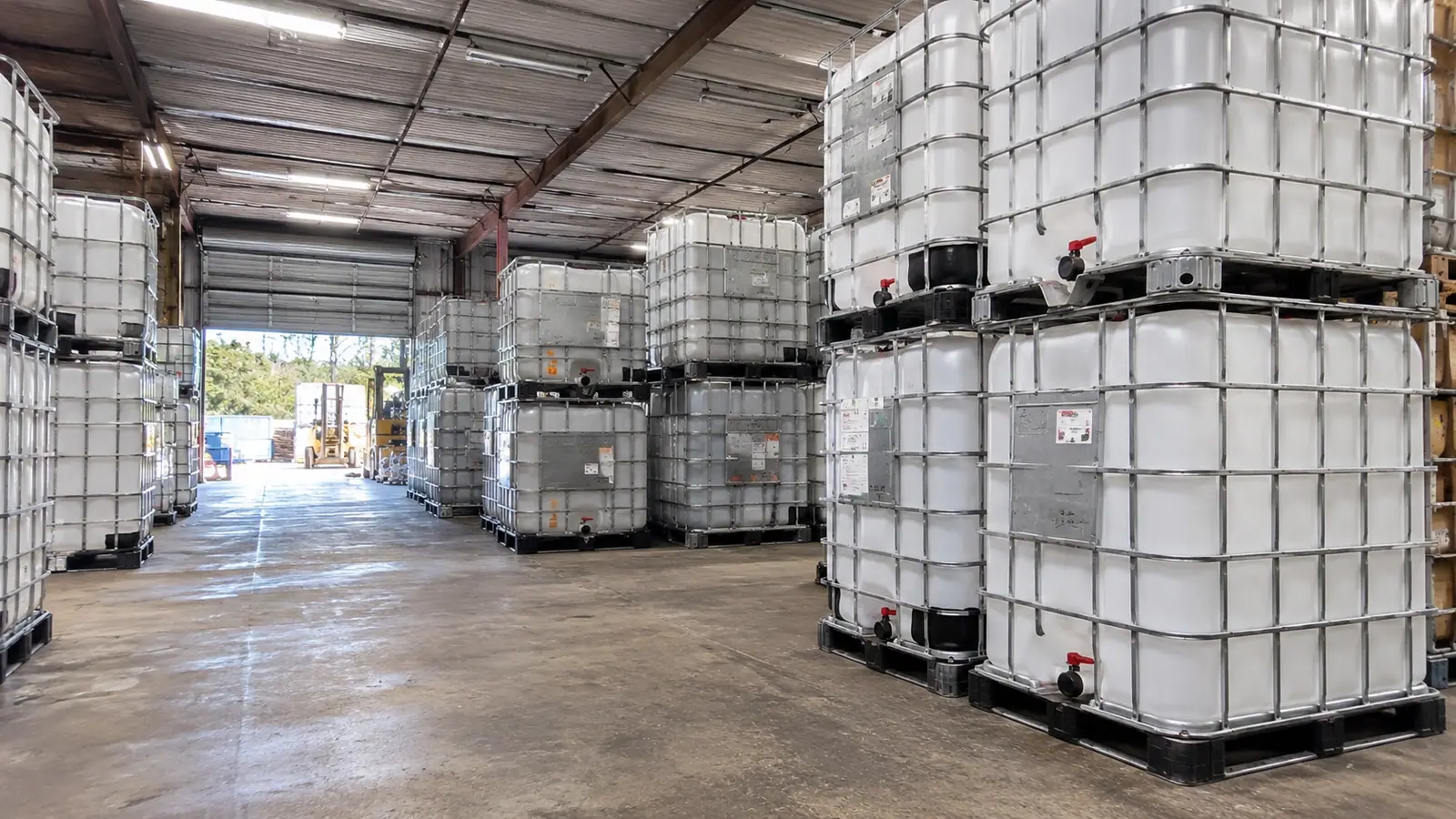
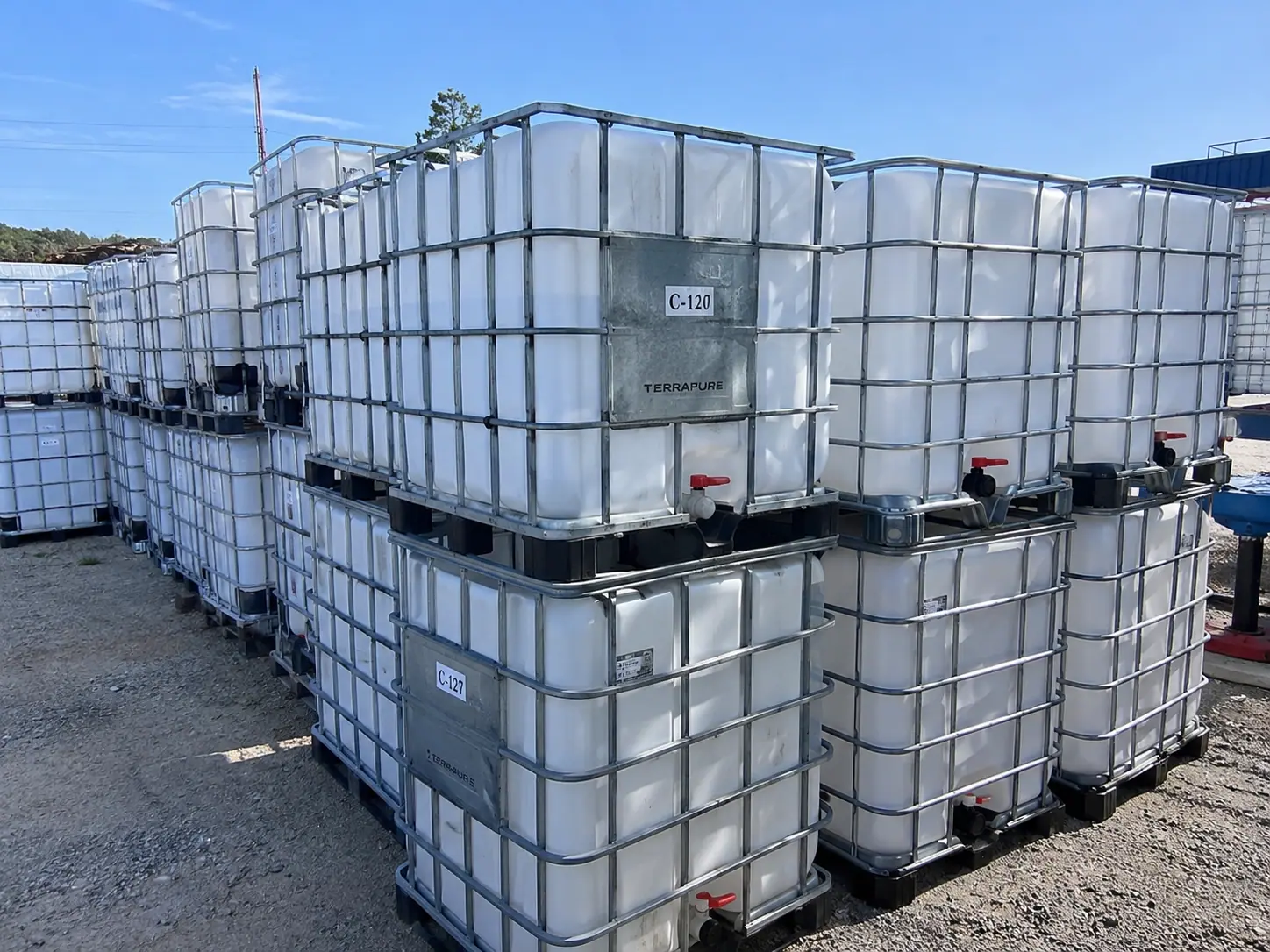
The stacking load figure on a UN marking is stated in kilograms and assumes a static test. A full tote of sulphuric acid sitting on another full tote of sulphuric acid is over four thousand pounds of sustained load on a cage designed around a water-density assumption. Do not stack dense cargo, and never stack anything while the contents are warm.
Maximum permitted gross mass
For regulated cargo this is the number that governs, and it is a field on the marking — not something you calculate. If your arithmetic says 4,338 pounds and the marking says a maximum gross of 1,450 kg, the marking wins and you are not allowed to fill it. Read the stamp, or send it to us and we will decode it for you.
Forklift capacity at extension
A truck rated at 5,000 pounds is rated at a specified load centre, typically 24 inches. A 48-inch tote puts its centre of mass further out than that, and the effective capacity drops accordingly. Check the data plate, not the headline figure.
Two related numbers worth knowing
Ullage. Nobody fills to 275 gallons. Thermal expansion needs head space — typically five to ten per cent — and on a hot trailer with a solid lid that head space is the difference between a sealed bottle and a deformed one.
Trailer axle loading. Forty-five totes of water is about 109,000 pounds and nobody is hauling that. In practice, dense cargo means fewer units per trailer, and that changes your freight per unit far more than the unit price does. Our dispatcher works this out before quoting; if you are arranging your own carrier, work it out before booking.
The habit worth building
Put the specific gravity on your internal spec sheet next to the volume, and compute the gross once. Then it is a known number rather than a surprise, and you can answer the three questions that actually matter — lift-gate, stack, marking — without a calculator at the dock.
If you tell us the cargo and the concentration in the request form, we will do the arithmetic for you and tell you which capacity and which delivery equipment to use.
Where to find your specific gravity
Section 9 of the safety data sheet, under physical and chemical properties. It may be given as specific gravity, relative density, or density in kilograms per cubic metre or grams per cubic centimetre. Density in g/cm³ is numerically the same as specific gravity for practical purposes; density in kg/m³ divided by 1,000 gives you the same number.
Two cautions. First, SDS figures are usually at 20 °C and some cargoes change meaningfully with temperature. Second, the figure is for the product as supplied — if you dilute it on site, your working density is different and nobody will have written it down for you.
The four-number spec line
We encourage customers to carry a single line on their internal container spec:
Capacity 275 gal · fill 90% · SG 1.32 · gross 2,866 lb
Four numbers, computed once, and the three questions that matter — can my lift-gate take it, can I stack it, am I inside the marking — all become lookups rather than arithmetic at the dock. The number of avoidable problems this prevents is out of all proportion to the effort.
Trailer loading, which is a different constraint
Forty-five totes of water is about 109,000 pounds of cargo. No legal configuration hauls that, so dense cargo means fewer units per trailer, which changes your freight per unit far more than the container price does.
A rough rule: with cargo at specific gravity 1.0 you are volume-limited and can run 45 to 48 units. Above about 1.15 you start becoming weight-limited, and above 1.3 you are firmly weight-limited and the count drops. If you are arranging your own carrier, work this out before you book; if we are quoting delivered, our dispatcher already has.
This is also why empty totes ship beautifully — double-stacked at 90 units they are still a light load — and full ones do not.
Partial fills and the depth table
If you need to know how much is in a tote without a gauge, liquid depth is a reasonable proxy. In a 275 gallon bottle, every inch of depth is roughly 6.7 gallons, so twenty inches is about half.
Multiply gallons by 8.34 and by your specific gravity and you have the weight of a partial fill, which matters for exactly the same three reasons. The full depth table is in chapter one of the size guide.
Hydrostatic head and your pump
Dense cargo also changes the suction conditions at the outlet. A full tote of sulphuric acid at 1.83 presents considerably more head at the valve than water does, which is helpful for gravity discharge and unhelpful for anything relying on a specific pressure drop.
The practical consequence is that a transfer pump sized on water performance may behave differently on dense cargo, particularly at the end of the draw when head is lowest. Worth a check if your transfer times matter.
The one that catches ag customers every spring
UAN 32 at specific gravity 1.32 in a 330 gallon tote is about 3,785 pounds. A great many farm and co-op lift-gates are rated at 3,000, and the rating assumes a centred load on a supported deck.
Every March somebody discovers this at their own gate. If you are ordering 330s for dense cargo and you do not have a dock, tell us in the form and we will quote the delivery differently — or recommend 275s, which at 3,168 pounds sit inside a lot more equipment ratings. There is more on seasonal booking in booking spring totes in January.