Plenty of cargo separates. Pigment settles, slurries stratify, brine develops a density gradient, and the first fifty gallons you draw are not the same product as the last fifty. Mixing inside a tote is entirely doable — the constraint is that you are bolting machinery to a container that was never designed as a process vessel.
Bolt to the cage, never to the bottle
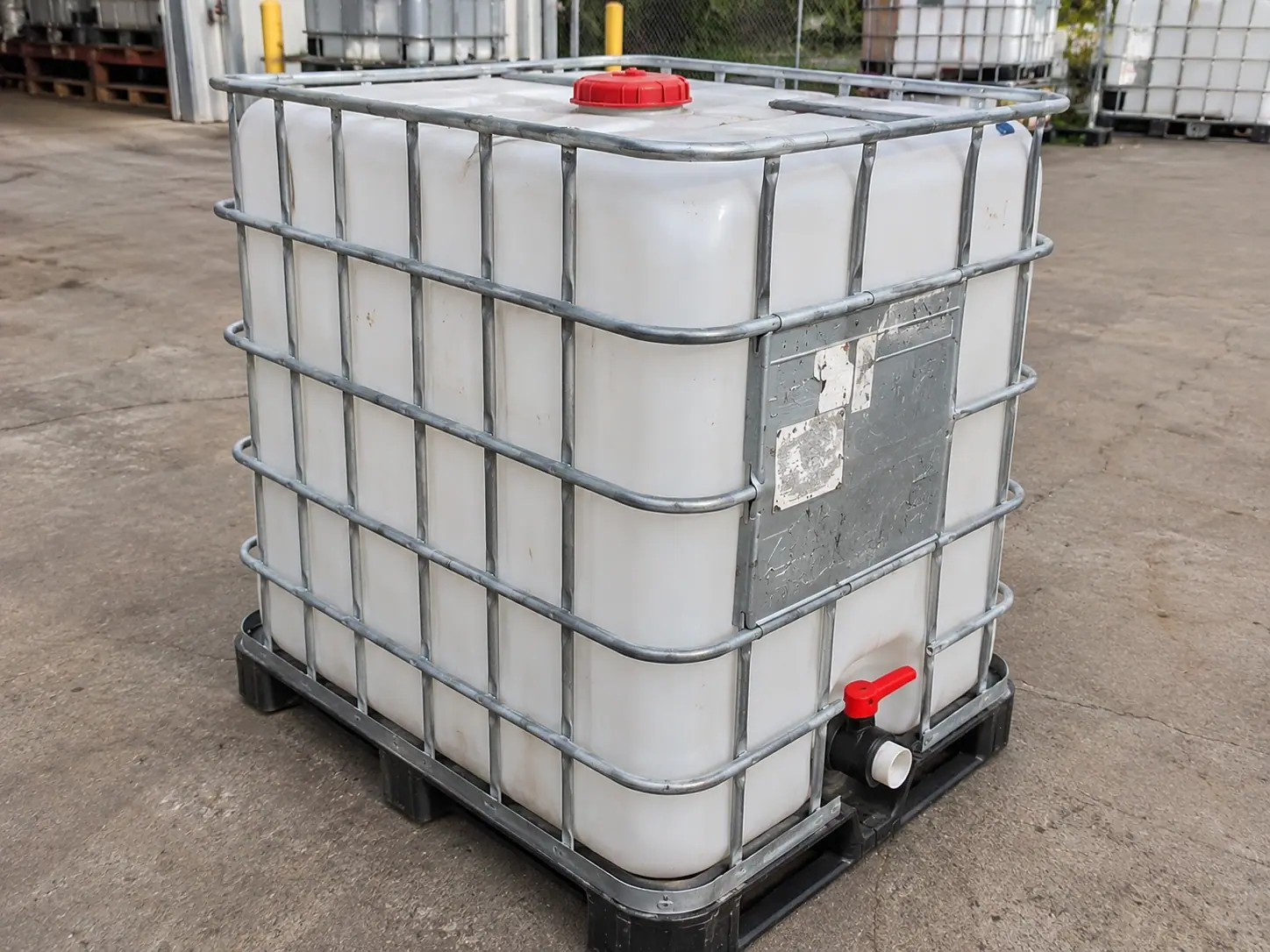
This is the one non-negotiable rule. The galvanised steel cage carries load; the HDPE bottle does not, and it creeps under sustained point loading. Any mount, bracket or bridge goes across the cage top rail.
We fabricate a welded steel bridge that spans the top rail, drilled to your motor pattern, with a shaft guide through the six-inch dome port. It takes the whole motor load into the frame, keeps the shaft concentric, and comes off in two minutes for washing.
Choosing an approach
Recirculation — cheapest and usually sufficient
Draw from the outlet and return through the lid with the transfer pump you already own. Ten minutes will re-homogenise most stratified liquids. No fabrication, nothing to clean, no mount. If your problem is a density gradient rather than hard settled solids, start here.
Top-entry agitator
A motor on a bridge with a folding or collapsible impeller that passes through the six-inch port and opens inside. This is the standard answer for genuine mixing duty. Folding impellers exist precisely because the port is much smaller than the useful blade diameter.
Clamp-on side mount
Occasionally sold, rarely a good idea on a composite IBC. It applies a continuous side load to the bottle wall and induces exactly the kind of creep and stress whitening our grading bench condemns units for.
Pneumatic
Air-driven motors are the right choice where the cargo is flammable or the environment is classified, because they remove the electrical ignition source. They are also quieter about overload — they stall rather than burning out.
Shaft clearance, which catches everyone
A 275 gallon bottle is about 41 inches internal height; a 330 is about 48. Your shaft needs to reach a working depth, which is usually two-thirds down, and still clear the underside of the dome when the impeller is folded for insertion.
Measure the actual unit. Interior dimensions vary a little between moulders, and a shaft cut for a 275 will be comically short in a 330. Our dimensions chapter has interior heights as well as external ones for exactly this reason.
Speed, not power
The instinct is to specify a bigger motor. For most tote duty the correct answer is a slower, larger impeller rather than a faster, smaller one. High shear in a 275 gallon bottle does three unhelpful things: it entrains air, it generates heat, and it puts cyclic load into a container that does not want it.
If your cargo is shear-sensitive — many emulsions and latexes are — high shear can break it outright, which turns a mixing problem into a disposal problem.
Static, if the cargo is flammable
Agitation generates charge, and HDPE cannot dissipate it. If your cargo is a low-conductivity flammable liquid, mixing in a plastic tote is the wrong plan — see static electricity and plastic totes. Stainless, bonded and grounded, is the answer there.
The marking question
Fitting a bridge that clamps to the cage does not modify the container and does not void its marking. Cutting a port, fitting a manway or drilling the bottle does, permanently — and we will grind the marking off before we do it. The reasoning is in why we grind off UN markings.
If you need both agitation and a valid marking, specify a clamp-on bridge rather than a fitted manway.
Cleaning afterwards
Whatever you fit has to come off for washing, or the unit becomes unwashable and therefore unsaleable at end of life. Bolted bridges, yes. Welded-in-place assemblies, no. It is worth thinking about the container's eventual second life at the point you are designing the mount, because it costs nothing then and costs the residual value later.
We build these to order in the fabrication bay — send a sketch, a photograph with a pen mark on it, or the motor's mounting pattern, and we will draw it back properly.
Sizing an impeller for a tote
The usual guidance for a stirred vessel is an impeller diameter of roughly a third of the vessel diameter. A 275 gallon bottle is about 36 inches across internally, which suggests a twelve-inch impeller — and the dome port is six inches.
Hence folding and collapsible impellers, which pass through the port closed and open inside. They are the standard answer and they are not an improvisation; several manufacturers build nothing else.
If you cannot use a folding impeller, the alternative is a smaller impeller run at higher speed, which brings the shear problems described earlier, or a side-entry recirculation loop, which brings none of them. For most settling cargo the recirculation loop is the better engineering answer and nobody considers it.
What you are actually trying to achieve
Worth being precise, because the answer changes the equipment entirely.
- Re-homogenising a density gradient. Gentle, low-shear, slow. Recirculation does it. A mixer is overkill.
- Re-suspending settled solids. Needs flow near the floor of the bottle. A bottom-entry recirculation line or a long-shaft impeller close to the base.
- Blending two components. Needs genuine turnover of the whole volume. This is a mixer job.
- Keeping something in suspension continuously. Needs low continuous energy, not high intermittent energy. Smallest motor that achieves it.
Three of those four do not need a mixer, which is the most useful thing in this post.
The dip tube that scores the bottle
A common and avoidable damage mode: a rigid dip tube or suction pipe dropped repeatedly into the bottle and dragged across the floor. Over months it scores the interior, and scoring holds residue that no wash reaches.
Two fixes. Fit a foot or a standoff on the end of the tube so it cannot contact the floor, or fit the tube permanently through the lid rather than inserting it each time. Either costs almost nothing and prevents a fault that drops a unit to Grade C.
Vibration and the cage
A motor bolted to a cage top rail puts cyclic load into a welded steel lattice. Over thousands of hours that fatigues welds, and a cracked weld is a condemnation rather than a repair.
Mitigations are straightforward: isolate the motor on rubber mounts, keep the impeller balanced, and avoid running at a speed that resonates with the frame. If a particular speed makes the whole tote hum, move away from it — that is the frame telling you something.
For continuous-duty mixing over years, a dedicated frame that the tote sits inside is better than a bridge bolted to the cage. We fabricate both.
Cleaning and the second life
Whatever you fit has to come off for washing. A bolted bridge comes off in two minutes. A welded-in-place assembly never comes off, and a unit that cannot be washed cannot be resold, which means you have quietly written off the residual value of the container at the moment you specified the mount.
That is a real number. A sound reconditioned tote has genuine buyback value; a tote with a welded gantry on it has scrap value. Design for removal and the container keeps its worth.
A note on explosion-proof requirements
If your area is classified, the motor has to be rated for it, and an air motor is frequently the simplest route — no electrical ignition source, no certification paperwork, and it stalls rather than overheating.
But if you are in a classified area because the cargo is a low-conductivity flammable liquid, pause before fitting anything. Agitating such a cargo in an insulating plastic container generates charge with nowhere to go, and the right answer is usually stainless rather than better mixing hardware. See static electricity and plastic totes.
Send us a sketch, a photograph with a pen mark on it, or just your motor's mounting pattern, and we will draw it back properly before anything gets cut. Details on the custom fabrication page.