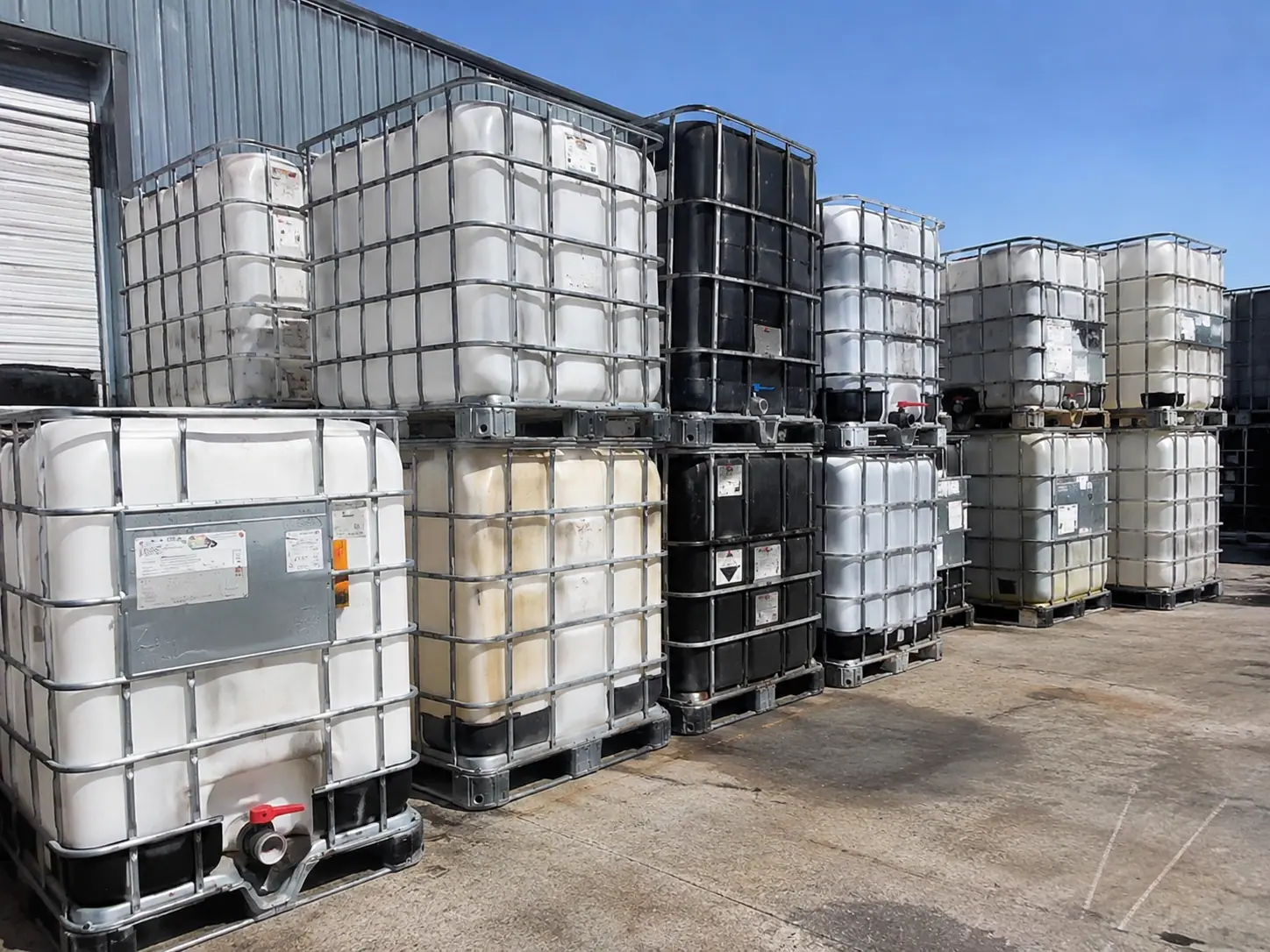
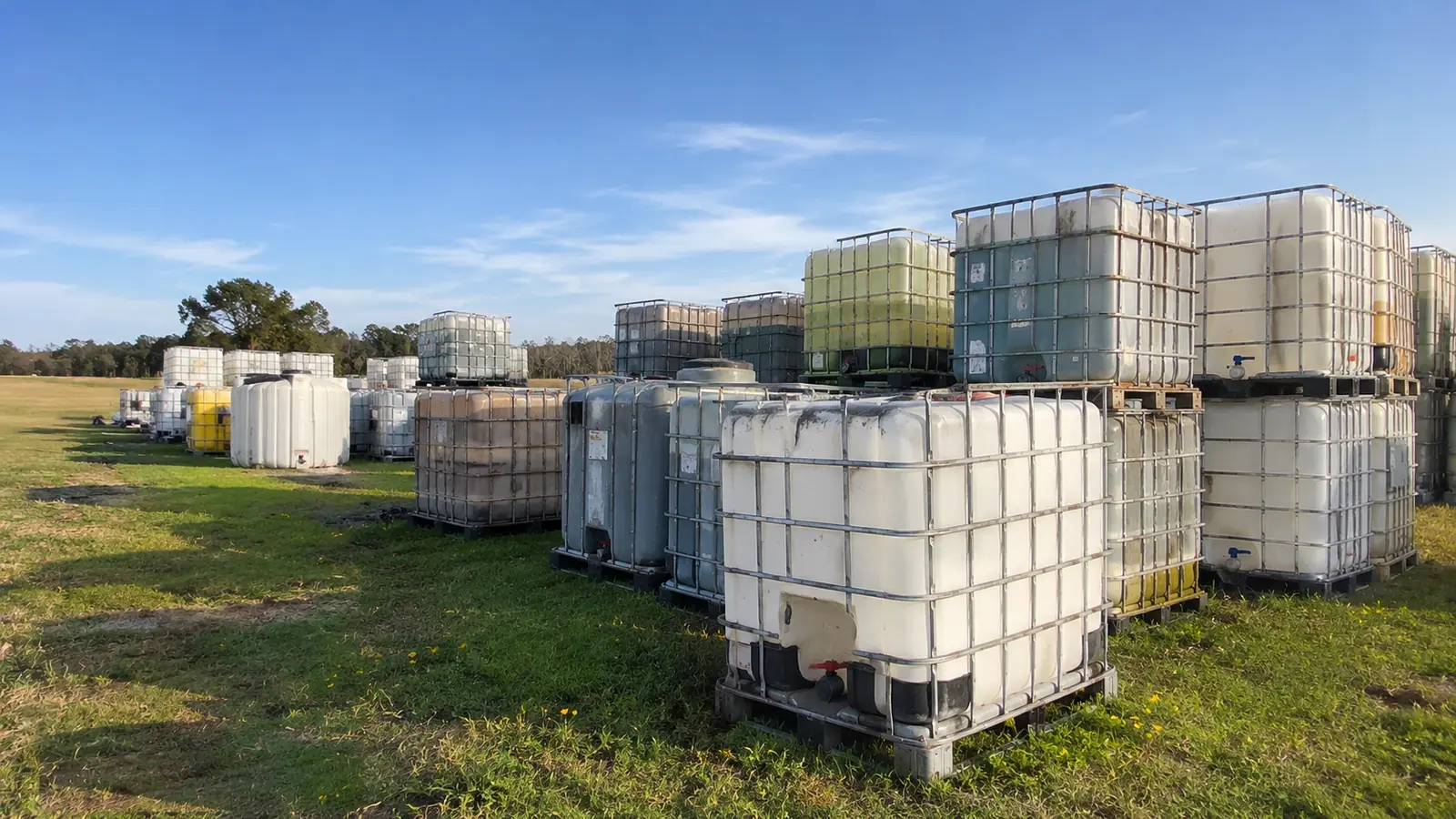
HDPE is an outstanding electrical insulator. That is a useful property in almost every context except one: moving a low-conductivity flammable liquid through it at speed.
Why charge builds at all
Charge separation happens whenever a liquid moves relative to a surface — flowing through a hose, splashing into a container, being filtered, being agitated. With a conductive cargo in a grounded metal container, that charge drains away as fast as it forms. With a low-conductivity cargo in a plastic container, it does not drain anywhere, because there is nowhere for it to go.
The charge accumulates on the liquid surface and on the container wall. If it reaches a high enough potential, it discharges — and if that discharge happens in a vapour space that is within its flammable range, you have an ignition source inside your container.
Which cargoes care
Conductivity is the variable, not flammability alone. Liquids with conductivity below roughly 50 picosiemens per metre are the concern.
- High risk: toluene, xylene, heptane, hexane, white spirit, many solvent blends, jet fuel and kerosene.
- Moderate: diesel and gas oil, particularly when filtered or splash-loaded.
- Low: alcohols and ketones — conductive enough to dissipate, though still flammable and still requiring care.
- Not a static concern: water-based chemistry, acids, caustics, brines, most ag-chem.
Note the uncomfortable overlap: several of the high-risk liquids are also the ones that attack or permeate HDPE. If your cargo appears in that first bullet, the right container is usually stainless, and the static question resolves itself because stainless can be bonded and grounded properly.
What a composite IBC can and cannot do
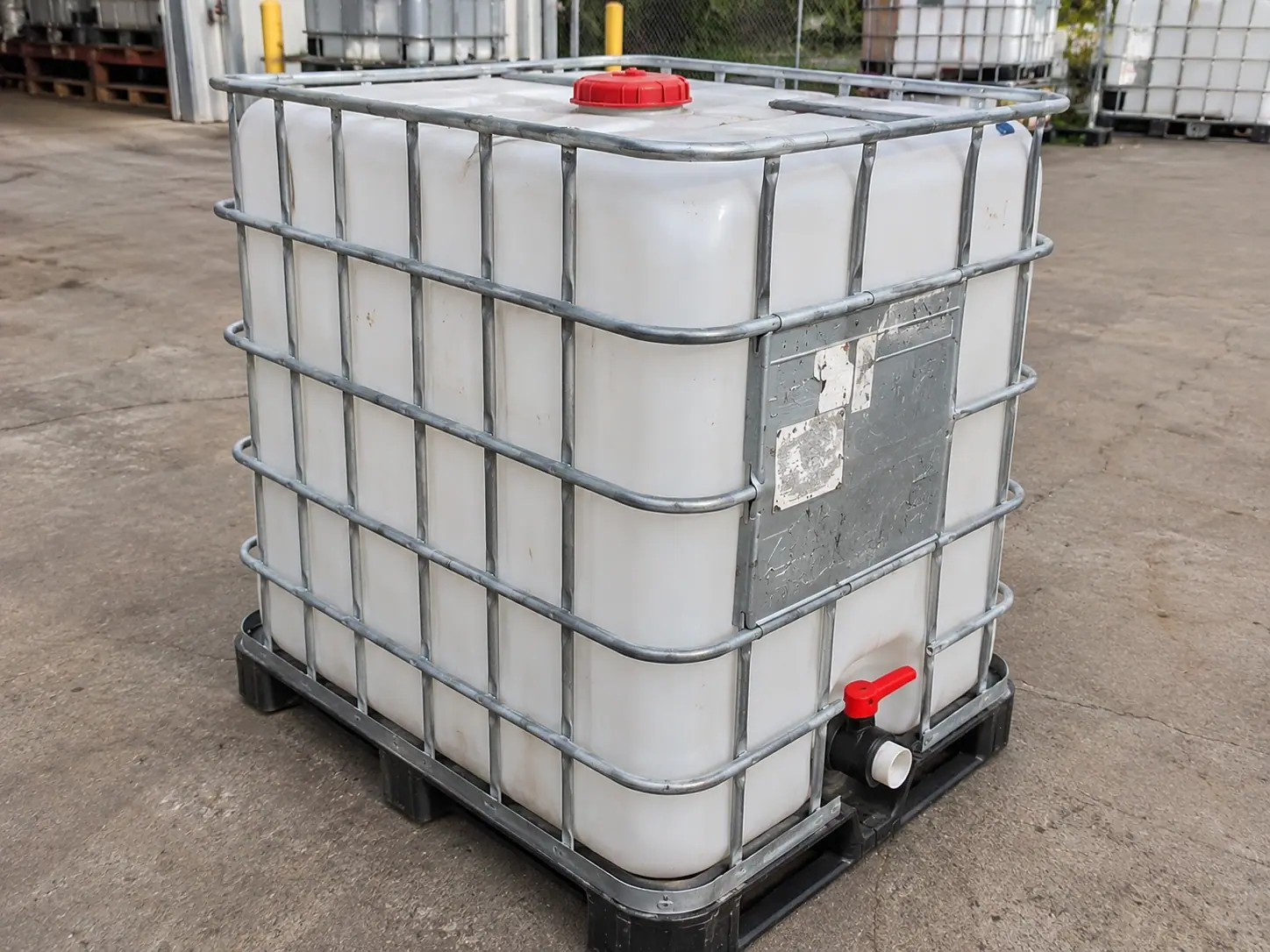
A standard composite IBC has a galvanised steel cage, which is conductive, and an HDPE bottle, which is not. Grounding the cage does nothing for charge on the liquid or the bottle wall. The cage is not a Faraday cage for your cargo; it is a frame.
Some manufacturers supply conductive or dissipative bottles with carbon-loaded resin and a bonding path. These exist, they work, and they are specified rather than assumed. A used tote is not one of them unless it is marked as one, and we will not represent a standard reconditioned unit as suitable for static-sensitive service.
Practical controls when you must use plastic
- Bottom-fill, never splash-fill. A dip pipe to the bottom of the container, or filling through the outlet, dramatically reduces charge generation compared with free-falling liquid.
- Reduce flow velocity. Charge generation rises steeply with velocity. Slower is safer, and the first portion of a fill is the most critical.
- Bond everything metallic. Pump, hose fittings, cage, drum, and the receiving vessel, all to a common earth. It does not solve the bottle-wall problem but it removes several other ignition paths.
- Allow relaxation time. Charge dissipates slowly in low-conductivity liquid. Do not open, sample or agitate immediately after filling.
- Control the vapour space. Inerting removes the oxygen side of the triangle entirely, which is why it is standard practice in facilities that handle this routinely.
What we will and will not sell you
We will sell reconditioned composite IBCs for non-regulated, static-insensitive cargo all day. For flammable low-conductivity liquids we will point you at steel drums or stainless IBCs, and we will say why. This is one of a short list of applications where the cheapest adequate container is not the right answer and we are not going to pretend otherwise.
If you are unsure where your cargo sits, send us the product name and concentration in the form and we will give you a straight answer — including, where appropriate, that we are not the right supplier.
How to find your cargo's conductivity
It is rarely on the safety data sheet, which is part of why this gets missed. Where it appears it is usually under electrical conductivity in section 9, in picosiemens per metre or in conductivity units. Below about 50 pS/m is the region of concern; above a few hundred, charge dissipates fast enough that accumulation is unlikely.
If it is not listed, the supplier's technical department will know, and asking is a five-minute email. Do not infer it from flammability — several flammable liquids are conductive enough to be low risk, and several low-conductivity liquids are not particularly flammable.
Why the cage is not a solution
The intuitive fix is to ground the steel cage, and plenty of sites have done exactly that in good faith. It achieves very little.
The charge of concern is on the liquid surface and in the bottle wall. The cage is separated from both by an insulator. Grounding it removes the cage as an isolated conductor, which is worth doing, but it does not give the charge on the liquid any path to earth. The bottle is still an insulating barrier between your charge and your ground.
This distinction matters because a grounded cage can create a false sense of control, and a false sense of control is worse than a known limitation.
Conductive and dissipative bottles
They exist. Carbon-loaded resin gives the bottle enough conductivity to bleed charge to a bonding point, and units built this way are marked as such and sold for exactly this duty.
Two things to know. First, they are specified, not assumed — a standard reconditioned unit is not one and we will not represent it as one. Second, the conductive path depends on the bonding hardware being intact and connected, which means it is a system to be inspected rather than a property to be relied on.
Bottom-filling, in practice
The single most effective control available to you is to stop splash-filling. Free-falling liquid generates charge at both the nozzle and the impact point, and the first portion of a fill — when the falling distance is greatest — is the worst.
Two ways to do it: fill through the outlet valve at the base, which is simplest if your pump can manage the head; or use a dip pipe through the six-inch port that reaches close to the floor of the bottle. Either eliminates the free fall entirely.
Combine that with reduced flow velocity on the first portion of the fill and you have removed most of the generation mechanism rather than trying to manage its consequences.
Relaxation time
Charge in a low-conductivity liquid dissipates slowly — minutes rather than seconds. The period immediately after filling is therefore the period of highest stored charge, and it is exactly when people open the lid to check the level or take a sample.
Wait. Thirty minutes is a commonly used figure for relaxation before opening or agitating, and it costs nothing but patience.
What we tell customers who ask
If your cargo is a low-conductivity flammable liquid, we will not sell you a standard reconditioned composite IBC for it. We will point you at steel drums, which bond and ground properly, or at stainless IBCs, which do the same and also take the solvents that would craze HDPE anyway.
It is a small category of enquiry and it is one of the few where the cheapest adequate container is genuinely not the right answer. Send us the product name and concentration and we will tell you which side of the line you are on — including, when it applies, that we are not the right supplier for the job.